Summary
Personal Information
Voyage
Transportation
Michael Dwyer was transported on the Tellicherry, departing 31st Aug 1805 and arriving 15th Feb 1806 with 161 passengers.
The 'Tellicherry' - built in 1796 at Thames, England for the East India Company. 467 tons. One sailing to Australia - Ireland to New South Wales in 1805, arriving 1806. 125 (or 130) male and 35 female prisoners, 2 children - 6 deaths. Many on the men on board were political prisoners. Departed from Cork, Ireland. (The register of these persons is NOT yet complete on this website - a work in progress.) In 1807 the Tellicherry was shipwrecked off the coast of the Philippines. The men were rescued and made their way to Manilla.
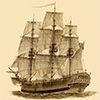 Tellicherry (generic)
References
| Primary Source | NSW Gov Records. Irish Convicts. The Descendants of Michael Dwyer – John Donoghoe – Freemans Journal 23 April 1898 Chris Lawlor, 'Michael Dwyer, the Wicklow Chief', paper delivered at the University of Melbourne, 1 August 2006. SMH 23 May 1898 page 3, The Dictionary of Sydney: '1798 Memorial' |
Claims
"My 4th Great Grandfather"

"4x great grandfather through his daughter Eliza and her daughter Mary Ann Bodecin."
"4x great grandfather via daughter, Esther."
"Michael Dwyer is my 4th great-grandfather through his daughter, Esther (m. Owen Byrne)"
Photos
No photos have been added for Michael Dwyer.
Convict Notes
Family connections for Michael (Dwyer) are: DWYER John (Dwyer) married Mary (Byrne). He was a farmer in Wicklow who moved to Eadestown in 1784. John (Dwyer) & Mary (Byrne) produced 7children: 1?.Michael (Dwyer) was born about 1772 at Camara Glen Imaal Wicklow Co. Ireland. He married Mary (Doyle) in 1798 & lived at 3 Brown St Earl of Meath’s Liberty Dublin. He joined the Society of United Irishmen & in 1798 fought in battles at Arklow, Vinegar Hill, Ballyellis and Hacketstown with the rebels as Captain [his lieutenant was Hugh 'Vesty' (Byrne 1806 TELLICHERRY). When surrounded by the British on 15 2 1799 he was the only person to escape. He was captured as an Irish rebel (United Irishman Wicklow Chieftain) at Wicklow co. Ireland, sentenced to Life by agreement in December 1803 & arrived in NSW as an exile with his family on 15 2 1806 after a voyage of 6months on TELLICHERRY; where he was issued his Conditional Pardon & granted 100acres on Cabramatta Creek Sydney. He sufferred under Governor (Bligh)s persecution of the Irish & on 28 5 1807 was sent to Norfolk Island arriving in June 1807 & relocated to Derwent Van Diemens Land (Tasmania) as part of the first evacuation on 26 12 1807 on (perhaps?) HMS PORPOISE, arriving on 17 1 1808-where his family was permitted to join him. He was permitted to return with his family to NSW in 1809. He become Constable & later Chief of Police from 1813 at Liverpool. He was recorded in 1814 as a constable. In October 1820 he was dismissed for drunken conduct and mislaying important documents. He became owner of The Harrow Inn. In December 1822 he lost his 620acre farm & Inn as a bankrupt & was imprisoned in Sydney debtors’ prison in May 1825. He died on 1 8 1825 age53 dysentry at Liverpool where he was buried; he was reburied at Devonshire Street cemetery Sydney in 1878 by his grandson John (Dwyer), dean of St Mary’s Cathedral; & again in May 1898 to a prominent place in Waverley Catholic cemetery commeemorating the Irish uprising.. ..[Some details taken from this Website] ...Mary (Doyle) was born anout 1772. She arrived in NSW with her family on 15 2 1806 after a voyage of 6months on TELLICHERRY. In May 1807 she was left with the children when her husband was incarcerated on Norfolk Island. She was permitted to join her husband with her children in Van Diemens Land (Tasmania) in 1808. She accompanied her family to NSW in 1809. She was recorded in 1828 as housekeeper to Rev T Therry. ...Michael (Dwyer) & Mary (Doyle) produced maybe 8children: ..1.Esther (Dwyer) was born about 1804. She arrived in NSW free on 7 10 1828 on SIR JOSEPH BANKS. She was recorded in 1828 as Governess Catholic School Hyde Park Sydney. Sir Joseph Banks, 1828, Governess, Catholic School, Hyde Park, Sydney. ..1b.female (Dwyer) was born about 1805. She may be 1of3children who arrived in NSW free on 7 10 1828 on SIR JOSEPH BANKS. ..1c.male (Dwyer) was born about 18??. He may be 1of3children who arrived in NSW free on 7 10 1828 on SIR JOSEPH BANKS-although this child is said to have been born <1816 & cvannot be child of this father. ..2.James (Dwyer) was born in 1806 in Sydney. He was taken to Van Diemens Land (Tasmania) in 1808 by his mother. He was taken back to NSW by his parents in 1809. He died on 28 1 1872 age about66. ..3.Bridget (Dwyer) was born in 1808 in Tasmania. She was taken to NSW by her parents in 1809. She died on 30 1 1878 age about69. ..4.Eliza (Dwyer) was born in 1812. ..5.male (Dwyer) was born >1816-he may be John (Dwyer) who is recorded as born in February 1816, parents not named. ..5a.Noted an Ann (Dwyer) is recorded as born in 1820, parents not named. a granddson=John (Dwyer) who was dean of St Mary’s Cathedral when he arranged removal of his grandfathers remains from Liverpool to Devonshire Street cemetery Sydney in 1878. 2?.Sarah (Dwyer) was born about 1778. She married Hugh 'Vesty' (Byrne) before 1799 & produced 18children. She arrived in NSW with her family on 15 2 1806 after a voyage of 4months on TELLICHERRY; she was Catholic. She was recorded with her family at Airds. She produced 17children in her lifetime. ...Hugh 'Vesty' (Byrne) was born at Kirikee Glanmalure Wicklow co.Ireland about 1770/78. He became a lieutenant of rebel leader Michael (Dwyer TELLICHERRY 1806 possibly relation of his wife whose family is shown just above) under General Joseph (Holt MINERVA 1800) & fought at battles of Arklow, Vinegar Hill and Hacketstown. He was charged with burning yeomans houses in the Irish Revolt of 1799 & stealing arms, held at Kilmainham Dublin in 1799, court martialled & sentenced to death: but escaped from Wicklow gaol & hid with Michael (Dwyer); he was 5'8" well made freckled fair face light or sandy hair shot through thigh. He was captured after surrender of Michael (Dwyer) in 1803 & they, with 3others known as the 'Wicklow Martyrs' agreed to exile in Botany Bay, were held again at Kilmainham gaol & arrived in NSW as exiles apparantly with his family on 15 2 1806 after a voyage of 4months on TELLICHERRY; where he was issued his Conditional Pardon: he was Catholic. He was placed at Cabramatta Creek; he was recorded in 1806 with 200acres & 3children. He was subject to legal persecution by Governor (Bligh). He later sold his land & bought land at Airds. He is recorded in 1826 as a settler & in 1828 with Conditional Pardon with his family on 210acres at Airds. In 1835 he was granted 100more acres. He died on 21 4 1842 age72 at Campbelltown father of 17children & was buried at St Johns CofE Campbelltown. ...Details of Hugh 'Vesty' (Byrne)s family are given in entry for Hugh (Byrne TELLICHERRY 1806) on this Website. Noted a William (Dwyer) was born about 1772. He is recorded, in Smees documentation, as arriving in NSW as an exile on 15 2 1806 after a voyage of 6months on TELLICHERRY. He had his Absolute Pardon when he died on 23 8 1825 age53. William (Dwyer) does not have an entry on this Website as yet; added by me. References: Craig James Smee 'Births and Baptisms Marriages and Defacto Relationships Deaths and Burials New South Wales 1788-1830' ..a complete listing from church & other records in the early colony. Irene Schaffer & Thelma McKay 'Exiled Three Times Over! Profiles of Norfolk Islanders Exiled in Van Diemens Land 1807-1813' James Hugh Donohoe 'Norfolk Island 1788-1813-The People and Their Families' Reg Wright 'Forgotten Generation of Norfolk Island & Van Diemens Land'
Bounty Immigration. 3 children Dwyer, Father: Michael Dwyer- Dead. Children: 2 females over 12 years; 1 male under 12 years. Ship: Sir Joseph Banks, Date of Arrival: 7 Oct 1828. Sourc: Familysearch https://www.familysearch.org/ark:/61903/3:1:S3HY-DT4Q-WP?cc=1542665&personaUrl=/ark:/61903/1:1:FL2M-RHH
https://trove.nla.gov.au/newspaper/article/147087628?searchTerm=Tellicherry Farrell Life story of Michael Dwyer.
Surname: DWYER; First name: MICHAEL; Sex: M; Place of trial: Dublin; Name of ship: TELLICHERRY 1806; Record reference code: FS 1828 2; Ireland-Australia Transportation Records© National Archives, Ireland Comments: List of prisoners of the Crown in the colony of New South Wales who solicit the favour of having their wives and families sent out to them. Children residing at 3, Brown St, Earl of Meath's Liberty, Dublin.

DWYER'S EARLY YEARS IN THE COLONY An important part of Dwyer’s life in Australia were the years from his own arrival in early 1806 until Governor Macquarie’s arrival in January 1810, when he was transported to Norfolk Island by Bligh, transferred to Tasmania, and eventually returned to NSW. Despite arriving in NSW as a free man, and during his first year in NSW in 1806 concentrating on his farming at Cabramatta, he and the other Irish state prisoners came under suspicion by Governor Bligh, who replaced Governor King in August 1806 six months after Dwyer arrived. Bligh regarded Irish Catholics in NSW with contempt, and deep suspicion. By January - February 1807, Governor Bligh was perturbed by rumours, fuelled on many small fronts, of a suspected Irish uprising (see “Unfinished Revolution: United Irishmen in New South Wales, 1800-1810” by Anne Marie Whitaker, pages 145 -151). In February 1807 he had Dwyer and the four other Irish State prisoners arrested - Hugh Byrne, Martin Burke, John “Morner”, Arhur Devlin - as well as Dwyer’s servant Walter Clare, - and a little later, two Irish convicts Thomas McCann and William Morris. The Sydney Gazette of 22 February 1807 reported the imagined uprising plans of “some designing Irish Prisoners who had artfully instilled into the minds of their countrymen a certainty of taking the Country and gaining their liberty” and commented about them that: “… at the present moment they are, particularly, living under greater comforts than ever fall to the lot of the labouring poor of any part of the World …” At their trial on 11th May 1807, two convicts gave evidence against Dwyer and his “Tellicherry” cohort claiming a conspiracy to raise an Irish insurrection with plans to march on Parramatta. Dwyer had been heard to say that all Irish will be free and while he didn’t deny these words, he denied the insurrection charges. The Court - comprised of the Judge Advocate and officers of the NSW Corps including Major George Johnston - declared the charges against the Irish state prisoners “perfectly false” and they were all acquitted, as was Dwyer’s servant Clare; however McCann and Morris were found guilty. But Bligh, completely ignoring this finding and intent in his belief that the evidence proved them guilty, the very next day called together a bench of magistrates to review the evidence, which found instead all the acquitted men guilty. Bligh simply wanted the Irishmen out of the way. He reported to London that he sent two each to Norfolk Island, Port Dalrymple, the Derwent and “kept two here” which possibly meant sent to Newcastle. (HRA I, vi, page 159) He had them re-arrested and sent Michael Dwyer, with Morris, to Norfolk Island departing 28 May 1807, instructing Capt Piper in charge of Norfolk that “O’Dwyer” was a convict for life, and was found a person “Necessary to be removed from this settlement”. They were also not allowed to leave Norfolk Island “unless by authority under my hand” ( see Bligh letter October 1807 to Piper recorded in K Sheedy page 191). Burke and the convict McCann were sent to Port Dalrymple, and of the others it was unclear who went to Hobart and who was "kept here”. Officers of the NSW Corps were appalled by Bligh’s actions against the Irish state prisoners, especially Col Johnston, (see Kieran Sheedy, “Upon the mercy of Government”). Six months later Col Johnson led the Rum Corps mutiny against him, Bligh’s action in this trial being one of the many justifications to oust him. Mary was left alone on the farm, with a new son, James, as were her four farming neighbours - the wives and de factos of the Irish state prisoners all on neighbouring land grants. But during 1808 hundreds of Norfolk Island prisoners were re-located to Van Diemens’ Land (their transfer being part of a plan originally proposed well before Dwyer’s NSW trial) because Norfolk Island was too expensive to run, and Dwyer was included in this general evacuation and re-settlement. When Dwyer was relocated to Van Diemen’s Land, Mary was permitted to move to Tasmania to settle with him. The Norfolk Islanders arrived in four tranches in 1808 (17th January, 2nd March, 5th June and 1st October) and Dwyer was probably in one of the earlier groups because a daughter, Bridget was born in Tasmania in 1808. In 1809, Dwyer was allowed back to NSW - Col Paterson of the Rum Corps being in charge from January 1809 until Macquarie arrived. Dwyer’s was one of 35 pardons given out; all the five Irish state prisoners were pardoned because the Court of criminal jurisdiction had acquitted them in May 1807. When Macquarie arrived in 1810 he confirmed these pardons. Finally, Michael Dwyer could get on with a peaceable life back on his NSW farm.
Michael Dwyer and his wife Mary have been immortalised in a magnificent memorial in Waverley Cemetery, built by the Catholic and Irish communities of NSW, commemorating the 1798 Irish Uprising, where their remains have also been buried for well over a hundred years. Their remains were removed to this third and final resting place in May 1898, marking the Centenary of the uprising. Tow years later, the beautiful monument was officially unveiled. Plans had been well underway by a '98 Committee in Sydney which raised the funds from the Irish community for the re-interment and planned the monument, which was to have a huge Celtic Cross. The monument memorialises the men who fought in the 1798 uprising, and particularly those, who like Michael Dwyer had suffered for it by banishment or transportation to NSW. The Dwyers' remains were reinterred on Easter Sunday 1898, having first been moved to St Mary's Cathedral from the Devonshire Cemetery on Holy Thursday. The SMH reported that 4000 member of the public joined the procession from St Mary's out to Waverley Cemetery, additional to the '98 Committee, and all the Irish societies and Guilds, SMH 23 May 1898 page 3: " The first celebration in honour of the Irish patriots of 1798 took place yesterday, and was made the occasion of a great public demonstration The remains of Michael Dwyer and Mrs. Dwyer, which were during the week exhumed from the Devonshire-street cemetery, were placed in a coffin and mounted upon a catafalque in St. Mary’s Cathedral during yesterday's services. At 1 o'clock Cardinal Moran, who was assisted by Monsignor O'Brien and the Cathedral clergv, pronounced the final absolutions and delivered a brief address, eulogising the patriotism of the Irish chieftain and exhorting his hearers to cultivate a similar love of country. At a quarter to 2 o'clock, when the coffin was placed in the hearse, an immense concourse had gathered without St. Mary's Cathedral. Shortly afterwards the procession started for Waverley Cemetery. ..." See also The Dictionary of Sydney: http://dictionaryofsydney.org/entry/1798_memorial_waverley_cemetery
Sainty & Johnson; 1828 Census of New South Wales: Page 134.... [Ref D1981] Dwyer, Mary, 50 Tellicherry, 1805, Housekeeper to Rev T Therry. [Ref D1982] Dwyer, Esther, 24, CF, Sir Joseph Banks, 1828, Governess, Catholic School, Hyde Park, Sydney. [Ref D1983] Dwyer, Bridget, 20, BC, Governess, Catholic School, Hyde Park, Sydney. Michael was of course deceased, he died in 1825. However, Hugh Byrne and others of the Wicklow outlaws are recorded.
The 1814 Muster records Michael and Mary: Baxter, Carol; General Muster of New South Wales: [Ref 3654] Michael Dwyer, Tellicherry, Constable. [Ref 3784] Mary Dwyer, Tellicherry, wife to a constable.
## Of Interest to the Researcher: Michael's sister Sarah, was the wife of his lieutenant Hugh 'Vesty Byrne'. She was also exiled as was his wife Mary. They were not in truth convicts, but they were exiled from ever returning to Ireland. They received conditional pardons on arrival in the colony.
Michael was the eldest of seven children of farmer John Dwyer and his wife Mary (née Byrne), who had a farm in the widespread fields of Wicklow and supplied the men of the rebellion with food. In 1784 the family moved to a farm in Eadestown. 1798 rebellion - Dwyer joined the Society of United Irishmen and, in the summer of 1798, he fought with the rebels as captain under General Joseph Holt in battles at Arklow, Vinegar Hill, Ballyellis and Hacketstown. Under Holt's leadership, he withdrew to the safety of the Wicklow Mountains in mid-July.[1] when rebels could no longer operate openly following their defeat in the disastrous midlands campaign. On 15 February 1799 at Dernamuck, he and about a dozen comrades were sheltering in three cottages when an informer led a large force of the British soldiers to the area. The cottages were quickly surrounded, the first two surrendering, but, following consultation, Dwyer and his men decided to fight on in the third one, Miley Connell's cottage, after negotiating the safe passage of women and children. In the hopeless gunfight which followed, the cottage caught fire and only Dwyer remained unwounded. At this stage, Dwyer's comrade, Antrim man Sam McAllister, stood in the doorway to draw the soldiers' fire on him, which allowed Dwyer to slip out and make an incredible escape. Australia - In December 1803, Dwyer finally capitulated on terms that would allow him safe passage to America but the government reneged on the agreement, holding him in Kilmainham Jail until August 1805, when they transported him to New South Wales (Australia) as an unsentenced exile. Dwyer arrived in Sydney on 14 February 1806 on the Tellicherry and was given free settler status. He was accompanied by his wife Mary and their eldest children and also by his companions, Hugh 'Vesty' Byrne and Martin Burke, along with Arthur Devlin and John Mernagh. He was given a grant of 40.5 ha (100 acres) of land on Cabramatta Creek in Sydney. Michael Dwyer was later to become Chief of Police (1813–1820) at Liverpool, New South Wales but was dismissed in October for drunken conduct and mislaying important documents. In December 1822 he was sued for aggrandising his by now 620 acre farm. Bankrupted, he was forced to sell off most of his assets, which included a tavern called "The Harrow Inn", although this did not save him from several weeks incarceration in the Sydney debtors' prison in May 1825. Here he evidently contracted dysentery, to which he succumbed in August 1825. Burial- Originally interred at Liverpool, his remains were reburied in the Devonshire Street cemetery, Sydney, in 1878, by his grandson John Dwyer, dean of St Mary's Cathedral.