
Summary
Personal Information
Transportation
Mary Martin was transported on the Canada, departing 28th Feb 1810 and arriving 8th Sep 1810 with 122 passengers.
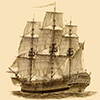 Canada (generic)
References
| Primary Source | Australian Joint Copying Project. Microfilm Roll 87, Class and Piece Number HO11/2, Page Number 10 |
| Source Description | This record is one of the entries in the British convict transportation registers 1787-1867 database compiled by State Library of Queensland from British Home Office (HO) records which are available on microfilm as part of the Australian Joint Copying Pro |
| Original Source | Great Britain. Home Office |
| Compiled By | State Library of Queensland |
| Database Source | British convict transportation registers 1787-1867 database |
Claims
No one has claimed Mary Martin yet.
Photos
No photos have been added for Mary Martin.
Convict Notes

APPENDIX 1 (Bradmore, 2015, pp7-10): "CONVICT MARY MARTIN First ‘Officially-Recognised’ Schoolmistress in Van Diemen’s Land by Don Bradmore and Judith Carter Convict Mary Agnes MARTIN nee HALLETT is believed to have been born in Surrey, England, about 1776. Little is known about her life prior to her conviction. On 1 June 1797 she married Abraham MARTIN, a Royal Navy surgeon, at the Church of St Matthew, Bethnal Green, London. At the Surrey Assizes on 9 August 1809, she was convicted of ‘larceny in a dwelling house’. A sentence of death was recorded but later commuted to transportation for life. On 23 March 1810 she left England as one of 122 female prisoners aboard Canada and arrived at Port Jackson (Sydney) on 8 September that year. She was 32 years old. She brought with her an infant son, William Joseph MARTIN. Whether Mary had been a schoolmistress in England before her conviction is unclear. The convict muster of 1814, however, lists her as a ‘schoolmistress’ at Toongabbie, now a suburb of Sydney, about thirty kilometres west of the CBD. There, she was obviously thought of highly for when, in mid-1815, she requested permission to marry Thomas FITZGERALD, a schoolmaster visiting from Van Diemen’s Land, and to go with him to Hobart, her application for a transfer was strongly supported by Rev. Samuel MARSDEN. In giving his approval, Gov. MACQUARIE wrote to Lt.Gov. DAVEY warmly recommending her employment as a schoolmistress. Within two weeks of her arrival at Hobart aboard Emu on 30 July 1815, she and FITZGERALD were married at St David’s by Rev. Robert KNOPWOOD. The marriage produced two children, at least. FITZGERALD had been in Van Diemen’s Land since January 1804. Two years earlier, then a clerk in London, he had been convicted of embezzlement and sentenced to transportation for seven years. Leaving a wife (Betty Ann nee CHILTON) and son (Henry) behind in England, he had arrived in the Australian colonies aboard HMS Calcutta as one of 300 convicts in the expeditionary party (which included free settlers, marines and civil administrators) led by Captain David COLLINS who had been charged with establishing a settlement at Port Phillip. During the voyage, FITZGERALD had conducted lessons for the children of the convicts and free settlers. When the settlement at Port Phillip failed after a few months, and COLLINS had been forced to move his party across Bass Strait to a site on the Derwent (which later become Hobart Town), FITZGERALD was made a clerk in the Lieutenant Governor’s office, responsible for the payment of salaries and serving the Bench of Magistrates. By 1807, however, he had also begun Evening Classes at his home in Hobart Town. In June 1812, he was appointed Government Schoolmaster on a salary of £10 p.a. By 1815, this had been increased to £25 p.a. in remuneration also for his services as Magistrates’ Clerk. In Hobart, Mary was immediately successful. Between them, the FITZGERALDs taught reading, writing, spelling, ‘figures’, grammar, geography and history in a room at the back of their house in Davey Street. In addition, the girls had instruction in sewing and needlework. By 1817, on the recommendation of Lt. Gov. SORELL, who had replaced DAVEY in 1816, Mary was receiving some financial assistance – the first female to be officially recognized in this way - for her role as schoolmistress because ‘… she pays much attention to the female scholars.’ However, in June 1817, SORELL saw fit to dismiss FITZGERALD from the Bench of Magistrates, informing MACQUARIE that it was because of ‘… repeated complaints of his drunkenness and neglect … his absence continuing for several days.’ Interestingly, he added that he felt FITZGERALD was still ‘… well-qualified to remain a schoolmaster’. In response, MACQUARIE expressed sorrow that FITZGERALD had turned out such a drunkard but felt that it was right for him to have been dismissed from the Bench. He agreed that FITZGERALD was ‘… very fit to remain a schoolmaster, if he could be kept sober.’ Whether FITZGERALD was treated fairly in the matter of his drinking is debatable. Although the Rev. KNOPWOOD testified before Commissioner John BIGGE in April 1820 that ‘… FITZGERALD’s conduct has been pretty good although he is sometimes guilty of excess in liquor’, there is no other evidence that he was anything else but hard-working and conscientious. Whatever the case, the FITZGERALD school was flourishing. A return of schools and scholars in the colony which KNOPWOOD provided to BIGGE in 1820 showed that Thomas had thirty-five scholars and Mary twenty-four. Later that same year, Peter MULGRAVE, who had been appointed superintendent of schools in Van Diemen’s Land in October 1820, informed SORELL that he was pleasantly surprised to find that education in the colony had been ‘… so well laid and widely extended’. He reported that, of the 236 children aged between four and seventeen in Hobart Town at that time, the FITZGERALDs had partially educated, or were in the course of educating, two hundred. In 1818, SORELL had notified MACQUARIE of the need for a new school in Hobart Town to cater for the children of poorer free settlers. He explained that, while the school run by the FITZGERALDs was the best, it was also expensive. Although a few children were educated there free of charge, most parents were paying between 1/- and 1/6d weekly. In 1820, MULGRAVE had reported that the FITZGERALDs, in addition to their government funding, were receiving about £3.8s.0d per week from parents. From about 1817, through hard work and enterprise, the FITZGERALDs had been able to lease land at Black Snake, near Hobart. There, they ran sheep and cattle, the property tended by two convict labourers who had been allocated to them. For the next few years, all went well. In April 1824, Mary received her certificate of freedom – but tragedy was about to strike. In the previous year, Henry FITZGERALD, Thomas’s son from his first marriage, had arrived from England. To help the young man get established, Thomas had acquired a run-down inn near his Black Snake property, intending to refurbish it and have his son manage it while he himself continued with his teaching and farming interests. The opening of the inn, which he called ‘The Golden Fleece’, was planned for 22 October 1824. However, on 5 September 1824, just six or seven weeks before the opening, Thomas passed away. He was 47 years old. No longer able to keep the school going, Mary struggled financially from that time. Although Thomas’s Will shows that he left all he had to her, she was forced to surrender her Davey Street home – over which there was a mortgage - in August 1826 and to move to cheaper accommodation in Goulburn Street. It is thought that she might also have inherited debts associated with ‘The Golden Fleece’ when it was sold in May 1825. This situation worsened dramatically when, on 25 September 1826, Henry, Thomas’s son, was drowned in a boating accident on the Derwent. Shortly after arriving in Van Diemen’s Land he had married, and Mary, who still had two young children of her own at home, was obliged to support his young widow and her two infants. During the next couple of years, Mary tried hard to re-establish herself as a schoolmistress. In late 1826, she advertised in Hobart newspapers that she was about to open a Day School and begged for the support of those who knew of the difficult circumstances in which she had been left – but the attempt was unsuccessful. Her days as a schoolmistress were over. In late December 1829, now 53, she accepted an offer of marriage from William NICHOLES (also seen as NICHOLS and NICHOLLS) a Clarence Plains cabinet-maker and farmer who, interestingly, had also come to Van Diemen’s Land with the COLLINS expedition in January 1804, but as a free settler rather than convict. The marriage was to bring little joy to either of them. Within twelve months, both husband and wife were imprisoned for non-payment of debts which Mary had incurred before the marriage. At their trial in January 1831, both claimed to be utterly destitute. During the trial, Solicitor General STEPHEN urged Chief Justice PEDDER to discharge Mary on the grounds of her age and ill-health. NICHOLES was imprisoned for a short period, certain allowances having been made for his circumstances. Within six months Mary was dead. Sadly, her death certificate shows her ‘quality or profession’ only as 'house-builder’s wife'." (https://www.femaleconvicts.org.au/docs/seminars/DonBradmore-Nov2015.pdf)
MORE ABOUT MARY MARTIN: Mary gave her occupation as a schoolmistress governess (school teacher is the only option on this site). She was also one of only 29 female convicts sent to VDL who said they were schoolmistresses or governesses. Ten of those women are the subject of a study by Don Bradmore whose paper, “Convict schoolmistresses in Van Diemen’s Land”, was presented in November 2015 in Hobart at the Female Convicts Research Centre seminar, “What the convicts brought with them – and what they left behind” (see https://www.femaleconvicts.org.au/docs/seminars/DonBradmore-Nov2015.pdf). About Mary Martin (2015, p2) he writes: "Mary Martin She is an outstanding example of a female convict who was able to bring her skills, abilities and experience as a schoolmistress with her to the colony. Between 1815 and 1824, she taught with great success in Hobart, becoming the first woman in the colony to be officially recognized by the government of the day for her services to education. [An account of her life and work is attached to this paper as Appendix 1.]" --0--
Croydon Assizes, August 10; S. Lamb, Mary Martin, and Mary Aylett, were indicted for stealing 2l. in Bank Notes, four rings, and other trinkets, the property of Mary Anne Cooke. Miss Cooke deposed, that these articles were in a small cabinet box, in the parlour of her mother’s house on the evening ‘of the 7th March. The next day she missed them, and applied to Bow-street, but they did not think her suspicions sufficiently founded, and refused her a warrant. One prisoner was the wife of a Naval Surgeon, and she had known her many years. The other female prisoner was her sister, and the man had lately returned from sea and lodged in the house with the other two prisoners. The next day the prisoners left their house at Lambeth, and went to Fulham. She heard no more of her property for nine or ten days. At last she heard that the box was exposed for sale at a broker's, in Wych-street, and there learned it had been sold by a man and a woman, answering the description of Martin. She then traced them to Hammersmith, where Adkins, the Officer, searched their house. He found part of an ear-ring which she knew to be hers, upon which Mary Martin confessed she had taken the box, and said part of the things were buried in the garden. They accordingly found several the articles. The finding of the goods was corroborated by the witness, who accompanied Miss C. and the broker said he bought the box (which was a cabinet one of ivory) of a man, but he could not speak distinctly to his person. Martin confessed she had taken the box, but said her fellow-prisoners were entirely innocent. The Jury found her Guilty, and acquitted the others. Public Ledger, 14 Aug 1809. ----------------------------------------------------- Tasmanian Record: https://stors.tas.gov.au/CON13-1-1$init=CON13-1-1p44 List of Names of male and Female convicts, proceeding to the Derwent in H.M. Colonial Brig Emu. Sydney 17 July 1815. 18 men were listed under heading of “Government Artificers.” and 10 men and women under the heading of Servants, etc. Listed under heading of “Servants &” Mary Martin, School Mistress, per Canada 2 ?, 1810. Tried at Surry Ass., 9 Aug 1809, Life.