
Summary
Personal Information
Transportation
William Niblett was transported on the Mangles, departing 29th Mar 1820 and arriving 7th Aug 1820 with 192 passengers.
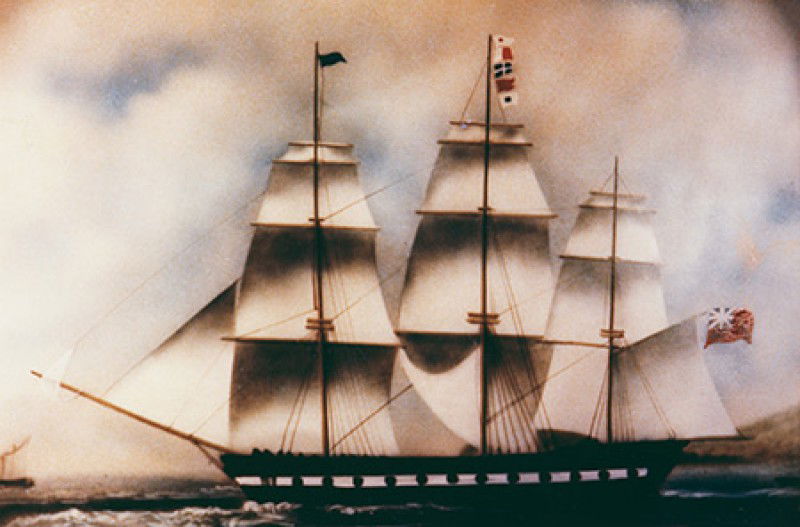 Mangles
References
| Primary Source | Notes and recollections of Stroud. by Paul Hawkins Fisher |
| Source Description | This record is one of the entries in the British convict transportation registers 1787-1867 database compiled by State Library of Queensland from British Home Office (HO) records which are available on microfilm as part of the Australian Joint Copying Pro |
| Original Source | Great Britain. Home Office |
| Compiled By | State Library of Queensland |
| Database Source | British convict transportation registers 1787-1867 database |
Claims
No one has claimed William Niblett yet.
Photos
No photos have been added for William Niblett.
Convict Notes


The following convicts were removed from our county Gaol on Tuesday last, and put board the Retribution hulk, at Sheerness, preparatory to their transportation to Botany Bay: Wm. Niblett, for life; Edward Sheppard, Thomas Smith, and John Gardner, for fourteen years; and Samuel Antill, Wm. Flint, Joseph Herring, William Hill, Nathaniel Lusty and Henry Williams for seven years. Cheltenham Chronicle, 16 Sep 1819. -------------------------------------------------- Sheerness Hulk Records. HO-9-7-1 page 44. Received from Gloucester 8 Sept 1819. Wm Niblett, age 42, Forgery, Tried at Gloucester, 31 Mar 1819, Life. Transported 15 Mar 1820.
ADM 101/47/1 - Medical journal and diary of the Mangles convict ship from 17 February to 15 August 1820 by Matthew Anderson, surgeon and superintendant. Folios 6-10: William Niblett, convict, aged 56; disease or hurt, while on deck received a blow on the right arm from the breaking and fall of a hook from the foretop mast by which the radius had fractured about its middle, in an oblique direction, the injury now to the soft parts is inconsiderable. Put on sick list, 29 March 1820, at Sheerness. Discharged 30 April 1820.

The embezzlement of clothing materials, and the dealing in them, was commonly called Slinge^ing; and the embezzled materials themselves were called Slinge.[In these words the letter "g" is sounded like "j"] This offence was very prevalent in the writer's youth : for then most of the anufacturing operations were done in the houses of the operatives, to whom wool and yarn were entrusted for carding, spinning, weaving, &c. And there, as also in the mills themselves, great facilities were afforded for secreting, purloining, and withholding parts of those materials,? of which constant advantage was taken; and by which the clothiers suffered great losses. The number of embezzlers and dealers in slinge was also great : and they found ready purchasers in the numerous small clothiers then existing, who worked up the slinge with new materials into inferior cloth. At that time, stealthy figures might be met in the twilight, crossing Hampton Common from valley to valley; and in all parts of the district, from one cottage to another : and the lines, or tracks of white stones, which are yet seen on the green turf of the common, are pointed out as having been dropped there, at short intervals from one another, to guide the slinge-dealers on their nightly expeditions. Of these, William Niblett was the most notorious. His last place of residence here was in Middle-street; and being a tall, spare man, he was popularly called Long Niblett. So large were his transactions, that he was once fined £120, as a single penalty; of which the treasurer of the Dispensary received £30. This man was at last found guilty of forgery, at the Gloucester Assizes, and condemned to be hanged. But the sentence was commuted to transportation for life, on the intercession (it was said) of some magistrates, who thereby purchased Niblett's disclosure of the particulars of his trade, and a large list of the names and abodes of his fellow slingers, in all parts of the neighbourhood, which he gave before he was shipped for Botany Bay. The writer once possessed the original paper containing the list, Ac., in the handwriting of Sir G. O. Paul, as it was taken down by him from Niblett's dictation. This offence, however, is almost (if not wholly,) discontinued. The introduction of machinery, by which so many of the clothing processes are now performed ; the use of steam-power ; the erection of large manufactories, where almost all the operations are concentrated, and whereby a more complete supervision and control over the operatives is effected; together with the adoption of stringent regulations, has made the offence very difficult, if not well nigh impossible.