
Summary
Personal Information
Crime
Voyage
Transportation
Daniel Parkes was transported on the Belgravia, departing 4th Apr 1866 and arriving 4th Jul 1866 with 277 passengers.
Belgravia was a three-masted ship of 889 tons registered in London. She was an oak ‘late frigate’ hull type. Her dimensions were length: 169 ft.; breadth 34.5 ft.; depth 21.2 ft.; draught 16 ft. In 1863 she underwent some repairs and was copper fastened and sheathed in yellow metal. She was surveyed in June 1863 and December 1864.
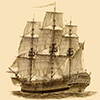 Belgravia (generic)
References
| Primary Source | Australian Joint Copying Project. Microfilm Roll 93, Class and Piece Number HO11/19, Page Number 157 (81) |
| Source Description | This record is one of the entries in the British convict transportation registers 1787-1867 database compiled by State Library of Queensland from British Home Office (HO) records which are available on microfilm as part of the Australian Joint Copying Pro |
| Original Source | Great Britain. Home Office |
| Compiled By | State Library of Queensland |
| Database Source | British convict transportation registers 1787-1867 database |
Claims
No one has claimed Daniel Parkes yet.
Photos
No photos have been added for Daniel Parkes.
Convict Notes
Daniel Parkes was my great great grandfather and was born in Netherton, near Dudley, Worcestershire, England 1834c. His parents were David and Honor (nee Crump). He was a Coal Miner, married to Kezia (nee Darby) and had 3 children, Daniel, John and Mary together with 3 step children. Young Daniel died age 7 in 1865 whilst his father was in Prison in England. In 1864 Daniel was one of the many Coal Miners on strike. A number of Miners chose to contine to work and as a result some were attacked by the striking Miners. Daniel being one of the attackers. Early one morning, he drunkenly threw a can containing gunpowder through the kitchen window of a house of working Coal Miner George Rowley. Fortunately no one was injured, but considerable damage was done and Daniel was charged and subsequently found guilty. After his release in 1870 he chose to remain in Australia and eventually died on the 18th November 1902 in Broken Hill District Hospital, New South Wales. I believe Broken Hill was a Mining town, so maybe he returned to his old trade Coal Mining.