
Summary
Personal Information
Voyage
Transportation
William Redfern was transported on the Nile, Canada And Minorca, departing 31st May 1801 and arriving 14th Dec 1801 with 305 passengers.
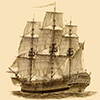 Nile, Canada And Minorca (generic)
References
| Primary Source | Australian Joint Copying Project. Microfilm Roll 87, Class and Piece Number HO11/1, Page Number 301 (150) |
| Source Description | This record is one of the entries in the British convict transportation registers 1787-1867 database compiled by State Library of Queensland from British Home Office (HO) records which are available on microfilm as part of the Australian Joint Copying Pro |
| Original Source | Great Britain. Home Office |
| Compiled By | State Library of Queensland |
| Database Source | British convict transportation registers 1787-1867 database |
Claims
"William Redfern (177?- 1833) is my 3rd great grandfather Robert's (1769?-1853) brother."

Photos
No photos have been added for William Redfern.
Convict Notes
Family connections for William (Redfern) are: REDFERN William (Redfern) was born about 1771/4, possibly in Canada, brought up at Trowbridge Wiltshire England & became a doctor & surgeon. In June 1797 he passed the examination of the London Company of Surgeons & became surgeon's mate in the British? Navy. He served on HMS NEPTUNE where he was involved in Mutiny of the Nore in 1797, tried on 27 8 1797 at Court Martial on NEPTUNE, sentenced to death reprieved to Life, held on NEPTUNE & 4years in British jails & arrived in NSW as a convict on 14 12 1801 on Fleet ship MINORCA; he was given Conditional Pardon on arrival & was issued Full Pardon in 1803. In 1808 he was appointed assistant Surgeon after proving his credentials & became doctor to Governor Macquarie. He was known as a gentleman & recorded as Pardoned when he married Sarah (Wills age15) on 4 3 1811 at St Phillips CofE Sydney. He was one of founders of Bank NSW in 1817. In 1819 he resigned from Colonial Medical Service after not being selected as Principal Surgeon; was selected as Magistrate but not sanctioned & continued practice as physician & surgeon. In 1821 he visited England with his family & is recorded at Island of Madeira in poor health in January 1824. Meanwhile in England his wife obtained a land grant for him. In 1826 he undertook scientific farming. He was recorded in Edinburgh in 1828 where he died in July 1833 age62. [Some details taken from this Website; where 2entries are found] Sarah (Wills) was born on 23 4 1796 in Middlesex. She arrived in NSW with her parents on 26 7 1799 after a voyage of 9months on HILSBOROUGH. In 1821 she visited England with her family. About 1824 she was able to obtain a land grant for her husband. Details of Sarah (Wills)s family are given in entry for Edward (Willis HILSBOROUGH 1799) on this Website. William (Redfern) & Sarah (Wills) produced perhaps 2children: 1.William Lachlan Macquarie (Redfern) was born on 27 7 1819 & baptised on 31 7 1820 age1 at St Phillips CofE Sydney. In 1821 he was taken to England by his parents. 2.Joseph Foveaux (Redfern) was born on 7 2 1823 & baptised on 1 5 1825 age2 at St Lukes CofE Liverpool. He died on 11 4 1830 age7 & was buried at St Phillips CofE Sydney. Reference: Craig James Smee 'Births and Baptisms Marriages and Defacto Relationships Deaths and Burials New South Wales 1788-1830' ..a complete listing from church & other records in the early colony.
William Redfern The Minorca's ship indent puts his birth year at 1771 and that he was tried on the 27 Aug 1797. He was sentenced to death for his part in the naval Mutiny of the Nore in 1797. After spending four years in an English jail he was transported to New South Wales in 1802. Redfern was granted a conditional pardon following his arrival in Sydney. In 1803, he received a full pardon from the colony's governor, King. As early as 1804 Redfern had been advocating the new smallpox vaccination. After being examined about his level of medical knowledge by the Surgeon-General of New South Wales, Thomas Jamison, it was certified that Redfern was "qualified to exercise the profession of a surgeon, etc." He was appointed as assistant surgeon in 1808 by Joseph Foveaux. Foveaux planned to confirm Redfern's appointment and stated that his "skill and ability in his profession are unquestionable, and his conduct has been such as to deserve particular approbation". Soon after Lachlan Macquarie's arrival as governor in 1810, he stated that he found that no transported men had yet been received into society at Sydney. He felt, however, "that emancipation, when united with rectitude and long-tried good conduct, should lead a man back to that rank in society which he had forfeited". He was aware that the attempt to do this would need caution and delicacy, and stated that up to then he had "admitted only four men of that class to his table", of whom Redfern was one. When D'Arcy Wentworth became principal surgeon in 1811 Redfern succeeded him as assistant surgeon. Redfern was doctor to governor Macquarie. In 1814 Redfern reported to Macquarie on the sanitary problems of the ships transporting convicts to New South Wales. As a result of this report the conditions were greatly improved.In 1817 he became one of the founders of the Bank of New South Wales. Redfern had expected to succeed Wentworth as principal surgeon; Macquarie indeed recommended him for the position in 1818 — however it was given to James Bowman in 1819. Redfern immediately resigned from the Colonial Medical Service and later in the same year Macquarie made him a magistrate, but this was objected to by Commissioner Bigge and the appointment was not sanctioned. Redfern had a large private practice as a physician, and though somewhat brusque in manner was much liked and trusted; he became the "best" and "best-known" surgeon in Sydney. He visited England in 1821 as a delegate for the emancipists endeavouring to obtain relief from their disabilities, and in January 1824 he was at the island of Madeira for the benefit of his health. His wife, who was then in London, made application on his behalf for an additional grant of land, which was allowed. He was evidently then in good circumstances. In 1826 he retired from practising as a physician, and for about two years engaged in scientific farming which had been a hobby of his for some time. He went to Edinburgh about the end of 1828 and died there towards the close of July 1833. He married in 1811 Sara Wills, who survived him, together with their son.