Summary
Personal Information
Crime
Voyage
Transportation
Henry Savery was transported on the Medway, departing 28th Jul 1825 and arriving 14th Dec 1825 with 173 passengers.
Built in Rochester, England in 1810. 435 tons. The 'Medway' was also used as a convict Hulk ship off Bermuda
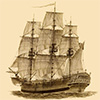 Medway (generic)
References
| Primary Source | Australian Joint Copying Project. Microfilm Roll 88, Class and Piece Number HO11/5, Page Number 285 (144) |
| Source Description | This record is one of the entries in the British convict transportation registers 1787-1867 database compiled by State Library of Queensland from British Home Office (HO) records which are available on microfilm as part of the Australian Joint Copying Pro |
| Original Source | Great Britain. Home Office |
| Compiled By | State Library of Queensland |
| Database Source | British convict transportation registers 1787-1867 database |
Claims
"Family connection possible 5 X grandfather"

Photos
No photos have been added for Henry Savery.
Convict Notes
National Archives. Criminal Petitions. HO 17/1/17 Description: 3 individual petitions (Robert Hart Davis MP, Lord Manvers and a copy of a petition from Henry Savery) and 5 collective petitions (8 people, members of the Bristol Copper Co, there are 3 copies of this 1 of which is unsigned; 3 people, members of the Bristol Copper Co, the prosecutors and 3 people, relatives) on behalf of Henry Savery, partner in the Bristol Copper Company, convicted at the City of Bristol Assizes in 1825, for forging and uttering a promissory note. Savery claimed that he was advised by alderman Stephen Cave to plead guilty to the charge and that only by this would he receive a remission (from the death sentence); this was contested by Cave. There are affidavits/informations from Philip Protheroe, Charles Savery, Lionel Oliver (sometimes Lionel Bigg or Lionel Oliver Bigg), Thomas Watson, John Yerbury, George Smith and the prisoner. There are also letters from Mr Protheroe, Hart Davis, Charles Savery, Joseph Blisset, George Smith, H F Cotteille[?], Society of Friends; Steven Cave, Bristol alderman; Messrs Osborne and Ward, Henry Hobhouse and Lord Gifford. These includes the prisoner's letter to Robert Peel thanking him for his pardon. There is also the presentment (on 19 counts of uttering/forging) with transcript of the forged note, a statement on the circumstances of the trial (also referred to as 'Petition on behalf of Henry Savery', with another copy titled 'Narrative'), a list of named papers sent to the Home Office, notes or 'Minutes' of whether to plead guilty or innocent, 'Observations for the Consideration of R H Davis Esq MP', a section of 'Hawkins: Pleas of the Crown Book' sent from Davis to Peel, an unsigned account of the trial itself, an unsigned letter from the Home Office and also letters from the prisoner. The petition from Manvers states that the prisoner is a relation of his. Grounds for clemency: prisoner had hoped to pay back the money (and the company he was a partner in was in credit) and thought this made the crime less than forgery, other members of the firm were elderly and infirm and feared prosecution, he was advised by 'high legal authorities' that it would be better for him if he confessed (which he did), recommended for mercy by the prosecutors, crime was not aggravated by drawing the money against a real individual. Initial Sentence: death.
Henry Savery was a convict transported to Port Arthur, Tasmania and Australia's first novelist. It is generally agreed that his writing is more important for its historical value than its literary merit.[1] Henry Savery was born in Somerset, England into the family of a well to do banker. Little else is known of his early years. He married Eliza Elliott Oliver, daughter of a London business man and their only son was born in 1816. His attempts to earn a living were unsuccessful, a sugar-refining business being declared bankrupt in 1819 and proprietorship of the newspaper The Bristol Observer lasting only a little over two years. But his return to sugar-refining ended in catastrophe. Probably because he could not admit having overextended the firm's commitments to his partner, he began trading in forged bills of credit which eventually amounted to over £30,000. His partner called the authorities when he absconded with £1500 and he was arrested on 9 December, having jumped from the boat that was to take him to America. While in prison his behaviour was so erratic that his trial had to be postponed. But on 2 April 1825 he pleaded guilty and was sentenced to hang on the 22nd of the same month. Through influential friends this was commuted to transportation, only a day before his execution was due. Sometime in August he departed England for the last time on the ship Medway with 171 other convicts. Arriving in Hobart, Van Diemen's Land at the end of 1825 Savery was retained in government service and worked for the Colonial Treasurer, an appointment which raised a few eyebrows. Henry was 33 years old, 5'8" tall, brown hair, hazel eyes, his occupation given as a "Sugar Refiner". He was married with 1 child. In 1828 his wife and son came to the colony and arguments between them culminated in his attempted suicide. There had been rumours about Eliza's conduct with the colony's Attorney General, her chaperone, during the journey from England. But equally she may have been angered that his letters to her had exaggerated his position in the colony. Soon after he was imprisoned for debt and Eliza took their son back England within three months. This was the last they were to see of each other. In prison he wrote a series of sketches of activities and personages in the colony. These were published in the Colonial Times and, after settling a libel suit, collected in the book The Hermit of Van Diemen's Land(1829). This occurred under the pseudonym 'Simon Stukeley' as a convict could be sent to the far worse Macquarie Harbour for being published. Indeed it is only through a note in his publisher's (one Henry Melville) own copy of the book that we know of Savery's authorship at all. It is assumed that he wrote his novel during this imprisonment and the ensuing assignment to a private household, which was on condition that he not carry on his own business. At any event Quintus Servinton: A Tale founded upon Incidents of Real Occurrence was published anonymously in 1831 to reasonably good reviews from the colonial press. His authorship became a public secret and was even mentioned in a reference for his ticket of leave which was granted in 1832. Unfortunately his relative freedom was quickly revoked because of his writing, in this case for the paper The Tasmanian. Then, farcically, the suspension was suspended when it turned out to be a pretext for tarring the reputation of Governor Arthur. Savery's illegal authorship was thereafter quietly ignored. His final years are murky, though it is known that he gained a provisional pardon and was able to rent a farm.[11] But he fell into debt again and possibly alcoholism. By 1839 he was refused a convict servant. Towards the end of 1840 he was caught at his old tricks and charged with forging bills. Brought before the magistrate who had chaperoned his wife, he was again sentenced to transportation. He was imprisoned at Port Arthur where, early in 1842, he died possibly after slitting his own throat. He was buried on the Isle of the Dead just off the coast of the prison. As noted above, posterity has not been altogether kind to his attempts at self-invention.