Summary
Personal Information
Crime
Voyage
Transportation
Joseph Baker was transported on the Lord Hungerford, departing 30th Jun 1821 and arriving 26th Dec 1821 with 228 passengers.
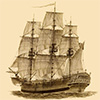 Lord Hungerford (generic)
References
| Primary Source | Australian Joint Copying Project. Microfilm Roll 88, Class and Piece Number HO11/4, Page Number 59 (31) |
| Source Description | This record is one of the entries in the British convict transportation registers 1787-1867 database compiled by State Library of Queensland from British Home Office (HO) records which are available on microfilm as part of the Australian Joint Copying Pro |
| Original Source | Great Britain. Home Office |
| Compiled By | State Library of Queensland |
| Database Source | British convict transportation registers 1787-1867 database |
Claims
No one has claimed Joseph Baker yet.
Photos
No photos have been added for Joseph Baker.
Convict Notes

Surname of convict on Lord Hungerford is Baker not Barker He and another, John Jackson accompanied Charles Swanston to Port Phillip (Victoria) extract from National Library of Australia Manuscript collection 17/01/1837 Police Office Hobart, 17th January 1837 My dear Sir [left margin: Joseph Barker 965 Lord Hungerford, John Jackson Same ship] The two men named in the margin /emancipists/ have obtained the permission of the Government to proceed to Port Phillip Captain Swanston in whose service they are has entered into the necessary bond there, but I omitted to take their own recognizance, will you oblige me by making them enter into a bond of £100 each for their appearance here in twelve months from this date. Believe me Yours M? Champ C.Clarke Esq BIOGRAPHICAL NOTES ON CHARLES SWANSTON Charles Swanston (1789-1850) was born in Berwick upon Tweed, Northumberland. He arrived in India in 1805 and was commissioned as a lieutenant in the Madras Army of the East India Company. He attended the Military Institute at Fort St George. In 1808 he was attached to a force under General Sir John Malcolm that was proceeding to Persia, but the expedition was abandoned. He took part in a campaign against the Rajah of Travancore and in 1810 was in the expedition that captured the French colony of Mauritius. Swanston carried out a military survey of Mauritius and produced a report on its defences. He returned to India in 1814 and was assigned to the Quarter-master General’s Department. In 1817-18 he was given command of the Poona Auxiliary Horse and took part in several actions in the Anglo-Mahratta War. In 1819 he received the brevet rank of captain in the Madras Army. In 1821 he became the military paymaster in Travancore and Tinnevelly, but his hopes of obtaining a more substantial promotion were disappointed. In 1828 Swanston was given a year’s leave. He and his family arrived in Hobart in June 1829. He brought £10,000 with him and immediately acquired a number of properties, including a town house in Newtown. Swanston decided to settle in the colony and he returned briefly to India to give up his army appointment. In 1831 he acquired a fifth of the shares in the Derwent Bank and was appointed managing director. In addition, he was an import and export agent, investment agent and wool broker and he acted as an agent for firms in Madras, Calcutta, Canton, Manila and Mauritius. He was a member of the Legislative Council from 1833 to 1848. In 1835 Swanston was one of 15 leading Tasmanian colonists who formed the Port Phillip Association with the aim of acquiring land and forming a settlement at Port Phillip Bay. The Batman deeds were declared void by Governor Bourke and most members of the Association sold out to Swanston. One of the main streets in Melbourne was named after him in 1837. The name of the Port Phillip Association was changed to Derwent Company, before being dissolved in 1842. Swanston acquired land in the Geelong district and later he and his son-in-law, Edward Willis, held a number of pastoral properties in the Western District of Victoria. The Derwent bank had prospered in the 1830s under Swanston’s management, but it struggled during the economic depression of the early 1840s. It went into liquidation in 1849, leaving him with substantial liabilities.