Summary
Personal Information
Crime
Voyage
Transportation
William Barr was transported on the Albuera, departing 6th Sep 1858 and arriving 28th Oct 1858 with 11 passengers.
Albuera, launched at Moulmain (British Burma) in 1854, made three voyages to Adelaide up to 1874. Sailing from Calcutta, India, on 6 Sep, 1858, she arrived at Fremantle with 11 military convicts on 28 Oct. They were all convicted by Courts Martial (in India and Burma) and sentenced to transportation. Note: Albuera is not to be confused with other ships of the same name or those spelled Albeura.
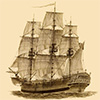 Albuera (generic)
References
| Primary Source | Convicts to Australia at https://www.perthdps.com/convicts/con-wa24.html --00-- Erickson, Rica and O'Mara, Gillian. The Bicentennial dictionary of Western Australians. V. 9. Convicts in Western Australia, 1850-1887. Nedlands, W.A. : University of Western Australia, 1987-[1997]. ISBN 1875560440. [Revision of Dictionary of Western Australians Vol. 2 Bond 1850-1868. Alphabetical listing of convicts and short biography of each] |
Claims
No one has claimed William Barr yet.
Photos
No photos have been added for William Barr.
Convict Notes


NOTE: Year of Birth is based on official records but not the day and month. The latter dates have been entered as 01/01 because the site does not allow those fields to be left empty.
FOOTNOTE: General court martial (GCM) "This was army’s highest tribunal, dealing with commissioned officers and the most serious cases involving other ranks. It could only be convened by the Crown or its deputy (for example, the commander in chief, or governors general). At least 13 commissioned officers had to be present if ‘at home’ (serving in the British Isles, Ireland, non-British territories or small British possessions), or five if ‘overseas’ (the British colonies), together with a judge advocate. Decisions were confirmed by the person who issued the warrant (that is, the Crown or its direct deputy)." ((https://www.nationalarchives.gov.uk/help-with-your-research/research-guides/courts-martial-desertion-british-army-17th-20th-centuries/) --000--
RETURN TO LONDON: 1876, 23 November: William Barr departed from Geraldton aboard the Daylight for London. He was one of 13 former convicts/expirees to make the voyage. The Daylight had earlier loaded wool at Champion Bay, along with barrels of Mother of pearl, scrap iron and gum (The Herald, Saturday 25 November 1876, p2; WA Police Gazette, 1877, p12, at https://slwa.wa.gov.au/pdf/battye/police_gazettes/187701_m.pdf). --00--
From his FREMANTLE JAIL record: BARR, William; inmate #5054, arrived 28 Oct 1858 per Albeura [sic] Date of Birth: 1820 Marital Status: Unmarried Occupation: Weaver, soldier Literacy: Literate Sentence Date: 1856 Sentence Place: Tonghoo, Burma Crime: Insubordination Sentence Period: 14 years Ticket of Leave Date: 26 May 1860 Conditional Pardon Date: 11 Oct 1864 Certificate of Freedom Date: 4 Nov 1871 Comments: To London, 23 Nov 1876 (https://fremantleprison.com.au/history-heritage/research/convict-database/). --00--
OTHER RECORDS -- 2: William Barr 5054 Male, #5054, b. 1820 Birth He was born in 1820. Convicted Convicted of insubordination (Court Martial) and sentenced to 14 years on 4 November, 1856 at Tonghoo, Burma. He had been convicted previously. Family Status Claimed that his marital status was unmarried as at 28 October, 1858 Occupation Recorded as a soldier; weaver on 28 October, 1858 Literacy Recorded as being literate as at 28 October, 1858 Transported Transported to WA on the Albuera arriving at Fremantle, Western Australia, on 28 October, 1858. He had been collected from Calcutta prison. Convict No. Assigned with Convict No. 5054 on 28 October 1858 Ticket of Leave His Ticket of Leave was granted on 26 May, 1860, at Western Australia Conditional Pardon His Conditional Pardon was granted on 11 October, 1864, at Western Australia Cert. of Freedom His Certificate of Freedom was granted on 4 November, 1871, at Western Australia Left William Barr 5054 left the colony for London on 23 November, 1876, (https://www.waconvicts.fhwa.org.au/ui749.htm). --00--
OTHER RECORDS -- 1: SURNAME BARR GIVEN NAMES William CONVICT NO 5054 BIRTH/DEATH 1820 - BRITISH DATA unmarried, weaver, soldier, literate, Church of England; general character - very bad CONVICTION Tonghoo, India [sic; located in Burma] 06.11.1856 -- General Court Martial, disobedience of orders and insubordinate conduct; previous convictions - 8 times convicted by Court Martial; 14yrs PHYSICAL DESCRIPTION (Police Gazette, 1877, p12) middling stout, aged 57, 5’5½” tall, brown hair, grey eyes, long visage, sallow complexion, pockmarked [Note: His WA Convict Record says “brown eyes, grey hair”.] ARRIVAL Fremantle – Albuera 28.10.1858, from Calcutta, India CERTIFICATES Ticket of Leave 26.05.1860, Champion Bay; Conditional Pardon 23.08.1863 Champion Bay; Certificate of Freedon 04.11.1871 LOCATION/ EMPLOYMENT 15.05.1859 transferred to Champion Bay; 30.06.1863 - 30.06.1864 Victoria District, hut keeper REFERENCES SROWA – Convict Register Acc 1156 R1, R8, R21B; Superintendent’s Orders Acc 1156 SO7; WA Government Gazette July 1863/34 p173; WA Police Gazette 1877, p12, at https://slwa.wa.gov.au/pdf/battye/police_gazettes/187701_m.pdf (https://midwestwaheritage.com/resultmcr/?id=6) --00--
IN WA: 1858, 28 October: On arrival, WILLIAM BARR, was listed as convict #5054, 38 years old, single, 5’5½” tall, brown eyes, grey hair, long visage, sallow complexion, pockmarked and middling stout appearance. A weaver by trade, he had been convicted at a General Court Martial, at Tonghoo, in Burma and sentenced to 14 years’ penal servitude for “disobedience of orders and insubordinate conduct” (Western Australia, Australia, Convict Records, 1846-1930; Convict Department, Registers; General Register for Nos 4679-5166 (R1)). Note: Various records give his year of birth as 1820, presumably based on an assumption that he was 38 on arrival in WA. However, the “Convicts to Australia” site says the age quoted on these WA Convict Records “seems to refer to the age of the convict when the passenger list was created”. Thus, William Barr’s year of birth could have been 1819. --00--
BRANDED with a “D”: Up to 1829, any soldier in the British military could be branded, but after that it was reserved for deserters who were “‘branded’ with a D on their left sides as a means of humiliating offenders” (Hilton, 2010, p140 at https://eprints.utas.edu.au/17678/2/Hilton_Thesis.pdf). Hilton doesn’t say how the branding happened and there are conflicting versions among writers. For example, some writers refer to barbaric fire brandings, while others describe painful tattooing using India ink. A post on the Irish Garrison Towns website (http://irishgarrisontowns.com/d-for-deserter/) says both practices were used – hot iron/fire branding being the preferred method until around the mid-19th century when it was replaced by tattooing: “A new device was created to mark the soldiers’ skin with ink, or even gunpowder… The large, blunt points [on the branding tool] hint at the pain it caused as a spring mechanism forced these points into the skin. Regimental doctors described the practice as ‘cupping’." Simon Barnard’s book “Convict tattoos: Marked men and women of Australia” (p55) has several shots of one of these spring loaded, brass “branding instruments”, manufactured by John Weiss & Sons of The Strand, London. Barnard says they were used by medical officers to tattoo army deserters. The head of the “Weiss’ Invention” model holds 47 needle points arranged in the shape of a “D”, all clearly capable of puncturing human skin. So, too, the points of the brass instrument featured on the Science Museum of London’s website. Made by Savigny & Co of London, its adjustable points “still bear traces of ink” and were pushed through the skin by a spring-powered mechanism. Savigny & Co was “better known as a major manufacturer of surgical instruments in the 1700s and early 1800s”. The Museum says branding was abolished in 1829, except for army deserters. The English Mutiny Act of 1858 provided that, in addition to other penalties, a court martial could order that a deserter be marked with the letter D on the left side, 2 inches (5.1 cm) under the armpit, with such letter to be more than 1 inch long. From 1829, the mark was tattooed on the body until the practice was abandoned altogether in 1879 (https://collection.sciencemuseumgroup.org.uk/objects/co155799/branding-tool-for-marking-deserters-london-england-1810-1850-branding-tool). --000--
ABOUT THE 69TH: 69th (South Lincolnshire) Regiment of Foot: “This British Army infantry unit was raised in 1758. It continued in service until 1881, when it was amalgamated into The Welsh Regiment... At the start of their 1857-64 deployment to Burma, they became the first British regiment to be deployed to the Far East overland via Egypt rather than by sea. 1867 saw them back in Canada, where they opposed an invasion by Irish-American Fenians in 1870...” (https://www.nam.ac.uk/explore/69th-south-lincolnshire-regiment-foot). --00--
POSSIBLE PREVIOUS CONVICTION: 1840, 21 November: Private William Barr, alias Mulligan, 69th Regiment, was convicted at Limerick and sentenced to 40 days’ hard labour, and to be branded with a “D” for “desertion and losing necessaries” (Page 117; Series: WO 86: Judge Advocate General's Office: District Courts Martial Registers, Home and Abroad; Description: Piece 004: Judge Advocate General's Office: District Courts Martial Registers (1840-1843)). Note: There is no indication of a “D” brand in the description on William Barr’s WA Convict Record, but this does not rule out the above as a possible record of one of his many convictions before his sentence of transportation and arrival in WA. Information about his previous eight courts martial is from https://midwestwaheritage.com/resultmcr/?id=6. --00--