
Summary
Personal Information
Crime
Transportation
George Barrington was transported on the Active, Albermarle, Atlantic, Barrington, Britannia, Mary Ann, Matilda, Salamander And William And Ann, departing 31st Dec 1790 and arriving 9th Jul 1791 with 1265 passengers.
The Third Fleet consisted of 11 Vessels. Active, Albermarle, Atlantic, Barrington, Britannia, Gorgon, Mary Ann, Matilda, Queen (from Ireland) Salamander and William and Ann. These vessels were provided by a private company; Camden, Calvert and King to ship convicts to the colony.
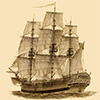 Active, Albermarle, Atlantic, Barrington, Britannia, Mary Ann, Matilda, Salamander And William And Ann (generic)
References
| Primary Source | Australian Joint Copying Project. Microfilm Roll 87, Class and Piece Number HO11/1, Page Number 120 |
| Source Description | This record is one of the entries in the British convict transportation registers 1787-1867 database compiled by State Library of Queensland from British Home Office (HO) records which are available on microfilm as part of the Australian Joint Copying Pro |
| Original Source | Great Britain. Home Office |
| Compiled By | State Library of Queensland |
| Database Source | British convict transportation registers 1787-1867 database |
Claims
No one has claimed George Barrington yet.
Photos
No photos have been added for George Barrington.
Convict Notes
GEORGE BARRINTON, PICKPOCKET, ACTOR, GENTLEMAN AND CONVICT. George Barrington have many appearences at the Old Bailey, he was once convicted and transported to America. He recieved a pardon and returned to London. He spent time in the hulks for theft and it wasnt till 1790 he was tried and found guilty once more he was transported once again to Australia. Known as the Prince of thieves there are many account written of his life. http://www.oxforddnb.com/view/article/1530 This account one of the better ones. George Barrington, pickpocket, was born near Dublin, possibly at Maynooth. The son either of Waldron, a silversmith, and a mantua maker, or of Captain Barrington, commander of an English troop stationed nearby, he is also said to have boasted royal descent, but his early life in Ireland is masked by romantic versions of infinite variety. His education was helped forward by various well-wishers and a dignitary of the church sent him to a Dublin grammar school in preparation for the university. At 16 he stabbed another schoolboy in a fight, was severely flogged, stole some money and a watch, and ran away. At Drogheda he joined a company of strolling players led by John Price, a swindler wanted by the police in England. They spent his money and taught him to pick pockets. When the company dispersed, he and Price became partners in the profitable business of theft in Dublin and then in London. About 1773 Price was arrested, tried and transported to the American colonies. Barrington soon became a legendary prince of rogues. Living in great style and posing as a gentleman, he stole the hearts of influential friends as readily as their purses. In 1776 he was caught and sent to the hulks for three years, but within twelve months regained his freedom. His victims included a Russian count, peers of the realm and some of 'the brightest luminaries in the globe of London'. Although arrested many times, his patrons and his plausible eloquence assured acquittal. Glorying in the notoriety of his crimes and amours, he claimed to draw the line only at libel: 'I never pilfered any man of his fair name'. However, his luck changed in September 1790. Tried at the Old Bailey for stealing a gold watch and chain on Enfield racecourse, he was severely reprimanded by the recorder, and sentenced to transportation, though for only seven years, his defence reputedly wringing tears from judge and jury. In the next months the press had Barrington attempting escape from Newgate in his wife's clothes, and condoling with other convicts for being sent to a land where the natives had no pockets to pick; on the voyage he was credited with quelling a mutiny and writing in lugubrious repentance to his wife, but the facts always failed to fit. On arrival in Sydney in the transport Active in September 1791, he was sent to work at Toongabbie. 'Irreproachable conduct' soon won him a place in the police watch that protected the government stores. In November 1792 he received a conditional pardon. In 1796 John Hunter made this absolute and appointed Barrington chief constable at Parramatta. He also had his own house at Parramatta, two thirty-acre (12 ha) land grants and fifty acres (20 ha) which he bought on the Hawkesbury and farmed with assigned servants. In 1800 'infirmity' led to his resignation as head constable, but he was allowed half his salary as a pension, the other half going to the officer who did his duties. The infirmity was thought by some critics to have been caused by excessive drinking or malversation of government property, but it soon proved to be lunacy and a commission took over his affairs. He died on 27 December 1804. Notoriety pursued Barrington long after his death. Irresponsible journalists credited him with great wealth and longevity, and countless works were published over his name. He wrote none of them and was not the author of the oft-quoted prologue reputedly spoken by him at the opening of the first Australian theatre in 1796. His persistent fame sprang from little more than 'a low pilfering habit' united with genteel manners and a shrewd fluency, although he showed signs of reform in New South Wales.