Summary
Personal Information
Voyage
Transportation
Thomas Beadle was transported on the Robert Small, departing 1st May 1853 and arriving 19th Aug 1853 with 30 passengers.
655 ton ship built in Newcastle, UK 1835. Conveyed convicts and passengers from England to Western Australia. Also carried approx. 100 free passengers. The register of convict passengers is currently being listed but not yet complete.
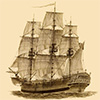 Robert Small (generic)
References
| Primary Source | https://waconvicts.fhwa.org.au/g0/p93.htm#i2313. --00-- https://discovery.nationalarchives.gov.uk/browse/r/h/C11542201 |
Claims
No one has claimed Thomas Beadle yet.
Photos
No photos have been added for Thomas Beadle.
Convict Notes

NOTE: Year of Birth is taken from official records but day and month are not known. The latter dates have been entered as 01/01 because the site does not allow those fields to be left empty.
WA RECORD: THOMAS BEADLE alias Bedale / Bradle Birth: 1835 Death: 31 May, 1853, at sea [Note: It’s 26 May on Surgeon’s record] Convicted: Insubordination (Court Martial) and sentenced to 14 years on 21 July, 1851, at County Dublin, Ireland Family Status: Unmarried Occupation: Soldier [7th Hussars] Convict No.: 2313 Transported: To WA on the Robert Small leaving from Queenstown, County Cork, Ireland, on 1 May, 1853. He had been collected from Ireland prison. He died on the journey. (https://waconvicts.fhwa.org.au/g0/p93.htm#i2313) --000--
MEDICAL RECORD: The journal of the Robert Small’s Surgeon Superintendent, Harvey Morris, shows Thomas Beadle succumbed to pneumonia 12 days after his diagnosis: "Folios 10-12: Thomas Beadle, aged 25, convict; case number 4; disease or hurt, pneumonia. Put on sick list, 14 May 1853 at sea. Died 26 May 1853" (https://discovery.nationalarchives.gov.uk/browse/r/h/C11542201). --0--
THE DREADFUL VOYAGE: By Weaver, P (2004) at https://fremantlebiz.livejournal.com/37766.html “Part 1. Irish prisoners for Western Australia on Phoebe Dunbar & Robert Small in 1853 This is the first part in series of eight which were extracted from a public talk which I gave at the Old Fremantle Prison celebrations in June 2000: On 30 August 1853 the 704 ton hired British convict ship Phoebe Dunbar hove-to in Owen’s Anchorage off Fremantle, Western Australia. On board was a consignment of 286 mostly Irish convicts and 29 British pensioner guards with their families, numbering 21 women and 42 children. A few days earlier on 19 August a similar sized consignment of Irish prisoners and British guards had arrived at Fremantle on board another hired convict ship, the Robert Small. Robert Small lost nine convicts and the figure would have been higher had it not been forced to put into Rio de Janeiro to off-load 150 tons of putrefied ballast, a black peat-like mixture of sand and Dutch clay. A medical board of enquiry convened at Fremantle laid most of the blame on the ballast, ‘...the smell of which was most offensive and likely to prove a fertile source of disease.’ However, had the leaky ship not inadvertently stopped off in South America where fruit and vegetables were purchased the death toll probably would have been much higher than nine. Surgeon Superintendent Harvey Morris - doctor on at least three other convict shipments to Norfolk Island and Van Diemen’s Land (Tasmania) had by his own admission deliberately falsified his records by registering only one third of those who came to him sick. His intention, as he wrote in his shipboard journal, was to instil in the prisoners a false sense of confidence in his abilities: ‘It is always advisable in a Convict Ship, especially when diseases are numerous, to keep the sick list down, as it is termed, with a view of deceiving the general body as regards the healthiness or unhealthiness of the Ship; and the more effectually to do this it is often necessary to keep the names of some off the list who ought to be there, and to register those of others who have little or nothing the matter with them...’ --0--