Summary
Personal Information
Voyage
Transportation
Elizabeth Beckwith was transported on the Wanstead, departing 31st Jul 1813 and arriving 9th Jan 1814 with 120 passengers.
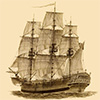 Wanstead (generic)
References
| Primary Source | Australian Joint Copying Project. Microfilm Roll 87, Class and Piece Number HO11/2, Page Number 106 |
| Source Description | This record is one of the entries in the British convict transportation registers 1787-1867 database compiled by State Library of Queensland from British Home Office (HO) records which are available on microfilm as part of the Australian Joint Copying Pro |
| Original Source | Great Britain. Home Office |
| Compiled By | State Library of Queensland |
| Database Source | British convict transportation registers 1787-1867 database |
Claims
No one has claimed Elizabeth Beckwith yet.
Photos
No photos have been added for Elizabeth Beckwith.
Convict Notes

I think that the information appended to this entry about George and Ann Hubbard is incorrect. My understanding is that Ann Hubbert was a convict in 'Wanstead'. There were two free passengers in the ship: Ann Hubbard, wife of George Hubbard; and Mary Ann Lycett, the young daughter of Joseph Lycett. Both Hubbard and Lycett were convicts transported in 'General Hewitt'. George Hubbard was sentenced to Transportation for Life at Shrewsbury Assizes for aiding and assisting two French prisoners to escape, General Frances Andre Bon and his aide. Regards Ian James in Fremantle WA

______________________ Elizabeth Beckwith was a married woman with two children when she was tried (per her petition in NSW dated 1818). Personal Description from Pardon of 1818: "servant, 5ft, fair complexion, brown hair and hazel eyes." She was also known as "Sarah" (per 1814 Muster). She was assigned to Mrs [Ann] Hubbard in Sydney, where she was mustered n 1814. Ann Hubbard, aged 24, had arrived on the same ship - Wanstead - as a convict but she was the wife of George Hubbard another convict native of Kent, who had arrived on "General Hewett" a few months before both the women, on 7 February 1814. George was a 24 yr old with the trade of a boat builder, althouh when he was convicted he was a publican at Deal in Kent who'd helped a French prisoner escape from Chatham, the same kind of crime that had been committed by Elizabeth Beckwith. In the August 1814 muster he was at VDL. Presumably through the Hubbards, Elizabeth Beckwith met William Vaughan, boatman, also originally of Kent. Mrs Ann Hubbard had been found guilty at Stafford in 1811 of housebreaking so had already done 3 years of her 7 year sentence when she arrived. Somehow, she was recorded in the 1814 Muster as free and had got Elizabeth Beckwith assigned to her as her own Government servant. Elizabeth received a Ticket of Leave between 1814 and 1818 (no. 844). 1817 Petition for mitigation of sentence. Transported for the crime of assisting a Danish prisoner to escape “Arrived on Wanstead, … sometime after received a Ticket of Leave by which [xx] Petitioner is enabled to support herself [illegible words]. “..prior to her misfortune supported a creditable character and left [behind her?] an husband and two children to bewail her [xx]. Asks her humble consideration some share of clemcncy and bestow a mitigation of sentence as to your excellency may seem meet … Obtained Conditional Pardon on 31 January 1818. No 1049. 1822 Muster recorded as “Beckford”, Sarah, and she is wife of W. Vaughan. W. Vaughan is likely to be William Vaugan arrived per "Pitt" in 1792 and was convicted at Maidstone, Kent for 7 years so had background of same native place. He was long free, and was a boatman in Sydney in 1806, Self-employed, and a boatman in 1814. In 1828 Census he was aged 71 years but no reference to Elizabeth Beckwith.
Elizabeth Beckwith was transported or life on the "Wanstead' convict ship to NSW for aiding and abetting an alien enemy Danish prisoner to escape from the 'Bahama' hulk at Chatham in February 1813, together with Frances Levens, wife of the boatswain of the 'Bahama'. Mrs Levens was also transported for life with Elizabeth Beckwith on the 'Wanstead'. NEWSPAPER REPORT OF CRIME at CHATHAM, KENT: Kentish Gazette, Tuesday 23 March 1813, Page 2, (Col 4) “KENT ASSIZES, MAIDSTONE, Friday March 19, Crown side. “Frances Levens and Elizabeth Beckwith were indicted under a late Act of Parliament, for feloniously aiding a prisoner of war named SOVEN CHRISTIANSON, to make his escape from His Majesty’s ship ‘Bahama’ at Chatham, in which he was confined on the 15th of February last. These are the first prisoners tried on the statute in question on this Circuit. It appeared in evidence that the prisoners attempted to effect their purpose by providing the witness Christianson, who was a native of Denmark, with female attire, which he first used on board the ship to prevent suspicion, in acting a female character in a play got up amongst his fellow prisoners. The next morning however he was smuggled on shore by the prisoners, in the milk-boat. He was soon after missed, and retaken in a public hose at Chatham. The prisoners were found guilty and sentenced to be transported for life.” In the same newspaper on page 4, col 4: ‘KENT LENT ASSIZES “The Assizes for this county terminated at a late hour on Saturday evening, when twenty-four prisoners received sentence of death, seven only of whom were left for execution. Below we have given the calendar of the whole, and in the preceding page, a detail of the most important trials. “Frances Levens, 30, and Elizabeth Beckwith, 42, for aiding and assisting (in company with Ann Honey and John Brock, acquitted, and Ann Brock discharged by proclamation), SOVEN CHRISTIANSON, an alien enemy and prisoner of war, to escape from His Majesty’s ship ‘Bahama’, to be transported for life.”