Summary
Personal Information
Crime
Voyage
Transportation
Horace Blades was transported on the Westmoreland, departing 15th May 1841 and arriving 12th Sep 1841 with 204 passengers.
The Westmoreland was a 405-ton sailing ship built in 1832 at Lynn, Norfolk, England. Four (4) sailings listed for her to transport convicts (and some free settlers and soldiers) to Australia - New South Wales and Van Diemen's Land (Tasmania). (Voyage in 1838 from Ireland to NSW is currently being compiled, incomplete list of persons to date.)
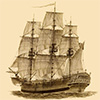 Westmoreland (generic)
References
| Primary Source | Australian Joint Copying Project. Microfilm Roll 91, Class and Piece Number HO11/12, Page Number 314 |
| Source Description | This record is one of the entries in the British convict transportation registers 1787-1867 database compiled by State Library of Queensland from British Home Office (HO) records which are available on microfilm as part of the Australian Joint Copying Pro |
| Original Source | Great Britain. Home Office |
| Compiled By | State Library of Queensland |
| Database Source | British convict transportation registers 1787-1867 database |
Claims
No one has claimed Horace Blades yet.
Photos
No photos have been added for Horace Blades.
Convict Notes

Horace Blades 1822 – 1847 and the Tasman Peninsular Coal Mines What connection does this have with the Blades Family - Horace was a brother of John Sharpe Blades. Brief history about Horace: - Living in Stamford and having grown up to the age of 19, he was literate his height was 5ft 3 and 3/4, fresh complexion, dark brown hair and dark brown eyes, single and with a trade as a Blacksmith and with one prior conviction, 14 days for stealing 3 bundles of faggot wood from the Marquis of Exeter. Horace and another lad, Alfred Wells were charged with killing a lamb with intent. For this they were both sentenced to 10 year and transportation. Horace was transported on the 19th May of 1841 on the Westmoreland (2) which departed from Sheerness. Unfortunately Horace was not a model prisoner and had many charges brought against him resulting in being sent to the Coal Mines. This was approved on the 27th February 1847 and this is where he met his demise, dying at the pits on the 1st June 1847 after only 4 months at the mines. How he died at the pits is not recorded. He was possibly buried at the Salt Water River Convict Cemetery. About the Coal Mines Historic Site The Coal Mines formed part of system of convict discipline and punishment on the Tasman Peninsula. During the busiest years almost 600 prisoners with their jailers and their families lived and worked at the mines. Today all is left are picturesque ruins of houses, barracks, offices and punishment cells. The Coal mines opened three years after Port Arthur. By the late 1830s they produced most of the coal used in Van Diemen’s Land. It was used extensively in government offices, but the householders did not like it because it emitted showers of sparks when it was first lighted, setting fire to carpets and ladies’ gowns. The Coal Mines as a punishment station was for men who had committed a serious offence in the colony or who continually committed relatively minor offences. By 1843 there were 579 prisoners, 27 soldier guards, 35 civilian supervisors and administrators, 14 of their wives and 90 children. Only convicts who were skilled miners worked at the coal face. They dug an average of 3 tons per day; each miner had three convict labourers to take away the coal. Most convicts here, however, were employed in quarrying, lime or charcoal burning, building, gardening, splitting timber, or laboring above and below the ground. The Coal Mines ran at a loss, and officials were very anxious about problems with discipline there, so the Mines were leased to private operators in 1848. With lower costs, the new owners managed to make a small profit until 1877. The Mines were finally abandoned in 1901.
Horace was transported for killing a lamb with intent. He died at the Coal Mines 1\6\1847.