Summary
Personal Information
Voyage
Transportation
George Bloomfield was transported on the Asia 1, departing 12th Apr 1841 and arriving 21st Aug 1841 with 258 passengers.
Built by A Hall & Co at Aberdeen in 1818. A Brig of 536 tons. (Wikipedia) 1830 - Voyage. Asia from Ireland. Female Convict Ship; Stead; Master, Alexander Nesbit M.D. Surgeon Superintendent. Arrived in Sydney Cove 13 Jan 1830. Mustered - 186. Died on Voyage - 3. Disembarked - 1. Total Embarked - 200
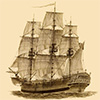 Asia 1 (generic)
References
| Primary Source | Australian Joint Copying Project. Microfilm Roll 91, Class and Piece Number HO11/12, Page Number 296 |
| Source Description | This record is one of the entries in the British convict transportation registers 1787-1867 database compiled by State Library of Queensland from British Home Office (HO) records which are available on microfilm as part of the Australian Joint Copying Pro |
| Original Source | Great Britain. Home Office |
| Compiled By | State Library of Queensland |
| Database Source | British convict transportation registers 1787-1867 database |
Claims
No one has claimed George Bloomfield yet.
Photos
No photos have been added for George Bloomfield.
Convict Notes


Old Bailey Online GEORGE BLOOMFIELD. Theft; stealing from master. 23rd November 1840 Text type Trial account Defendants GEORGE BLOOMFIELD Offences Theft > Stealing from master Session Date 23rd November 1840 Reference Number t18401123-89 Verdicts Guilty Punishments Transportation 89. GEORGE BLOOMFIELD . was again indicted for stealing, on the 29th of June, 3 parasols, value 1l. 1s., and 186 umbrella-handles, value 7l., the goods of William Sangster and another, his masters. MR. PHILLIP. conducted the Prosecution. ALLAN PHILLIP . (police-constables F 48.) I went to the prisoner's lodgings, and found there a considerable deal of property belonging to Mr. Sangster, and two duplicates relating to this property, I found in his box—these are them—I know it was his lodging, because I found a card in his pocket—I heard the prisoner say to Mr. Sangster, "I hope you won't, sir, for it is the first time." Cross-examined by MR. CLARKSON. Q. What was the conversation you had with the prisoner when you took him? A. He asked me what I thought they would do with him—I said it was impossible to tell—he began to cry—I asked if he was married—he said no, he was going to be married on Tuesday, and if Mr. Sangster would not give him in charge he would make it all right—he did not deny his guilt to me. JOSEPH BAKER . I am an assistant to a pawnbroker. I produce three parasols, and 186 umbrella handles, which I believe to have been pawned by the prisoner for 1l. 6s., on the 29th of June—I gave the duplicates produced to the party—I do not remember making any inquiries about him—I imagined these handles to belong to a person who made these sort of things. WILLIAM SANGSTER . These parasols are mine—I have a workwoman to swear to them—I have not taken stock, and found that I have 186 handles missing, but I believe these are mine from some particular ones among them—some were made in Paris, and some in Germany—here are two small heads, which I have had in my possession eight or nine years—they were very expensively carved in Paris, and were too dear for what they were intended—here are two feet carved in Paris—they never make such things in London. Cross-examined. Q. Do you remember in June last the prisoner buying any parasol covers of you? A. No, it was later than June—I should say he did not buy silk of this description of me—he wanted to have a dozen of soiled covers, which I let him have, which he never paid me for—I should say the cover of this parasol is not one of them, most decidedly not—it is quite clean—he pawned this when he had been only ten days in my service—it was after June he bought of me—I swear that—these handles are mine—they manufacture in Paris for other persons, but these two heads have been through my hands twenty times, I suppose in stock taking—I do not think there is a workman in London could carve like them—I have handed to the prisoner articles of this sort to complete goods of mine—I when he had goods to work, he took out a certain number of finishers and brought them home—he was not allowed to take home more than his parasols required. Q. Look at this Peruvian's head, and tell me whether you did not hand that to him to put on a cane when he could get one? A. It might be so, I really cannot recollect it—I might have said, "There is a particular head, if you can find a cane, put that in a certain lot of goods you are going to make"—he had the management of that branch, so much that I never looked much after it—if there were canes to be found to be applied to heads, he did it, but after the parasol season was over, his book was closed, and he ought to have brought back all he had—I cannot swear that there are heads here which were not delivered to him in the course of his work—it would be impossible for any manufacturer so to do. Q. Have you ever given him heads, and before they were put on given him others, and told him to put them on instead? A. Decidedly, but not often—he may have had one or two heads, but not one hundred and eighty-six—when I spoke to the prisoner, he repeatedly kept putting his arm in mine, and repeatedly said, "Let me go—it is the first time," COURT. Q. Even if you did give him any of these things, did you ever authorize him to pawn them? A. Never. ANN SHEEN . I work for Mr. Sangster. These two parasols I made for him I am certain—(looking at too.) MR. CLARKSO. called WILLIAM DUTTON . I am a water-gilder and umbrella-maker, and live in Ogle-street. I have worked for the prisoner in his business as an umbrella-maker—about June last, the prisoner said he bad bought seven pairs of parasol covers of Mr. Sangster, and he showed them to me, one by one—I did not receive any of them. Q. Are you able to say whether the covers of either of these three parasols is one? A. I am certain this is one—(looking at a parasol)—or one of the very same pattern—it is a soiled qne—the prisoner was in the habit of cleaning them before he put them on—(looking at those identified by Sheen)—I cannot swear to this one—I have seen one like it—I can swear to this other by the flowers being faded, and I know the silk by the border. Q. But what do you know this silk by, any more than any other piece of silk that came from the entire piece? A. I cannot tell, only from the flowers being faded—I have got four parasols in my possession, which I found in the prisoner's box when I took the things from his lodging after he was in custody, and after the officer searched the premises—here they are—(producing them)—they are soiled, and have been taken off old parasols. Q. Take up any one of the three parasols that have been produced, and now mind how you answer this question for the prisoner's sake, and for your own; do you mean to tell the Jury that you, believe this silk has been taken off another parasol, and cleaned, and put on this? A. I cannot swear that, because the prisoner had a particular way of doing it. Q. Now look at the second; do you believe that cover has been on a parasol, and taken off and cleaned, and put on another? A. Yes I do—this third one I cannot speak to—these heads and handles, or some like them (looking at them) I have seen before the prisoner worked at Mr. Sangster's—these two I saw before he worked there—this one I saw months before he worked at Mr. Sangster's house, when he worked for him at his lodging—I have seen heads like these others—I can only speak to a similarity of pattern—here is one, the head of an Indian Chief, which I saw in his lodging while he was working for Mr. Sangster, but not at his house—I made part of the frames of the seventeen or eighteen umbrellas in the last case only—we work one in another, that is, I have made one part, and he another—he being a better hand than I am he has finished them—there is a mark on one of these parasols that I can swear to—this is the one—(taking up one)—here is the stain—the prisoner said he could not get it out—I cannot swear to this one—I had been at his lodging on the Saturday morning before he was taken—there were materials for making up many dozens of umbrellas and parasols. MR. PHILLIPS. Q. Did you ever see this Greek head? A. Yes, at the prisoner's lodging, I should think seven months ago—I remarked it particularly—he told me he had pawned some of the knobs, and I believe he had pawned them—I would believe him if I heard him make an assertion. Q. Then if when Mr. Sangster charged him with robbing him, he said it was the first time, would you believe him? A. I do not know. MARY WHEELER . The prisoner brought these three parasols to main June last, to try to sell them—I took them to a lady, and she said they were soiled—he said he had bought the covering of Mr. Sangster, and they were soiled—he was in the habit of making parasols and umbrellas—I made a great many for him. JONES. I am an umbrella frame-maker. The prisoner has bought materials of me—he bought a few hooks about two months ago, and bought silk of me four or five months ago, but not such materials as those produced. SAMUEL PRIOR . I am an umbrella-manufacturer, in Holborn. I have known the prisoner perhaps a year and a half—he has bought materials of me for making parasols, but I cannot identify any of these parasols—these heads were never in our house. (Susannah Barnett, a parasol-coverer, in Tichfield-street; and Frederick Churchill, a coal-merchant, gave the prisoner a good character.) GUILTY . Aged 21.— Transported for Seven Years.