
Summary
Personal Information
Voyage
Transportation
Richard Byrne was transported on the Minerva, departing 24th Aug 1799 and arriving 11th Jan 1800 with 240 passengers.
The Minerva was built at Lancaster, England in 1804. 4 voyages bringing convict transportees to Australia.
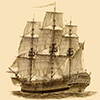 Minerva (generic)
References
| Primary Source | http://srwww.records.nsw.gov.au http://colsec.records.nsw.gov.au Mitchel Library NSW - United Irishmen NSW 1800 - 1806. |
Claims
No one has claimed Richard Byrne yet.
Photos
No photos have been added for Richard Byrne.
Convict Notes

birthplace remains obscure . he was arrested inWicklow although resident in Kildare . some records say born in Kildare while others say Castletown,Wicklow . there appears not to be a castletown in Wicklow and no records at Castletown Kildare . Another record says native of Pallis ,Wexford which is close to Castletown , Wexford
an irish rebel from 1798 . he married mary kelly . their home is a preserved archaeological site at 'The Rocks'' in Sydney . He built the Hart Pub at the Rocks which still operates . He was later involved in the Castle Hill rebellion , got 500 lashes authorized by Rev SamuEL Marsden and served time on Norfolk Island where he became paymaster . after returning to Sydney he received a pardon and won government work as a builder
resident at Calverston,Kildare at time of arrest
Born - CastleTown Wicklow County Ireland. Irish Rebel Soldier Died - 1841 Cumberland St Sydney. Richard Byrne was affiliated with the United Irishmen. He was arrested band tried in 1798 with many others, including:- John Austin, Brien Byrne, Benjamin Carrol, Christopher Coleman, Thomas Brady, Joseph Davis, Robert Doogan, Partrick Duffy, Thomas Ennis, Roger Gavin, John Hewitt, Robert Keane, John Kinkaid, John McDonald, Joseph McKinly, Charles McClean Ferdinand Maurant, Joseph Murray, Michael Mulhall, William Noble, Owen Nugent, John Reddington, William Russell and Robert Wilson Following his trial in 1798, John Austin was named in the Banishment Act and would become a voluntary exile. The Banishment Act (38 George III, c.78) pardoned named individuals concerned in a rebellion. Return to British dominions or passage to a country at war with Britain were prohibited. There were approximately 100 Wicklow men transported after the rebellion of 1798. Another 500 from other counties would also join them in Australia.