
Summary
Personal Information
Transportation
Michael Carroll was transported on the Mangles, departing 21st Jun 1822 and arriving 8th Nov 1822 with 190 passengers.
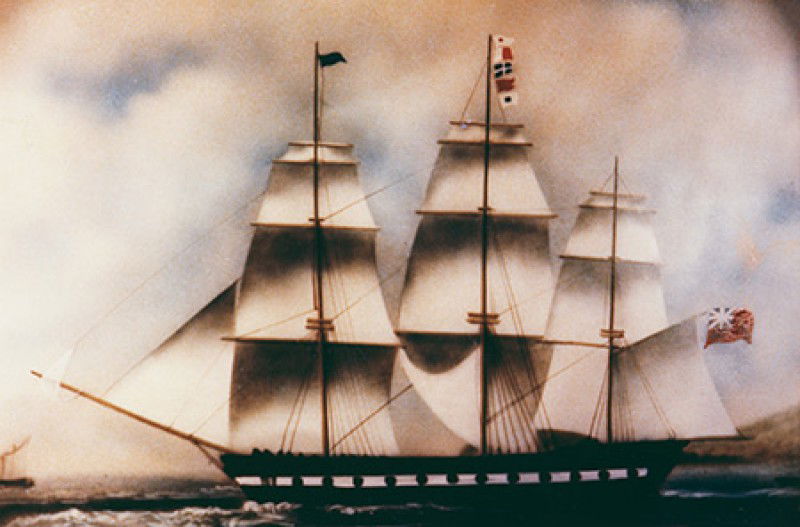 Mangles
References
| Primary Source | Irish Convict Database, by Peter Mayberry. |
Claims
No one has claimed Michael Carroll yet.
Photos
No photos have been added for Michael Carroll.
Convict Notes

The above is from a long account of his trial published in The Waterford Chronicle, March 12 1822.
Michael Carroll was convicted under the Insurrection Act, for being out of his house after the hours of sunset. He came from a wealthy farming family and had previously travelled to America. Special Session under the Insurrection Act. Limerick, March 2. “Michael Carroll, a decent-looking farmer, from near Kildimo, and who had been taken the previous evening, within a quarter of seven o’clock, was put to the bar. His trial excited very considerable interest. John Ternett, a policeman, went on the patrole between six and seven o’clock the preceding evening, by order of Edward Villiers Fitzgerald, Esq. A Magistrate, who gave him directions to go a bye way, and to avoid going through Kildimo; his party were seven in number; they were going in the Pallas-Kenry direction, where they saw the prisoner in a field, talking to a man who had a saddle in his arms. Witness asked them what they were doing at that hour of the evening; Carroll said they were returning from the fair of Crogh. Witness had seen Carroll before this time, but cannot say he knew the person who was with him. Cross-examined. Knew Carroll to be always a genteel man, clean and well dressed; It was near seven o’clock when he took him; witness can’t say that it was a common path-way the prisoner was on; witness does not know where the Prisoner lives; witness brought two other persons prisoners before Mr Fitzgerald, who seemed equally guilty, and he discharged one of them, but it was to be presumed he was the best judge; by the watch it was a quarter before seven o’clock, and twilight. Edward Villiers Fitzgerald, Esq. A Magistrate, deposed , that his residence is at Rockfield; and that he gave particular orders to the party who took the Prisoner, to proceed in the direction where they took him; there were other persons taken the same evening under the Insurrection Act, and the prisoner at the bar was one of those brought before him. Cross-examined by Mr Fitzgerald. Witness knew the person who had been taken along with the prisoner; he had a saddle; his name is Locke; witness is acquainted with Carroll’s dwelling-house, which is about two miles from his own house; witness had discharged five of six persons who were brought before him, being satisfied with the account they gave of themselves. Q. Pray why did you not discharge the Prisoner at the bar as well as the others - what charge had you against him? A. Because Carroll was one of those persons whom I suspected as being connected with the disturbances; and further, there was an old transaction in which he was implicated – after which he fled to America. Witness heard that the Prisoner brought money with him from America, and knows his father to be an oppulent farmer; but if witness was at liberty to state facts, he should say that he had received a bad character of Prisoner; for that he had, in his Magisterial capacity, received private information about him, and he begged to state that such was his character among the Magistrates; for that about three weeks since, a person swore that the prisoner was one of a party who made an attack on the informant’s house, and that the informant was afraid to swear it publicly; there were sixteen persons engaged in the attack with the prisoner; witness also heard he was a conspirator, and connected with a party who beat a man; witness had never had a difference with the Prisoner, but had with his father ten or twelve years since; it was a money transaction; but since that period he had rendered material services to the family of Prisoner; for when Prisoner had a dispute with his brother, and was shot in the back by him, he (witness) had been sent for by Prisoner, and was going to arrect the brother, but afterwards succeeded in reconciling them; when that part of the country was disturbed, Prisoner fled to America; the lands on which Prisoner was taken were those of Knockroe, and it was a tedious craggy way for the Prisoner to go home, being out of this line, if his way was through Kildimo; Prisoner said that he had been in Kildimo, which was his direct road, but he was on the direct contrary road; witness was not at the father’s house since the time of the affray between the brothers; Carroll’s house is in the eastern direction; Knockroe, where the prisoner was found, is in the northern direction, and Kildimo is central between both places, so that Prisoner should go home circuitously; witness never had a difference with the Prisoner, but had a money difference with the father; witness did not speak to Prisoner since his return from America, but supposes Prisoner had heard witness’s avowal and declaration against all persons connected with the disturbances in the country. Defence. Patrick Sheehy, publican, Roches Street,, examined. Witness was at the fair of Croagh, where he had seen the Prisoner several times during the day. …. The Prisoner was in the habit of doing his father’s business; selling cows, sheep, corn, &c. … Patrick O’ Brien, farmer, knows the Prisoner Carroll; was a t the fair of Croagh; Had sheep for sale there, and so had the Prisoner; witness put the Prisoner behind him on the horse, and he dismounted near the lands of Knockroe, when the Prisoner said he had to go to the farm, to get some corn ready for Saturday’s market, as Mountiford Westropp, Esq. Was pushing for rent. Prisoner’s brother had from twenty to thirty acres, and the father had forty acres of Knockroe; there were three cars in readiness to put the corn upon; Geary, Kenny and another person, were the carmen; Witness cut across in the direction of his own house and left the Prisoner. … No other witnesses appearing for the Defence, the Court and a numerous Bench of Magistrates retired, when they returned about a quarter of an hour, and brought in a verdict of guilty. The Learned Serjeant then addressed the Prisoner as follows: Michael Carroll, … You, from your situation in life and circumstances, cannot plead ignorance; you are a person who has visited other countries, and of course, has had an experience which others had not. You belong to a wealthy family, and you are a person who became an object of inquiry to the Magistrates of your part of the Country; …. you are sentenced forthwith to be transported this very night to one of his Majesty’s Colonies. The Prisoner then said, that Mr Fitzgerald had a grudge of a long standing against him, of thirteen or fourteen years; this was clear as he made a Prisoner of him, and discharged those taken along with him for the same offence. The Court felt disappointed in the Prisoner’s sentiments with respect to Mr Fitzgerald. The greatest impression as to the awful visitation of the law was felt by the whole Court and populace on this man’s conviction and prompt banishment.
Irish Convict Database, by Peter Mayberry. Michael Carroll, age 30, per Mangles (2) 1822, Tried Limerick Co., 1822, 7 years. DOB, 1792, native of Limerick Co. Ploughman. ---------------------------------------------------- Colonial Secretary Index. CARROLL, Michael. Per "Mangles", 1822. 1822 Nov On list of convicts landed from the "Mangles" and forwarded to Bringelly for distribution (Reel 6009; 4/3506 p.430) ----------------------------------------------------- 1828 Census Index. Michael Carroll, age 35, T.L. Mangles 1822, 7 years, catholic, Fencer, T. Nowlan, Hunters Hill, Luskintyre district. -------------------------------------------------- Convict Index. Michael Carroll, Mangles 1822, Ticket of Leave, 27/225. Michael Carroll, Mangles 1822, Certificate of Freedom, 11 Jun 1829. 29/0595.