
Summary
Personal Information
Crime
Voyage
Transportation
William Charker was transported on the Perseus And Coromandel, departing 31st Dec 1801 and arriving 14th Aug 1802 with 254 passengers.
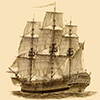 Perseus And Coromandel (generic)
References
| Primary Source | Australian Joint Copying Project. Microfilm Roll 87, Class and Piece Number HO11/1, Page Number 311 (155) |
| Source Description | This record is one of the entries in the British convict transportation registers 1787-1867 database compiled by State Library of Queensland from British Home Office (HO) records which are available on microfilm as part of the Australian Joint Copying Pro |
| Original Source | Great Britain. Home Office |
| Compiled By | State Library of Queensland |
| Database Source | British convict transportation registers 1787-1867 database |
Claims
No one has claimed William Charker yet.
Photos
No photos have been added for William Charker.
Convict Notes

William Charker was born at Winchester, Hampshire, England. He was the fourteenth child of a family of fifteen. His father was Edward Charker, a Tallow Chandler, and his mother was Elizabeth, nee Barr. The Charkers were relatively wealthy traders and yeoman farmers and thus William was well educated and financially independent yet on 7th December,1800 he inexplicably became involved in a substantial burglary (with an accomplice)at St Mary Lambeth stealing goods to the value of 33 pounds 6 shillings. He was arrested and tried on 25th March,1801 at the Surrey Assizes and sentenced to only seven years transportation even though his crime was then a Capital Offence. At his trial, his name was given as William Charker, alias William Chalker. This is the first known use of the alias which was to become his usual name in NSW except on Legal Documents and Government Correspondence where he always used Charker. After a period in a prison hulk at Deptford he was placed on board the "Coromandel" which sailed from Spithead on 12th February, 1802 with 138 convicts and 35 free settlers and arrived at Sydney on 13th June, 1802. William was assigned as a farm labourer for Jonas Archer and Mary Kearns in the Hawkesbury district. In 1803, after Archer fled to avoid his creditors, Mary became the sole owner of the farm and soon after married William. The farm then became known as "Chalker's" farm. By 1806 they were prospering but all was about to change with a devastating flood in March of that year in which the settlers lost everything. William became a hero attempting to save the lives of several of his neighbours with a small boat. When it overturned,the adults drowned but William swam ashore with a small child clinging to is back. He was rewarded with a Conditional Pardon in August 1806. Soon after, their marriage ended with a legal separation, notified in the Sydney Gazette, July,1807 and William left taking only his horse. With his sentence expired, William was granted an Absolute Pardon on the 7th April,1808. He was now free to return to England but chose to remain in the employ of Gregory Blaxland as his Farm Overseer at Brush Farm and South Creek. After leaving the employ of Blaxland in 1810, he became the Farm Overseer for William Lawson until 1814. In November 1808, he selected Elizabeth Shackle as his "hut keeper" from the Parramatta Female Factory. Elizabeth had arrived on the "Speke" with her two year old son Daniel on 6th November, 1808.She was assigned to William Charker within days of her arrival and although they did not marry, she assumed the name and role of Mrs Chalker almost immediately. Their first child Edward was born 10th September,1809 at South Creek. Other children were William James(1810), Maria (1811), Joseph Henry(1813), John(1815), James (1817), Mary Ann(1818)and George(1821). Frederick was born two years after Williiam died but was known as Chalker. Along with his Absolute Pardon in 1808, William received a grant of 30 acres of land at the Cook's River but did not take up the grant. Instead, in August, 1812 he applied for and received a grant of sixty acres at South Creek. The South Creek farm was used mostly to raise cattle while he pursued his other sources of income. He was appointed as Principal Overseer of Government Stock at the Cow Pastures in January 1816 at a salary of 50 pounds p.a.with provisions for himself and his family, Chief Constable in 1817 (20 pounds p.a.)and in 1820 as Pound Keeper. In 1818, he purchased a further 50 acres adjacent to his South Creek grant and also received an additional grant of 125 acres there. He had become a substsantial land holder and continued to supply meat to the Government Stores. In April 1820, William was chosen to accompany Surveyor James Meehan on an exploration of the Wollondilly River area to assess its suitability for pasturing Government stock. He deemed it unsuitable but applied for permission to graze his own stock there. This was granted and by October, 1821 he had constructed a hut and stockyards at Mittagong and applied for a grant of land there. After his death, 200 acres was eventually granted to Elizabeth at Mittagong Ranges. Soon after returning to the Cow Pastures, William was afflicted with "severe indisposition.....the same originating in the performance of his public duties". He resigned almost immediately and requested that he and his family be victualled from Government Stores "as a reward for faithful service". The request was granted. By now, William's health was fading rapidly, even though he was only 48 years of age. He made his Will on 30th January, 1823 leaving all his considerable possessions to his "friend and companion, Elizabeth Sheckle during her lifetime, and then to be divided equally among her children" thus including Daniel. William died three days later and was buried at St John's Cemetery Parramatta where his headstone still stands. From the time of his trial, William was known as both Charker and the alias Chalker. The latter appears to have been used both by himself and others on a daily basis while all Legal and Government references to him were as Charker. He called himself Charker in his Will but after his death, his headstone remembers him as Chalker. Elizabeth during her lifetime and all her children except William James, were known as Chalker.