
Summary
Personal Information
Voyage
Transportation
Richard Chear was transported on the Guardian, departing 30th Jun 1789 and arriving 21st Feb 1790 with 26 passengers.
The Guardian struck an iceburg and limped back to Africa and arrived at the Cape 21/02/1790. * 20 convicts survived and joined the Second Fleet
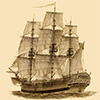 Guardian (generic)
References
| Primary Source | Australian Joint Copying Project. Microfilm Roll 87, Class and Piece Number HO11/1, Page Number 24 |
| Source Description | This record is one of the entries in the British convict transportation registers 1787-1867 database compiled by State Library of Queensland from British Home Office (HO) records which are available on microfilm as part of the Australian Joint Copying Pro |
| Original Source | Great Britain. Home Office |
| Compiled By | State Library of Queensland |
| Database Source | British convict transportation registers 1787-1867 database |
Claims
"My 5x great-grandfather - born in 1759 at Abingdon in Berkshire, England. One of the survivors after the ship, Guardian, which struck an iceberg and limped back to Africa where they were picked up by other ships of the Second Fleet."

Photos
No photos have been added for Richard Chear.
Convict Notes
The Guardian transport was to sail this morning from Portsmouth on her voyage to Port-Jackson; she has 25 convicts on board, mostly carpenters and blacksmiths, and a lading of beds, clothing, and other articles, of which Commodore Phillips had not a sufficient supply, Eight superintendants of convicts embarked with them; and a skilful botanist, provided provided with glass frames, and every thing necessary for the preservation of rare plants, for the royal garden at Kew, also takes his passage on board this ship. Derby Mercury, 10 Sept 1789. Riou departed on the final leg of the Guardian’s journey to Sydney on 12 December 1789. About ten days later, the ship ‘fell in with several Islands of Ice, floating in the Ocean 400 leagues from land’. According to Riou’s account of what followed, he judged conditions safe enough to sail closer to the icebergs, so as to collect floating slabs of ice with which to supplement the ship’s supply of fresh water. But then the weather deteriorated and on the evening of 24 December the ship struck what Riou recalled as ‘a body of Ice full twice as high as the Masthead’. The collision opened a huge gash in the Guardian’s hull and tore off its rudder and part of the keel. The next morning, the crew attempted to remedy the damage: strapping a sail along the hull, pumping out water and jettisoning heavy objects such as guns, anchors and livestock. The following day, acknowledging that ‘little chance was left of safety’, Riou agreed to demands from roughly half of the ship’s company to escape in the longboats. All but fifteen of those who abandoned ship perished. Riou remained on board with 60 others, including 21 convicts, who managed to keep the stricken vessel afloat for nine weeks until it drifted within sight of the Cape and was rescued. The surviving convicts and salvaged cargo eventually arrived in New South Wales in June 1790, having been distributed among the ships making up the infamous Second Fleet when they called at Cape Town. Fourteen of the convicts were immediately pardoned due to Riou’s report of their ‘admirable and wonderful’ conduct in assisting to save the Guardian. https://www.portrait.gov.au/portraits/2011.65/part-of-the-crew-of-his-majestys-ship-guardian-endeavouring-to-escape-in-the-boats A lot of information about the voyage of the Guardian, and its collision with ice, twelve days after leaving the Cape, having taken on more supplies there. https://www.freesettlerorfelon.com/convict_ship_guardian_1790.htm Richard Chear was one of the 14 convicts who received a pardon.
One Clark, a noted horse-stealer of Gloucestershire, well known at Cheltenham and other places, is now in Kingston goal, where, save his own neck, he has made great discoveries of horses stolen, and accomplices connected with him. Several farmers are gone to are gone to Kingston to claim their horses. It is said Clark and his gang stole eight horses in one week from in one week from the neighbourhood of Tewkesbury and Cheltenham. Six of his gang have been apprehended, George Stock, Richard Cheer, John Cheer, John Gordon, John May, and Richard Holloway. Salisbury and Winchester Journal, 14 Jan 1788. ---------------------------------------------------- Kingston Assizes on Friday last, George Stock (commonly called Black George) and two others, Brothers, were capitally convicted Horse stealing, and immediately received Sentence of Death, This George Stock has for some Time kept a House near Moulsey where he has had large stables full of stolen horses, from almost every county upon the coast from Kent to Cornwall, and kept many Persons in his Pay, to mark and disguise the stolen Horses, and others to steal them.—He has by his own own Confession stole upwards of 300 Horses. He was acquitted on two Indictments but convicted on the third, owing to the Activity of James Chambers Esq, of the University of Cambridge, whose Horse he stole in November last.—One Clarke, an Accomplice, who turned Evidence, contributed greatly to the Conviction of Stock, and has also discovered many others of the Gang, several whom have been capitally at the assizes in the different Counties. Northampton Mercury 5 April 1788. -------------------------------------------------- George Stock and John Chear were both executed at Surrey for horse theft in April 1788. The Assize date was 26 March 1788. Source: http://www.capitalpunishmentuk.org/surrey.html

Richard's brotherm John Chear, was tried along with Richard on 26 March 1788. John Chear was executed (hanged I presume) in Aprilm 1788 at Kennington Common ( at the age of 41 years)
Richard was christened on 12 August 1759 in Abingdon, Berkshire, the sixth of eight children. He and his older brother John had clashed with authorities on a violent suspicion of having, on 22 October 1787, lead away from Hampstead Norris in Berkshire, to Walton-upon-Thames in Surrey, two horses, which apparently had been passed on to them to deliver to the market sale near London, as part of their normal duties. Richard was a convict, tried at Surrey Assizes on 26 March 1788 and transported to New South Wales for life and sent out with the second fleet on the 'Guardian' and then 'Surprize' with other skilled convicts. Being well trained in husbandry and the land, he qualified and was selected, as one of 25 special 'transportees' to accompany Lieut. Edward Riou, Commander of Guardian to relieve the serious agricultural famine which beset Governor Arthur Phillip, R.N., soon after the establishment of the New Colony. Richard was separated from his first wife, Mary Pratt and their daughter Ann from the time of his committal on 7 December 1787 to the date of the 'Guardian's' departure from Spithead on 12 September 1789, a period of 21 months (Ann would have been almost 4 years). On arrival in the colony (28 June, 1790) Richard was given his freedom (a Warrant of Emancipation) 'for his fidelity to Captain Edward Riou R.N. in helping the few other physically capable and loyal members of the crew to pump and bail, in two-hourly relays, day and night, under extremely difficult weather conditions' after the ship hit an iceberg. Richard and 13 other transportee-husbandmen' were given conditional pardons by Lieut. Riou. The Warrant of Emancipation was granted to Richard on condition they did not return to England within the period of their respective sentences (life). Richard was granted 30 acres at Kissing Point (Ryde)known as Cheers Farm at Eastern Farms and as further acknowledgement of his character, was granted two town leases, where he established the first butchering business in the New Colony, running his animals on the area bounded by George, Pitt, Hunter and Bridge Streets and watering them from the Tank Stream. His shop was situated on the corner of George and Hunter Streets. His slaughterhouse was situated at the tip of Dawes Point, where the south pylon of the Sydney Harbour Bridge now stands. His other property was at the corner of George Street north and Middlesex Lane where in 1798 he opened the 'Black Bull' hotel. Richard was granted 100 acres of land north of the harbour (Manly)and it was known as Cheers Farm. Richard married Esther Weaver (aka Hester Vevars) on 2 March, 1795.Richard was living with Margaret Fogarty from 1801 with their children. It is unknown what happened to Esther, but his later partnership with Margaret Fogarty (marriage not registered) produced sons Richard (1802), John (1804) and daughter Harriet (1806). Richard received one of the first liquor licences in the colony. Margaret died 23 August 1810 from drinking excessive alcohol. She is buried in the Old Sydney Burial Ground (under Town Hall Railway Station). Richard married Jane Ann Smith 16 October 1815 at St Phillips, Sydney. They had 4 children (Elizabeth born 1816, Mary Ann born 1818, James born 1819 & William born 1821) Jane died 2 March 1823 & was buried in the Elizabeth St Burial Grounds (under Central Railway Station). Richard died 21 February 1827 & was buried in Devonshire St Cemetery (under Central Railway Station)
Was freed after saving multiple lives during an iceberg collision.