
Summary
Personal Information
Crime
Voyage
Transportation
William Chiffey was transported on the Isabella, departing 11th Jul 1833 and arriving 14th Nov 1833 with 299 passengers.
The Isabella was built in London in 1818. She was owned by William Wiseman, Patrick Chalmers and James Wallace. The Isabella transported convicts to Australia in 1818 (NSW), 1822 (NSW), 1823 (NSW), 1832 (NSW), 1833 (VDL) and 1842 (VDL).
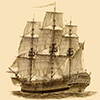 Isabella (generic)
References
| Primary Source | Australian Joint Copying Project. Microfilm Roll 90, Class and Piece Number HO11/9, Page Number 166 |
| Source Description | This record is one of the entries in the British convict transportation registers 1787-1867 database compiled by State Library of Queensland from British Home Office (HO) records which are available on microfilm as part of the Australian Joint Copying Pro |
| Original Source | Great Britain. Home Office |
| Compiled By | State Library of Queensland |
| Database Source | British convict transportation registers 1787-1867 database |
Claims
No one has claimed William Chiffey yet.
Photos
No photos have been added for William Chiffey.
Convict Notes

1846: Muster - William Chiffey was listed as at Port Arthur (see New South Wales and Tasmania, Australia Convict Musters, 1806-1849). 1849: Muster - listed as at Norfolk Island (see New South Wales and Tasmania, Australia Convict Musters, 1806-1849). 1852, 19 June: William Chiffey is on a list of probation passholders employed by Richard Chilton at High Plains, Tasmania (see Tasmania, Australia, Convict Court and Selected Records, 1800-1899). Richard Chilton/Chelton owned "Langloh Park", near Hamilton -- a property of more than 2000 acres that was originally a land grant to his wife Mary's first (and deceased) husband, Frederick Langloh.
1843, 15 September: The 1846 Muster has a notation about his conviction by the Supreme Court, at Hobart, on 15 September. He was sentenced to life for "a nameless offence" [a reference of the time to homosexuality]. The term "nameless offence" was used in the newspaper report of his trial [where he was called Thomas Chiffey], published on 19 September in the Colonial Times, p3: "Thomas Chiffey, who was convicted of a nameless offence, was then placed at the bar, and addressed to the following effect:- His Honor observed, that he had been convicted upon very clear evidence of a most detestable crime, the penalty of which was death; he (the prisoner) was perhaps aware that the Executive Government had recently spared the lives of two men who had been convicted of a similar offence; of the views of the Government in doing so, his Honor knew nothing, neither had he known of any exception in this colony to the execution of the sentence for such crimes. It was his Honor's duty to pass sentence of death upon the prisoner, and he would tell him, that he did not think there was anything in the prisoner's case to induce the Executive to spare his life. If he had been guilty of the same crime as that with which the other two men had been charged, his Honor would not, he thought, have passed sentence of death upon him, but merely ordered sentence of death to be recorded against him, for he never passed sentence of death upon a prisoner, unless he thought it would be carried into execution. His Honor could not tell whether the prisoner's life would be spared, but his advice to him was to prepare to die; for aught his Honor knew, the sentence he was about to pass would be executed. During the last century, his Honor believed all similar cases, both in this colony and in England, had been punished with death, with the exception of the two men he had referred to, and the act which spared their lives, emanated from the Executive, and not from the Legislative Functionaries. The prisoner's speedy death, therefore, might be considered inevitable, perhaps before this day week, and his Honor would advise him to give up all thoughts of having his life spared. His Honor then passed sentence of death upon the prisoner, and observed, that if the Executive Government should spare his life, the observations his Honor made, would, if he took his advice, render him better prepared to pass the remainder of his wretched existence. With this view, his Honor had offered these observations; but he could give him no hope of pardon, which there was nothing to justify, as his case was widely different from that of the two men who had been pardoned. The prisoner was then removed, who, on this occasion, as on that of his trial, exhibited a stupid apathy, which appeared to render him callous to his dreadful fate."
1832, 7 January: William Chiffey was convicted for larceny - stealing a gun (see hulk record). 1832, 18 January: He was received aboard the prison hulk Retribution at Woolwich; aged 19; prisoner #9695. He was sent from there for transportation on 14 June 1833 (see UK, Prison Hulk Registers and Letter Books, 1802-1849). 1833: On arrival in NSW, prisoner #1617 William Chiffey was single. 1833: Muster - he was assigned to Public Works (see New South Wales and Tasmania, Australia Convict Musters, 1806-1849). 1835: Muster - assigned to public works. 1838: William Chiffey was granted a Ticket of Leave (see Hobart Town Courier, 2 March, p1). 1841: Muster - he was listed as free by servitude (see New South Wales and Tasmania, Australia Convict Musters, 1806-1849).