
Summary
Personal Information
Crime
Transportation
William Clackson was transported on the Speke, departing 13th Dec 1820 and arriving 18th May 1821 with 156 passengers.
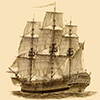 Speke (generic)
References
| Primary Source | Australian Joint Copying Project. Microfilm Roll 88, Class and Piece Number HO11/3, Page Number 427 (215) |
| Source Description | This record is one of the entries in the British convict transportation registers 1787-1867 database compiled by State Library of Queensland from British Home Office (HO) records which are available on microfilm as part of the Australian Joint Copying Pro |
| Original Source | Great Britain. Home Office |
| Compiled By | State Library of Queensland |
| Database Source | British convict transportation registers 1787-1867 database |
Claims
No one has claimed William Clackson yet.
Photos
No photos have been added for William Clackson.
Convict Notes
A full pardon was given in 1835 to those convicted at Sterling in 1820 with Baird and Hardie (who were execured). There is a petition file in UK National Archives at Kew. Reference HO 17/23/10 https://discovery.nationalarchives.gov.uk/details/r/C14596749
New South Wales, Australia, Tickets of Leave, 1810-1869 for William Clackson no 27/131 dated 31/3/1827 5' 4" ruddy complexion brown hair and dark grey eyes allowed to stay in Sydney district New South Wales, Australia, Certificates of Freedom, 18/12/1827 no 27/1086 states received 14 years to be enacted to the contractor for 7 years New South Wales, Australia, Convict Registers of Conditional and Absolute Pardons, 1788-1870 Conditional No 106. Part of a bulk granting of a conditional pardon. William and 16 others all tried for same crime and sentenced to death commuted to transportation
HOUSE OF COMMONS, MARCH 18.— Mr. Wallace, enquired of the Lord Advocate for Scotland, if anything had been done by His Majesty's Government on behalf of the eighteen unfortunate men who had been convicted in Scotland in the year 1820, of what was called in those times, treasonable practices, whose names were as follow :— John Barr, William Clarkson, James Cleland, Andrew Dawson, Robert Gray, Alexander Latimer, Thomas M'Culloch, Thomas M'Farlane, John M'Millan, Benjamin Moir, Allan Murchie, Thomas Pike, William Smith, David Thomson, Andrew White, and James Wright. The Lord Advocate was happy to inform the Hon., Member for Greenock, that His Majesty had been graciously pleased to pardon the whole of these men, and instructions to that effect had been sent to New South Wales. The True Colonist (Hobart), 7 Oct 1836 The Radical War, also known as the Scottish Insurrection of 1820, was a week of strikes and unrest, a culmination of Radical demands for reform in the United Kingdom of Great Britain and Ireland which had become prominent in the early years of the French Revolution but had then been repressed during the long Napoleonic Wars.. An economic downturn after the wars ended brought increasing unrest. Artisan workers, particularly weavers in Scotland, sought action to reform an uncaring government. Gentry fearing revolutionary horrors recruited militia and the government deployed an apparatus of spies, informers and agents provocateurs to stamp out the movement. A Committee of Organisation for Forming a Provisional Government put placards around the streets of Glasgow late on Saturday 1 April, calling for an immediate national strike. On Monday 3 April work stopped in a wide area of central Scotland and in a swirl of disorderly events a small group marched towards the Carron Company Ironworks to seize weapons, but while stopped at Bonnymuir they were attacked by Hussars. Another small group from Strathaven marched to meet a rumoured larger force, but were warned of an ambush and dispersed. Militia taking prisoners to Greenock jail were attacked by local people and the prisoners released. James Wilson of Strathaven was singled out as a leader of the march there, and at Glasgow was executed by hanging, then decapitated. Of those seized by the British Army at Bonnymuir, John Baird and Andrew Hardie were similarly executed at Stirling after making short defiant speeches. Twenty other Radicals were sentenced to penal transportation. It became evident that government agents had actively fomented the unrest to bring radicals into the open. The insurrection was largely forgotten as attention focussed on better publicised Radical events in England. Two years later, enthusiasm for the visit of King George IV to Scotland successfully boosted loyalist sentiment, ushering in a new-found Scottish national identity. In various towns a total of 88 men were charged with treason. James Wilson was hanged and beheaded on 30 August watched by some 20,000 people, first remarking to the executioner "Did you ever see such a crowd, Thomas?". On 8 September Hardie and Baird were executed in Stirling, watched by a crowd of 2,000. Thomas McCulloch, John Barr, William Smith, Benjamin Moir, Allan Murchie, Alexander Latimer, Andrew White, David Thomson, James Wright, William Clackson / William Clarkson, Thomas Pike/Thomas Pink, Robert Gray, James Clelland, Alexander Hart, Thomas McFarlane, John Anderson, Andrew Dawson, John McMillan and the 15-year-old Alexander Johnstone were in due course transported to the penal colonies in New South Wales or Tasmania. Peter Mackenzie, a Glasgow journalist, campaigned unsuccessfully to have them pardoned, and published a small book: The Spy System, including the exploits of Mr Alex. Richmond, the notorious Government Spy of Sidmouth and Castlereagh. Eventually, on 10 August 1835 an absolute pardon was granted. Source: Wikipedia