
Summary
Personal Information
Transportation
Francis Cock (Per 'Salamander') Cox was transported on the Active, Albermarle, Atlantic, Barrington, Britannia, Mary Ann, Matilda, Salamander And William And Ann, departing 31st Dec 1790 and arriving 9th Jul 1791 with 1265 passengers.
The Third Fleet consisted of 11 Vessels. Active, Albermarle, Atlantic, Barrington, Britannia, Gorgon, Mary Ann, Matilda, Queen (from Ireland) Salamander and William and Ann. These vessels were provided by a private company; Camden, Calvert and King to ship convicts to the colony.
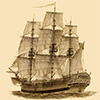 Active, Albermarle, Atlantic, Barrington, Britannia, Mary Ann, Matilda, Salamander And William And Ann (generic)
References
| Primary Source | State Records of NSW ref: 4/4003; Ship source: Salamander, Year: 1791; Volume entry number: 12945. SRNSW ref: SZ115 pp147-202; Proceedings of the Old BAILEY 25 Feb 1789. |
Claims
No one has claimed Francis Cock (Per 'Salamander') Cox yet.
Photos
No photos have been added for Francis Cock (Per 'Salamander') Cox.
Convict Notes

ENLISTMENT in NSW CORPS Our convict, Francis Cox, per ‘Salamander’, was free in 1796 (7 yr sentence expired). He remained on Norfolk Island. In 1800 he enlisted in the NSW Corps, and was discharged after three years, in 1803. [per research by National Centre of Biography, Australian National University, for People Australia website). In July 1800 a new Lt-General, Foveaux, arrived on Norfolk. On 13 December 1800, plans by recently arrived former United Irishmen to take over the island in an armed uprising were revealed to Foveaux just 24 hours before the planned action. Foveaux acted harshly and Francis Cox, as NSW Corps soldier, would have been witness to, and involved in the response. Arrests were made early in the morning and the same afternoon the three main co-conspirators were summarily hanged, with all the settlement’s convicts and soldiers assembled (compulsorily) to watch. FAMILY After three years, in 1803, Francis was discharged from the NSW Corps. In 1805 he was listed as a labourer on the Norfolk Island victual lists. At the end of 1803, his first child with free immigrant Sarah Edge was born. As the couple was not formally married the children were recorded with their mother’s surname: 1. A boy, Francis Edge, born 29 Dec 1803. Sarah was then aged 15 yrs. Her father, Fane Edge, had died at the beginning of 1803. Her child was baptised 1805 (UNE list) 2. Their second boy was born in 1804 - named Fane Strange Edge, after his grandfather. [From the database of Fellowship of First Fleeters, based on Smee CJ] In 1802, Sarah’s mother no longer appeared in the island’s muster record, so that may be the year she died. Sarah’s two little sisters are recorded as being on stores from January 1802 victualling lists (Mary Ann was then aged 8 and Hannah 6 soon to turn 7). In the 1807 victualling list, Mary Ann (aged 13 at year’s start) and Hannah (11) were both actually recorded as orphans. Possibly they lived with their sister and Francis Cox? RELOCATION TO TASMANIA The family relocated to Tasmania along with all convicts and free settlers, when Norfolk Island settlement was being closed down. The first shipload left in September 1807 but the Cox family didn’t depart until a year later, on 9 September 1808, on ship ‘City of Edinburgh’. The ship indent recorded Francis Cox with 1 x wife and 2 x children. [Tasmanian archives, CSO1/1/177/4306 p. 222.] They arrived at their new home on 2 October 1808. Sarah was only 20 years old. With them on the City of Edinburgh (recorded on above document) was Sarah’s brother Fane Edge (junior) aged about 17. Since at least 1806 (aged 16) his job on Norfolk Island was coxswain on the government boat (per N.I. victualling list, 13 August 1806). He’d perhaps gone to Tasmania to help Sarah and her family. However, he didn’t remain. Sarah’s two younger Edge sisters were not repatriated to Tasmania with the Cox family. They remained on N.I victualling lists in 1809. Possibly they stayed on with their elder brother Fane. He was recorded as finally removing to Tasmania in February 1813 on board ‘Minstrel II’. *His sister Hannah was recorded on the same page of the Minstrel as Fane, listed as Hannah Matthews, with a 16 month old daughter. She was then married (whether formally or otherwise) to Robert Matthews (per ‘Coromandel’) who had also been employed on the government boat in the 1808 lists. Matthews remained on the island as part of the ‘cleanup party, and departed Norfolk Island by ship Kangaroo Feb 1814. He was granted a free pardon by Macquarie that year – see his own separate page. See: https://libraries.tas.gov.au/Digital/CSO1-1-177-4306/CSO1-1-177-4306-6. “List of Settlers embarked on board. The [Minstrel] for the purpose of removing to Port Dalrymple.” Fane had no wife or children. * MaryAnne Edge departed the island for Sydney on Endeavour Schooner on 10 February 1812. [per U.N.E Convict History Research Collective - Directory of the Norfolk Island First Settlement, 1788-1814]. A few months later she married in Sydney on 15 June 1812 to John Thomas Holford ‘mariner’. (St Phillips register) *********************************
CORRECTION: Fane & Sarah Edge came to NSW and later onwards to Norfolk island with two children, (return of 'Pitt' to Norfolk Island lists the Provost Marshall, wife and 2 children). As well as daughter Sarah aged 3-4, there was son Fane (jun) aged prob about 14 months. English birth records: Fane Edge born to Fane & Sarah, baptised 20 Feb 1791 at Alverstoke in Hampshire. This is near Portsmouth where the father would have been stationed before departing with NSW Corps. 'Mary Ann' did not depart Portsmouth on 16 Feb as some claim, it only started loading convicts onboard on 14 Feb 'Times [London] 15 Feb. 1791 ‘News in Brief’]
Overview of Francis Francis Cox and the other approx. 160 male convicts who arrived at Port Jackson on 21 August 1791 remained on board ‘Salamander’ for 14 days and then sailed on to Norfolk Island without having being disembarked. They were one of the largest delivery of convicts to the island since ‘Sirius’ brought approx 160 convicts 18 months earlier. Francis remained on the island after he became Free when his sentence expired in 1796. He had children born on Norfolk with Sarah Edge, who’d arrived free, (see below). The family remained there until Government relocated all the inhabitants to Tasmania in 1807-08. He and Sarah, with 2 children, went on the fifth shipload to Tasmania, “City of Edinburgh’ leaving in Sept 1808 and arriving on 2 Oct at Hobart. The next year, Francis and Sarah formalised their marriage in Hobart, at St David’s Church, on 24 July 1809. Two more children were baptised together in Tasmania in 1811 – but they might have been older children born on Norfolk. ********************************** THE EDGE FAMILY- Francis Cox’s future in-laws: In March 1792, a NSW Corps soldier named Fane Edge was sent from Sydney to Norfolk on the Pitt (overseeing another group of convicts on board) having been appointed by Gov. Phillip as provost-marshall of the island. Accompanying him were his wife Sarah, and daughter Sarah Edge, then aged 3 to 4 years (B 1788). It appears that Edge had enlisted in the NSW Corps to solve his poor financial situation. In August 1786, the Government had decided to establish a new penal settlement at Botany Bay. The Home Office was instructed to prepare a transportation fleet to be sent there, and this was a matter of public knowledge. ‘Capt’ Fane Edge then wrote to the Home Office authorities ‘seeking employment’. He said he would be happy to go to Botany Bay. His letter stated that he had served for 20 years with the 53rd Regiment of Foot in Gibraltar, Ireland and North America but lost money by the failure of a mercantile house in Quebec. REF: British National Archives: HO42/10/106 [This is quoted from the online description of that record]. Fane Edge had enlisted in the NSW Corps on 1 Aug 1790. He was considerably more experienced than most of the new enlistees. The family arrived in Sydney in July 1791 when Edge was in the detachment of NSW Corps guarding convict women on the ‘MaryAnn”. His experience as a soldier was probably the reason he was plucked out of the pack by Governor Phillip and made provost-marshall at norfolk Island (responsible for order and discipline over the other soldiers). On Norfolk, Mr & Mrs Edge had three more children (Fane, MaryAnne and Hannah). In 1801, Edge was refused leave to return to England for private business and to be extricated from debt. In 1802, he’d been ten years in his role – perhaps too long, because the island’s Lt-Governor, Joseph Foveaux, suspended him from his duties as provost-marshall for repeated disgraceful transactions that had rendered him unfit for public service. He died several months later, being buried on Norfolk Island in January 1803. REF: Vivienne Parsons, 'Edge, Fane (?–1803)', Australian Dictionary of Biography, National Centre of Biography, Australian National University, ***********************************************
NOTE: In the Third Fleet, there were two men named Francis COX (both also recorded at trial and on indent as "Cock"). Both has 7 years. This one on Salamander was tried at the Old Bailey in Feb 1789. The other one was on Brittania, a blacksmith, tried at Salop Assizes (Shropshire) in March 1790. ***************************************** OLD BAILEY, Sessions starting 25 Feb 1789: "227. FRANCIS COCK was indicted for stealing, on the 23d of January last, four Prince's metal candlesticks, value 10 s. a brass mortar, value 3 s. two brass pestles, value 2 s. the property of James Fleming . "The prisoner in company with another lad, was seen standing at Mr. Fleming's door, and the other lad took the things out of the window, and gave them to the prisoner, upon whom they were found directly. GUILTY. Transported for seven years." After leaving England when The Salamander eventually sailed on 27th March 1791, he arrived in NSW on 21 August 1791. He then departed NSW on Salamander again, bound for Norfolk Island on 4th September 1791 with 160 male convicts, stores, provisions, two non-commissioned officers and eleven privates. On the voyage the ship entered Port Stephens, the first ship to have done so.