
Summary
Personal Information
Crime
Transportation
John Collins was transported on the Mangles, departing 21st Jun 1822 and arriving 8th Nov 1822 with 190 passengers.
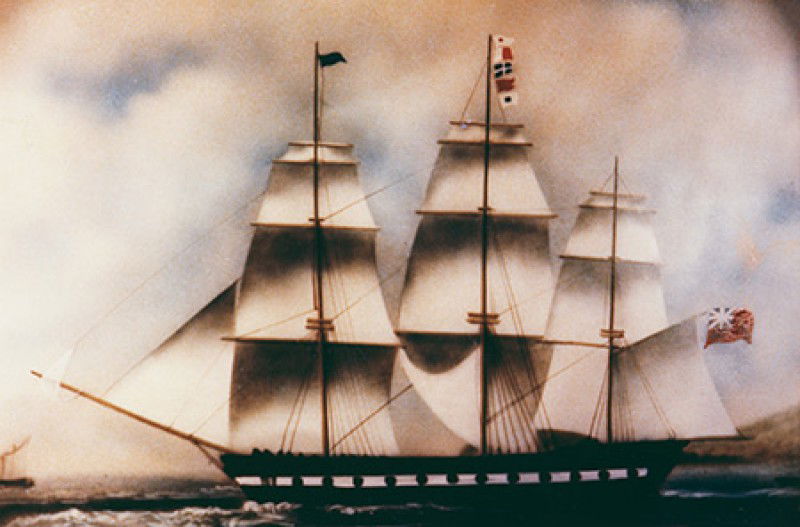 Mangles
References
| Primary Source | Irish Convict Database, by Peter Mayberry. SRNSW ref:, Convict Indents Ship source: Mangles, Year: 1822; Vol. number 4/4008, Entry no: 180 Freemans Journal (Ireland), Wed 29 May 1822, p.3 |
Claims
No one has claimed John Collins yet.
Photos
No photos have been added for John Collins.
Convict Notes


[NOTE - there are two men named John Collins transported on Mangles in 1822. One, aged 35, was tried at Limerick, entry no 96 on the Mangles indent, and got his Certificate of Freedom in 1829. The other John Collins, aged 26, was entry no 180 on the indent, was tried at Tipperary, and committed suicide in 1825 while still a convict. This is the story of the Limerick man, who received his certificate of Freedom in 1829.] JOHN COLLINS, aged 26, occupation: ploughman; was 5ft 5&1/2 inches tall, with brown hair, hazel eyes, born in Co. Tipperary, and was tried at a Special Sessions at CASHEL, in Co. Tipperary in May, 1822. SEDITIOUS ACTIVITY Special Sessions were held solely to try prisoners under the Insurrection Act of 1822 which could be proclaimed in force in any County where the Justices of the Peace considered the County to be in a state of disturbance. Activities prohibited under the Act itself, such as swearing false oaths, delivering threatening notices, threatening evictions, attacking property, including stock such as by houghing cattle, holding night meetings of secret societies which planned and ordered these activities, etc. Being found guilty deemed the accused ‘an idle and disorderly person’ and got him 7 years’ transportation. JOHN COLLINS of TIPPERARY had been involved in such activities, having been found guilty under the Act. The facts involved a house being set fire during the night, and a group of men being seen in a ditch nearby. Given that Collins was not proved to be at the setting of the fire, his charge would have been based on his being seen with others unidentified in a ditch at night, contrary to the curfew hours. From the facts reported, the father of John Collins was a man named William Collins, who had a son-in-law named John Long. Therefore Long was also John Collins’s brother-in-law and married to Collins’s sister. They all lived together in the one house, near to the prosecutor, Mr Neal. The sarcastic words thrown at Neal by someone in the Collins family house - “There’s cabbage and butter for you!” – indicates that leasing the land (i.e. to produce “cabbage & butter”) has brought troubles such as the house being burnt down. This implies that the Collins family believed the land was leased unfairly to Neal, or to his landlord John Ryan who he sub-leased from. For example, perhaps Neal had offered a higher rent causing an existing tenant to be evicted, or John Ryan had. John Long’s activity that night hints at him being part of the local illegal agrarian association – perhaps the Whiteboys – that had taken action to frighten Neal off the land. REPORT OF TRIAL Freemans Journal, Wednesday 29 May 1822, p.3: “On Saturday last (25 May 1822) at the special sessions of Cashel under the Insurrection Act, …. “John Long and John Collins were next arraigned under the Act, at the prosecution of a man named Neal. Neal was in the charge of a house and farm at Holycross that had been taken [i.e. leased] by one John Ryan from Mr Sadlier [i.e. the landlord]. On the night of Tuesday, the 17th [May] the house in which Neal was, as well as one or two other houses, were burned near the same place, by banditti. “Neal deposed that on the said not his wife awoke him in consequence of finding smoke in the house, which had almost stifled herself, a boy and a child; that Neal and the other inmates of the house got up and with great difficulty groped to the door and escaped, carrying with them only a feather bed. “Neal saw, behind a ditch, four or five men, one of him was the prisoner. Long, who went quickly off, and was followed by Neal into the house of William Collins, who is Long’s father-in-law, where he, Neal, on telling how his house had been burnt, was answered by a man who said: “There’s cabbage and butter for you!” “Long had got [himself] into Collins’s [house] some time before Neal, and had stripped himself and slipped into bed. With regard to the identity of the other prisoner, John Collins, son of William, Neal proved that he saw John Collins also inside the ditch, who turned aside his face – but he knew him also from his voice. Both the prisoners were convicted. “Mr Blacker, in passing sentence, pronounced their crime so atrocious as to be sufficient to disgrace the most savage nation, and had they been tried at the assizes for such an offence he had no hesitation in saying their lives would be forfeited. He then sentenced them to seven years transportation.” In NSW: John Collins and his brother-in-law John Long were both transported on Mangles (2) arriving in late 1822. • November 1822 – John Collins was on the list of Mangles convicts landed and forwarded to Evan for distribution. Here he was assigned to Samuel Terry in the District of Evan. This was probably on Terry’s farm named “Mt Pleasant’ on the Nepean River near Penrith. (Terry was an ex-convict who had become wealthy through an inn, a store, land grants, trading, farming, and lending out money on mortgages). • After two whole years with Mr Terry he was transferred on 3 May, 1825 from Samuel Terry to Mr Robert Crawford whose 800 acre farm was called ‘Hill End’ at Prospect. (from Return of convicts transferred in the District of Evan). Collins’s brother-in-law, John Long, resided here, having been assigned to Crawford since landing. • Collins’s subsequent action (suicide) raises the question whether he had been in a melancholy state, and/or insane, for some time and whether this was the reason he was transferred to the farm where his brother-in-law resided. Did Mr Terry, and Mr Crawford’s farm supervisor, take a humane approach? Had Collins himself asked to be transferred to be with his brother-in-law? Or had Mr Terry had separately decided it would be better to do so? Crawford’s statement of insanity being the cause of Collins’s death doesn’t indicate whether he was morose and depressed, or whether he was raving, manic or ‘mad’. • Convict Muster of Sept 1825 – Convict, 7 yrs, Residing at Parramatta as Government Servant to Robert Crawford (it was actually Prospect, near Parramatta). Besides Robert Long, Patrick Lysaght (from Co. Limerick neighbouring Tipperary) was another convict from Mangles in 1822, transported under the Insurrection Act, who was assigned to Robert Crawford since arrival. Crawford had 25 convicts in 1822, and about 35 convicts during 1825, when he wrote in November 1825 to the Governor with a list of all their names, claiming that the number he kept entitled him to 1,900 acres (he had, then, 1,000 acres). • 1825 death of JOHN COLLINS by suicide while in the service of Robert Crawford. This probably occurred between September 1825 (when he was recorded on the Convict Muster) and 9 November when Crawford wrote with his list and advised the Governor of Collins’s death. Letter 9 November 1825 from Robert Crawford Crawford wrote laying before the Governor “a list of 34 prisoners who have been … in my service during [xx xxx]” According to the terms (?) of my Grant, I am obliged to victual and maintain a convict for every hundred acres – the bonds necessary for this purpose have been duly executed by me but since then I conceive that I am freed from the obligation of the bond so far as regards five of my servants, namely: • Joseph Parker, Speke, died in Sydney Hospital • Thomas Padley, Coromandel, died in Parramatta Hospital • Roger Caldwell, Lord Eldon, became free • George xxx Francis (?) became free • And JOHN COLLINS, Mangles, put a period to his existence while in a state of insanity.” These I apprehend ought to be added to the list now transmitted, and deducting twenty the number proportionate to my grant, the excess would entitle me to nineteen hundred acres. ************************* ‘HILL END’ Farm at PROSPECT - where John Collins “put a period to his existence”: Robert Crawford, proprietor, arrived in 1821 as a 22 year old under the patronage of Governor, Sir Thomas Brisbane. Brisbane had been the client of Crawford’s solicitor father, Hugh, back in Glasgow. Crawford quickly received two land grants – one of 200 acres at the Cowpastures, and one of 800 acres at Prospect which he named ‘Hill End’ after his family home on the banks of the Clyde, at Glasgow. He also quickly received a large number of convicts to clear the land. He lived in Sydney where Gov Brisbane also gave him a post as Asst Secretary to the Chief Secretary. (See magazine ‘Australiana’, Vol 24, no 4. Nov 2002, chapter ‘Clyde Bank’ by John Hawkins, at p.100. Also, Pictorial History, Blacktown and District. Alan Sharpe, 2000) In early 1823 an ex-sergeant of the Garrison Regiment named Henry Lewis Campbell began working for Crawford as the ‘Hill End’ farm superintendant. He was the superintendant until near the end of 1825 when Crawford replaced him with a newly arrived brother, Thomas Crawford. Whether Henry Campbell was a difficult master or not isn’t known but this is the person who was in charge in the six months or so that John Collins was alive on “Hill End”. The superintendant’s demeanour may have been affected by the fact that his employer, Robert Crawford, began an affair in 1824 with Campbell’s young wife, and in late 1825 removed her to Sydney (together with Henry Campbell’s five young children), the reason for his employment then being terminated. ***************************
Irish Convict Database, by Peter Mayberry. John Collins, age on arrival, 26, per Mangles (2) 1822, Tried 1822 at Tipperary, 7 years. DOB, 1796, Native place, Tipperary, Trade, Ploughman.