
Summary
Personal Information
Voyage
Transportation
Richard Cottle was transported on the Claudine, departing 19th Aug 1829 and arriving 6th Dec 1829 with 180 passengers.
The 'Claudine' was an East Indiaman built in Calcutta in 1811 from teak wood with a tonnage of 452 tons. In 1820 she ran from London to Hobart Town, Sydney, Batavia and back to England. After leaving Sydney on 10 May 1820 under the command of John Welsh, she discovered the Claudine Reef in the Coral Sea, before making her way past Murray Island in Torres Strait on her way to Batavia. The Claudine made two voyages to Australia as a convict transport. Departing Woolwich 24 August 1821 mastered by John Crabtree with Henry Ryan as ship's surgeon. She arrived in Port Dalrymple, van Diemen's Land after a passage of 113 days via Teneriffe, on 15 December, landing 40 convicts. She then sailed on to Hobart Town and landed the remaining 119 male convicts, one prisoner having died en route . On 24 August 1829 the Claudine departed London, arriving in Sydney on 6 December 1829 after a voyage of 104 days; her Master was William Heathorne, the surgeon William H Trotman. On this voyage she sailed with 180 prisoners and their guard; two prisoners died en route. she then sailed on to Madras on 30 December. The Claudine returned to merchant service and on Monday 21-22 November 1840 under the command of captain Brewer was deliberately beached with another East Indiaman 'Westminster' during a storm off the Kent coast near Margate. This stranding was the subject of a famous engraving by William Henry Bartlett and a pencil and chalk sketch by J.M.W. Turner. The 'Westminster' successfully unloaded 6000 chests of tea into two steamers which delivered it to the East India Docks and was refloated on 7 December. 'Claudine' which was beached onshore unloaded into 200 carts the following day 23rd November and was then refloated on a spring tide after 7 December. Both ships having been dismasted in the storm, were repaired and put back into the trade. The Claudine appears to have been sent to the wreckers in 1849.
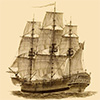 Claudine (generic)
References
| Primary Source | Australian Joint Copying Project. Microfilm Roll 89, Class and Piece Number HO11/7, Page Number 174 |
| Source Description | This record is one of the entries in the British convict transportation registers 1787-1867 database compiled by State Library of Queensland from British Home Office (HO) records which are available on microfilm as part of the Australian Joint Copying Pro |
| Original Source | Great Britain. Home Office |
| Compiled By | State Library of Queensland |
| Database Source | British convict transportation registers 1787-1867 database |
Claims
No one has claimed Richard Cottle yet.
Photos
No photos have been added for Richard Cottle.
Convict Notes

RICHARD COTTLE 1811 to 1864 Richard Cottle was arrested and placed on trial 28th March, 1829 at the Somerset Assizes. Richard was found guilty of house breaking. He was sentenced to be transported to Australia to serve 14 years in the Colony. He spent 4 months in Ilchester Gaol before his transportation to the colony of New South Wales. On the 24th August 1829, the ship 'Claudine' set sail under the command of Captain W M Heathorn. There were 283 male convicts on board. After 3 months & 12 days at sea, the 'Claudine' disembarked her passengers in Sydney on the 6th December. Richard was originally put into service with George Blaxland Esq; but was not a model prisoner. He absconded twice. [Ref: Convicts & Employers (NSW) index: 1882, 1832-1833, jan 1838-Jan 1844] As a result, his sentence was lengthened and freedom came on the 3rd February 1846. [Ref: Certificate of Freedom No. 46/133 3 February 1846] He had served 16 years, 10 months and 6 days at the pleasure of the Crown. Richard's Certificate of Freedom describes him as 5' 4 1/4" in height, with several scars, black hair, ruddy complexion and brown eyes. On 26 June 1856, Richard married Emma Salina Goodfellow (nee Fairbrother), an English immigrant who had arrived in Australia on board the vessel "Bee" that year. The ceremony was conducted by Lovick Tyrrell, who went on to become Archdeacon at the Parish of St Peter's in East Maitland, Hunter Valley. Their first child William was born on 9th July 1857. His birth was followed by the births of Richard on 9th September 1859, John 12th May 1861 & Samuel in 1864. Richard worked as a carpenter. According to his death certificate he died of acute bronchitis on 5th March 1864, at the age of 53. He was buried at Campbells Hill near Maitland, on the 6th March 1864 in Section 83, Plot 21. At the time of his death the family lived in Portland St, West Maitland. Emma remarried to Theodor Pohl 12th August 1865 and moved the family to Tenterfield. By Vic Cottle