
Summary
Personal Information
Crime
Voyage
Transportation
Robert Coward was transported on the Adelaide, departing 8th Aug 1849 and arriving 29th Nov 1849 with 304 passengers.
The 'ADELAIDE’ was built 1832 in Calcutta. Wood ship of 640 Tons. 1849 voyage: Departed London 17 Aug 1849. The convicted persons were then known as 'Exiles' because they had served part of their sentence in England and providing they were of good conduct were to be given a 'Ticket of Leave' or Conditional Pardon upon arrival in Australia. The 'Adelaide' arrived at Hobart, VDL on 29 Nov 1849 and disembarked 40 men. The ship then sailed to Port Phillip, Victoria but was refused entry and so sailed on to Port Jackson, New South Wales arriving there 24 Dec 1849. 1855 voyage: departed Portland, England on 19 April 1855, arriving Fremantle, Western Australia on 18 July 1855. 260 convicts, 1 death. The ship also carried 30 Pensioner Guards and their families.
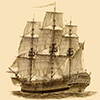 Adelaide (generic)
References
| Primary Source | Australian Joint Copying Project. Microfilm Roll 92, Class and Piece Number HO11/16, Page Number 88 |
| Source Description | This record is one of the entries in the British convict transportation registers 1787-1867 database compiled by State Library of Queensland from British Home Office (HO) records which are available on microfilm as part of the Australian Joint Copying Pro |
| Original Source | Great Britain. Home Office |
| Compiled By | State Library of Queensland |
| Database Source | British convict transportation registers 1787-1867 database |
Claims
No one has claimed Robert Coward yet.
Photos
No photos have been added for Robert Coward.
Convict Notes
Charles Coward, George Allen, Samuel Clarke, Robert Coward, Samuel Foot, Silas Haine, Edmund Ballum, taking guns and assaulting Sir E. Baker's game-keeper, at Shroton ; Salisbury and Winchester Journal, 11 March 1848. Dorset Assizes. Charles Coward, George Allen, Samuel Clarke, Robt. Coward, Samuel Foot, Silas Haine, and Edm. Ballam, were indicted for having entered certain close of land, in the occupation Sir Edward Baker, Bart. at Shroton, being armed with guns and other weapons for the purpose of destroying game, and assaulting and beating the gamekeeper of Sir Edward Baker. William Smith deposed as follows:—I am gamekeeper to J J. Farquharson, Esq. Saturday, Dec. 18th, I was out watching Long-hedge; two others were with me; about twelve o'clock we heard a gun from the direction of Ranstone ; we called up Arthur Prince and Barnard Prince ; we heard the report of other guns ; I sent after John Harvey, who is keeper to Sir Edward Baker; we went in the direction of Lower Lodge Copse; we remained at the corner; guns were firing; Harvey and his son came ; we were then seven in number; I saw 7or 8 men come out of Mr. Farquharson's copse and go into Sir Edw. Baker's copse, called Lower Well Copse we then proceeded round the copse, so get to the top of it; guns were firing; John Harvey, sen., went first, and ... ... Other confirmatory evidence having been adduced, the prisoners were all found guilty. Mr. Baron Platt, in passing sentence, thus addressed the prisoners—You have been convicted of the offence charged in this indictment. It appears by the evidence that you went out in a formidable party, armed to the teeth, to carry on the depredation which you had designed. You seem to think that taking game is no way dishonest; but be it remembered that those who begin by taking game in this manner, and going out in these desperate gangs generally end in becoming criminals of a higher order; for there is but one step from the copse to the farm-yard. You, Robert Coward, were the leader of that gang—you were in service in a good place, where you were earning your bread, and without being driven by want such an offence as this; and as you led your relation, Charles Coward, by your persuasion that night, you cannot but be taken to be the leader, and probably by your hand was inflicted that desperate blow by which that unfortunate young man has lost two of his teeth, and received injuries in his head——you are marked out signally for punishment. With regard to the others, your respective cases, though desperate, do not appear to possess the great aggravation of leading the others on. It would have been well for you, Charles Coward if you had listened to the advice of your wife on that occasion: if- would be well for all such men to listen to the good and safe and moral advice which their wives give them. You that advice; you must take the consequences, and not only you but your monitor must unfortunately be a sufferer, because she must be deprived of you, in maintaining her and her children for time. Tho sentence of the last six of you is, that you be imprisoned for twelve months, and kept to hard labour, and upon you, Robert Coward that you be transported for seven years. Salisbury and Winchester Journal, 18 March 1848.

His wife Ann and daughter Rhoda left Stourpaine in 1851 to sail to Australia on board the Sarah which left from Plymouth. Robert had a "Ticket of Leave", and was placed in Bathurst before re-joining his wife and daughter at East Maitland. He became a farmer, and his farm was sold for £1,550 after his death.
He was sentenced by Mr. Baron Platt on account of being the ringleader of a group of night poachers near Stourpaine. His wife and daughter followed him and the family settled in East Maitland in NSW. As the date of birth is unknown, I have given his date of baptism at Holy Trinity, Stourpaine.