
Summary
Personal Information
Transportation
John Curtis was transported on the Ganges, departing 31st Jul 1796 and arriving 2nd Jun 1797 with 212 passengers.
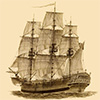 Ganges (generic)
References
| Primary Source | Prerogative Court of Canterbury Wills England & Wales, 1384-1858 |
| Source Description | This record is one of the entries in the British convict transportation registers 1787-1867 database compiled by State Library of Queensland from British Home Office (HO) records which are available on microfilm as part of the Australian Joint Copying Pro |
| Original Source | Great Britain. Home Office |
| Compiled By | State Library of Queensland |
| Database Source | British convict transportation registers 1787-1867 database |
Claims
No one has claimed John Curtis yet.
Photos
No photos have been added for John Curtis.
Convict Notes

John Curtis was probably born in Bristol England in c1749. He was married at St Phillips and Jacobs in Bristol England to Jane Purrier on 10th September 1773. John and Jane had 10 children. John practiced accountancy until the mid 1790’s. In March 1795, 45 year old John was tried and convicted at the Lent Assizes in Gloucester on 4 counts of “forging, counterfeiting, coining . . . silver coin of the realm called a sixpence”. He was transported to NSW on board the 'Ganges' arriving in June 1797. Upon arrival in Sydney John was sent to work as a dairyman at the Government Stores at Toongabbie. In 1802, he was promoted to overseer and Superintendent of the Government herd. John Curtis was granted emancipation on 4 June 1802 by Governor King. Unaware that his wife, Jane Purrier, had died from consumption in 1800, he petitioned Governor King in 1803 for permission to return to his family in England. Despite his good reputation and that Governor Patterson, George Johnston and Rev. Marsden signed his plea he never returned to England. In 1802, an Irish convict, Ann Moran arrived in NSW on board the ‘Hercules’, one of the first 100 Irish women convicts, She was assigned to work for John as a dairymaid. John and Ann eventually married in 1814 and had 5 children, not necessarily in that order. In January 1810 John was granted 80 acres of land at Liberty Plains/ Pilgrim Hill (now Chester Hill) in the District of Parramatta, Sydney. On 7th December 1812 John further petitioned the Governor, this time for a free pardon. He received the pardon in 1813. By 1821 John owned a house in Parramatta, 26 head of cattle, 2 mares and a 30 acre farm on Sydney Rd, near Haslem’s Creek, adjoining a grant of 100 acres made to Ann after John’s death. On Wednesday 12th September 1821 John Curtis died at age 71. He was taken from Parramatta into St Mary's Sydney for his funeral than taken back to Parramatta for burial. John is listed as the first Funeral in the new St Mary's Cathedral and since there was no Catholic Cemetery in Parramatta he was laid to rest in the C of E Cemetery behind St John's Church Parramatta, down by the brick fence well away from the C of E section.
John Curtis was probably born in Bristol England in c1750.John Curtis was married at St Phillips and Jacobs in Bristol to Jane Purrier on 10th September 1773. John and Jane had 11 children. John practiced accountancy until the early 1790’s . In March 1795 45 year old John was tried and convicted at the Lent Assizes in Gloucester on 4 counts of “forging, counterfeiting, coining . . . silver coin of the realm called a sixpenceâ€. Originally, when convicted he received the death sentence at Gloucester Assizes which was later commuted to transportation to Australia for life. He was transported to Australia on the Ganges and arrived on 2 June 1797. John Curtis was granted emancipation on 4 June 1802 by Governor King. John petitioned Governor King in 1803 for permission to return to his family in England, unaware that his wife Jane had died in 1800. Despite his good reputation and that Governor Patterson, George Johnston and Rev. Marsden signed his plea he never returned to England. In 1802, an Irish convict, Ann Moran arrived in NSW and was assigned to work for John as a dairymaid. She had been transported to Australi on the Hercules, arriving 1802. Very lonely, John formed an attachment with Ann and a daughter Elizabeth was born to them in 1803. They had four other children - John Joseph(c1809,), Peter (c1811), and Catherine (1814). They eventually married on 16 August 1814 at St Johns Church, Parramatta. John was granted land at Pilgrim Hillin 1810. The Villawood Migrant Hostel in Millers Rd Villawood stands on John Curtis’s original estate. By 1821 he owned a house in Parramatta, which he left to his oldest daughter, Betsy, 26 head of cattle and a mare, a 30 acre farm on Sydney Rd, near Haslem’s Creek (now Lidcombe), adjoining a grant of 100 acres made to Ann after John’s death. This land stayed in the family. Because of John’s advanced age,( he was now 72), Ann Curtis set up business for herself. On 21 April 1821 she paid into the Police Fund for 6 months brewing license and a retailing license (Wentworth Papers dip 228). John wrote his will on May 28th 1821.In his will John Curtis left everything to Ann in trust for his children, Elizabeth, James, John, Peter and Catherine. To his married daughter, Elizabeth Ready he also left 10 head of cattle. Almost six months later on Wed 12 September 1821 John Curtis died and was laid to rest in the Burial Ground behind St Johns Church in Parramatta.