
Summary
Personal Information
Transportation
Charles Dyche was transported on the Baring, departing 31st Mar 1815 and arriving 7th Sep 1815 with 302 passengers.
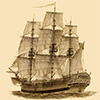 Baring (generic)
References
| Primary Source | Australian Joint Copying Project. Microfilm Roll 87, Class and Piece Number HO11/2, Page Number 198 |
| Source Description | This record is one of the entries in the British convict transportation registers 1787-1867 database compiled by State Library of Queensland from British Home Office (HO) records which are available on microfilm as part of the Australian Joint Copying Pro |
| Original Source | Great Britain. Home Office |
| Compiled By | State Library of Queensland |
| Database Source | British convict transportation registers 1787-1867 database |
Claims
No one has claimed Charles Dyche yet.
Photos
No photos have been added for Charles Dyche.
Convict Notes
… and Charles Dyche, for issuing at Ashbourne, on the l? th day of February last, forty-one forged and counterfeit one pound notes, purporting to be signed by John Gill, for Samuel Smith, Esq. and Company, for the payment of one pound each, well knowing sad notes and each them forged and counterfeit, with intent to defraud George Ball, and also the said Samuel Smith and Company; he pleaded guilty. The two prisoners received sentence death, but have since been reprieved. Northampton Mercury, 6 Aug 1814.
Committed to Derby gaol, the ? Inst. Charles Dyche,Burton-upon-Trent, charged with paying Mr. Ball, of Alstonefield, Staffordshire, farmer, on the ? th of Feb. last …. Staffordshire Advertiser, 16 April 1814.
England & Wales, Criminal Registers, 1791-1892 for Charles Dyche England Derbyshire 1814 Charged with forgery and sentenced to death Summer assizes Derby
New South Wales, Australia, Convict Records, 1810-1891 for Charles Dyche Musters Muster of Prisoners in the Colony, 1810-1820 Charles Dyche Baring .... life. Derby assizes. 8/1814 servant to Mr Lacey and in the colony New South Wales, Australia Convict Ship Muster Rolls and Related Records, 1790-1849 1815 Baring. Charles Dyche listed The Sydney Gazette and New South Wales Advertiser (NSW : 1803 - 1842) Sat 21 Sep 1816 Page 2 PRINCIPAL SUPERINTENDANT'S OFFICE, Sydney, September 14, 1816. SEVERAL Prisoners having absconded from their Employment during this Week, and particularly the undermentioned, it is hereby directed that every Exertion shall be made on the Part of the Police, as well as the Settlers and Inhabitants of the Colony, to apprehend the Persons referred to, who are suspected of the Piracy of the Brig Trial, on the Night of the 12th Instant. Charles Dyche, by trade a sawyer, late a publican at Burton upon Trent, tried at Derby in August 1814, convicted for life, 40 years of age, 5 feet 6½ inches high, a native of Staffordshire, dark complexion, brown hair, hazle eyes, arrived per ship Baring, from the Justicia hulk, and, either from infirmity or imposition, was employed a considerable time in the Invalid Gang. Still absent May 1818 https://www.sea.museum/2014/01/13/australian-pirate-tales In 1816 the brig Trial was ‘piratically seized’ in Sydney Harbour by a ‘banditti of villains’, mostly convicts employed in the stonemasons gang working on the Macquarie light tower, as well as two ‘natives of Portugal’. Trial (ship) From Wikipedia, the free encyclopedia Trial was a ship that was seized by convicts and eventually wrecked on the Mid North Coast of New South Wales, Australia in 1816. Trial was a brig owned by the merchant Simeon Lord. While waiting near the Sow and Pigs Reef in Port Jackson for good winds to take her to Port Dalrymple, she was seized by a group of thirteen convicts. The ship was sailed northwards but was wrecked some 97 kilometres (60 mi) north of Port Stephens, in what is now called Trial Bay. The survivors of the wreck constructed a new boat out of the ship's remains but, according to the local aborigines, the ship capsized and all thirteen convicts were drowned. The convicts abandoned at Trial Bay the ship's master, William Bennett, his crew, and some passengers, numbering eight or ten in total (including a woman and child). These survivors attempted to walk back to Sydney but disappeared without trace. This is how Trial Bay was named