
Summary
Personal Information
Crime
Voyage
Transportation
John Fairara was transported on the Guildford, departing 30th Nov 1814 and arriving 8th Apr 1816 with 229 passengers.
The ‘Guildford’ was built on the River Thames, England in 1810. Used as a Convict Transport ship to Australia - voyages 1812, 1816, 1818, 1820, 1822, 1824, 1827 & 1829. The ship was lost at sea near Singapore in 1831, loosing all aboard.
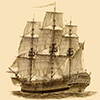 Guildford (generic)
References
| Primary Source | Irish Convict Database. |
Claims
No one has claimed John Fairara yet.
Photos
No photos have been added for John Fairara.
Convict Notes
NOTICE. — The following Prisoners having absented themselves, all Constables and others are hereby strictly required to use their utmost Exertions in apprehending and lodging them in safe Custody. John Ferrara, a Portuguese, dark complexion, thin visage, five feet six inches high, and absconded from the Guildford. Sydney Gazette, 20 Apr 1816.
Irish Convict Database. John Fairara, Guildford (2) 1816, Tried at Dublin City, 1815, 7 years. ---------------------------------------------------- Colonial Secretary Index. FERARA, John. Per "Guildford" 1816; Portuguese. 1816 Apr 9 - Escaped from the "Guildford"; listed as Ferary (Reel 6045; 4/1735 p.14) 1816 Apr 10 - To William Hutchinson re escape of Ferara & measures for apprehension (Reel 6004; 4/3494 p.451) -------------------------------------------------- Seizure of the Trial - On the night of the 12th September 1816 ten prisoners of the Guildford together with two men from the Fanny and another from the Baring made a desperate bid to escape from the Colony. They seized Simeon Lord's brig Trial, Master William Burnett, which was at anchor near the Sow and Pigs in Watson's Bay and sailed out of the harbour. They headed north and by daybreak were out of sight. Passengers on the Trial may have included Sergeant and Mrs. Annandale, William Briskland, William Probert, John Suibson, William Morgan, and two Otaheitans Touboui and Dick as well another woman. None of the passengers had been allowed to return to land. Governor Macquarie was informed at midday on the 13th and that evening about 5 o'clock the armed colonial brig Rosetta with a detachment of soldiers of the 46th regiment was sent in pursuit of the fugitive prisoners. The Rosetta returned to port a fortnight later without having found them. Their descriptions were soon posted in the Sydney Gazette: ---------------------------------------------------- PRINCIPAL SUPERINTENDANT'S OFFICE, Sydney, September 14, 1816. SEVERAL Prisoners having absconded from their Employment during this Week, and particularly the undermentioned, it is hereby directed that every Exertion shall be made on the Part of the Police, as well as the Settlers and Inhabitants of the Colony, to apprehend the Persons referred to, who are suspected of the Piracy of the Brig Trial, on the Night of the 12th Instant. John Ferrara, arrived per ship Guilford, native of Portugal and mariner, a young man of mild temper, about 5 feet 9 inches high, dark yellow complexion, and owing to his desertion from the Guilford on her arrival, was not mustered with the prisoners of that ship; he was generally in company with Manuel de Sylva, and belonged to the Boats' Crew. Sydney Gazette, 21 Sept 1816. -------------------------------------------------- On 12th January 1817 six soldiers embarked at Newcastle on the Lady Nelson commanded by Thomas Whyte to investigate a report of a wreck fifty miles to the north of Port Stephens and ascertain the fate of the vessel. (Thomas Whyte, master mariner had arrived as a convict on the Baring in 1815). They discovered part of the wreck on 14th on the beach of a deep and extensive bay in latitude 30 20' South. They learned from natives in the vicinity that the Trial had been wrecked and some of the men constructed a boat out of the materials of the wreck in which a large party once more went out to sea. Others had taken to the bush, among whom was a woman with a young child of whom not a single trace could be found. The soldiers spent several days exploring the bushland in the vicinity to ascertain the fate of the passengers. They could not positively establish whether the small vessel made from the Trial sank or only disappeared from the view of the black spectators on shore. The Captain, passengers and crew, had endeavoured to make their way towards Newcastle, but no account had been further received from them. There were rumours of a woman who had stowed away on the Trial and was living with the natives in a most distressing state, however in February 1817 Richard Palmer wrote to the Sydney Gazette regarding this woman claiming that she was a relative of his and that she had not secreted herself but had a regular clearance for the Derwent where her husband was in the employ of Simeon Lord. He offered a reward of twenty pounds to any person finding her. In 1826 an anonymous correspondent to the Monitor claimed to have knowledge of the woman who escaped from the wreck of the Trial and was sojourning with a tribe of Aboriginal natives with her daughter about 12 or 13 years old. She was married to one of the tribe by whom she had two children and acted as a midwife to the matrons of the tribe. He received his information from a native of a tribe near Liverpool Plains. Source: https://www.jenwilletts.com/convict_ship_guildford_1816.htm