
Summary
Personal Information
Voyage
Transportation
George Farrow was transported on the Hercules, departing 14th Jun 1832 and arriving 16th Oct 1832 with 204 passengers.
The "Hercules" ship was built in 1801 at South Sheilds, England. 1801 voyage from Ireland to New South Wales, Australia. Sailed via Rio de Janeiro and the Cape. A mutiny occurred just prior to their arrival at Rio - after 45 minutes it was quashed but 13 convicts had been killed. Jeremiah Pendergass was named as the ring leader and shot. 44 deaths in total on this voyage. There was then another ship, also named, "Hercules" built 1822 at Whitby, England who made 3 trips to Austraia, in 1825, 1830 & 1832.
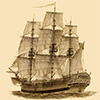 Hercules (generic)
References
| Primary Source | Australian Joint Copying Project. Microfilm Roll 89, Class and Piece Number HO11/8, Page Number 356 |
| Source Description | This record is one of the entries in the British convict transportation registers 1787-1867 database compiled by State Library of Queensland from British Home Office (HO) records which are available on microfilm as part of the Australian Joint Copying Pro |
| Original Source | Great Britain. Home Office |
| Compiled By | State Library of Queensland |
| Database Source | British convict transportation registers 1787-1867 database |
Claims
No one has claimed George Farrow yet.
Photos
No photos have been added for George Farrow.
Convict Notes

22/7/1831 Stamford Mercury Lincolnshire, England: Crown Court Attempt to poison a Child at Melton Ross. George Farrow, aged 22, was arraigned on a charge feloniously administering poison to Fanny Roberts, the infant daughter of Elizabeth Roberts, of Melton Ross, on the 31st of May last. The Prosecutrix stated that on the 1st of May she was delivered of a female bastard child, of which the prisoner was the father. On the 31st of May, Farrow came to her lodgings, and before he left, asked for permission to see the child, who was asleep in an adjoining room ; leave being granted, he went into the room, stopped about a minute, and bringing the child out with him, gave her to witness. He then left the house. Soon after the prisoner had gone, the infant was siezed with a choking, and seemed as though she could not swallow. On witness giving the breast, the infant threw curds from its stomach, some of which fell upon a pocket-handkerchief and her gown, changing the colour of both to a pinky hue. A slip forming part of the child's dress was wet with some liquid which had been administered to her. ___Mary Green, the person at whose house the prosecutrix lodged, corroborated this testimony, and further stated that on going to the prisoner' uncle, Farrow came to the door, and on being charged with having given something to the child, denied it, saying, "Indeed he had not." Mr. Wm. Ostler Nicholson, chemist, of Brigg, said that the slip was presented to him in the magistrates' room, that he might examine it in order to detect any poisonous matter in the stain upon it. In consequence of the smallness of the quantity of the liquid spilt, he could apply only one test, which was moistened blue paper. In a few minutes after the application, the paper changed to a red or yellow colour which was the appearance it would assume if oxalic acid had been used. On his cross-examination by the Judge, witness said that, though oxalic acid was not a strong poison, yet it would not require a large quantity to destroy a child ; a small tea-spoonful would be sufficient. ___Reuben Barron, shopkeeper of Wootton, stated that the prisoner came to his shop on the 21st of May, and bought half-an-ounce of toot-top stuff ; during the conversation which ensued, either the prisoner, or a person named Rands who was present asked the witness whether it was poison, to which he replied that it was if they took enough of it. __Mr. Empson clerk to the magistrates at Brigg, who took down his examination on the 4th June, stated that the prisoner's confession was quite voluntary, but after it had been read over to him he refused to sign it : it was to the following purport. "The charge is true ; did poison the child ; it did not swallow much, there was not much in the bottle ; it was oxalic acid in the bottle diluted with water ; I bought it of Reuben Barrow."__The prisoner made no defence but left himself to his lordship and the jury.___The Judge summed up the evidence at great length ; explaines to the jury the reason of the different counts in the indictment ; and instanced the decision of the twelve Judges in a case in which a prisoner had attempted to poison a child by means of poison concealed in a cake, in which their lordships' decision was that the prisoner could not be convicted, the child having spit the poison out of its mouth, and not received any on its stomach.____The Jury returned a verdict of guilty of administering poison to the child with intent to murder ; but did not consider the poison to have been swallowed. Sentence of death was then recorded against the prisoner. Ancestry Convict Indents: George Farrow was listed as 22 years old on arrival - he was illiterate, protestant, single, 5'8" tall, ruddy complexion, brown hair, grey eyes, severa warts back of right hand, wart back of fourth finger left hand. 19/12/1832 Sydney Gazette: RETURN OF ALL MALE CONVICTS ASSIGNED AND TRANSFERRED BETWEEN THE 1st AND 31st DAYS OF OCTOBER, 1832, INCLUSIVELY. 4583. Farrow George, Hercules (4), ploughs, &c., to John Rooking, Minchinbury. 1837: Assigned to Grayson Hartley at Maitland. 24/7/1839: TOL, Upper Williams River 21/4/1843: TOL cancelled for dishonest conduct, Dungog. 24/4/1834: TOL cancelled for deceitful conduct in not preventing the destruction of property 20/2/1844: TOL, Paterson.