
Summary
Personal Information
Transportation
David Gow was transported on the York, departing 30th Apr 1829 and arriving 28th Aug 1829 with 192 passengers.
The York I was built in Southwick, West Sussex, England in 1819. 429 tons. Three voyages to Australia with transport convicts - 1829, 1830 and 1832. The York II was built in Sunderland, England in 1854. 940 ton ship. Transported convicts and pensioner guards and families to Western Australia in 1862.
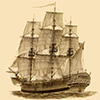 York (generic)
References
| Primary Source | Australian Joint Copying Project. Microfilm Roll 89, Class and Piece Number HO11/7, Page Number 57 (31) |
| Source Description | This record is one of the entries in the British convict transportation registers 1787-1867 database compiled by State Library of Queensland from British Home Office (HO) records which are available on microfilm as part of the Australian Joint Copying Pro |
| Original Source | Great Britain. Home Office |
| Compiled By | State Library of Queensland |
| Database Source | British convict transportation registers 1787-1867 database |
Claims
No one has claimed David Gow yet.
Photos
No photos have been added for David Gow.
Convict Notes

--00-- Marriage: 1840, 7 December: David Gow, 25, married Sarah Newland (formerly Wallis), 32, a widow, at the home of Reverend John Anderson of the Church of Scotland, Launceston (see https://stors.tas.gov.au/RGD37-1-2p75j2k). 1843, 7 September: David GOW in court in Launceston on larceny charge: "David Gow was charged with stealing four case bottles of gin, from the warehouses at the wharf. It appeared that the prisoner had very cunningly attempted to destroy the bottles when taken into custody, and had partially succeeded in his object, but sufficient of the liquor was saved to answer the purposes of justice The prisoner was remanded. David Gow was brought up for re-examination, together with another man of the name of Stephen Wilkinson, on the charge of stealing a quantity of gin from the warehouses at the wharf. The prisoner Wilkinson was suspected of having given the spirits to Gow. After hearing evidence at some length, the prisoners were remanded." (see The Teetotal Advocate (Launceston), Monday 11 September 1843, p3; Launceston Police Report)
Background to the death/capture of Benjamin Ball and Co: "REWARD! ONE HUNDRED SOVEREIGNS AND FREE PARDON! Police Department, Hobart Town, June 12th, 1838. HEREAS, Information is now before me, that Benjamin Ball, George Birrell, and John Beard, Convicts illegally at large, headed by Thomas Fisher, free by servitude, did lately forcibly enter and rob the Dwelling-house of Edmund Bryant, Esquire, at Ben Lomond, and together with one James Ely (now in custody), did barbarously and feloniously murder one Samuel Day, on or about the 9th instant, at a hut belonging to John Glover, Esquire, at Mills' Plains, near Ben Lomond, the body of the said Samuel Day, being also, much burnt;—This is to Give Notice, that I am authorised by his Excellency the Lieutenant-Governor, to offer the Reward of One Hundred Sovereigns for the apprehension of either of the above-named Offenders; and if the same be performed by a Convict, then a Free Pardon, in addition to the above Reward. M. FORSTER, Chief Police Magistrate." (see The Tasmanian, Friday 15 June 1838, p3) --00-- A BUSHRANGER SHOT! Many of our readers will probably have heard that Benjamin Ball has been shot — one of the four bushrangers for whose apprehension a considerable reward has been offered by the Government. We have obtained the following particulars of the affair, from official communications which may be relied upon as substantially correct:— On Friday afternoon last, about five o'clock, DAVID GOW [my emphasis], a prisoner of the Crown, holding a ticket-of-leave, in the employ of Mr. William Newland, at the Nile, received orders from his mistress to go to a shepherd's hut at the Nile, belonging to Capt. Barclay, to enquire about her husband. This hut is about two miles from Newland's house. GOW had a single barrel gun with him loaded with shot, intending to shoot a kangaroo on his road. When about a mile from his master's house, his dogs commenced barking; he went towards them, and found that they were barking at a hut or tent formed with a blanket; he immediately turned back, when a voice called out, 'Halloo.' GOW turned round, and a man fired at him. At this time GOW thought it was one of Mr. Bryant's men. The man who had fired then stepped behind a tree, and whilst GOW was looking to see who it was, Ball moved out from behind the tree, and fired at GOW a second time. GOW then ran off, as he had nothing but coarse powder and small shot; he ran over to Captain Barclay's shepherd's hut, and told Henry Agnew (a prisoner holding a ticket-of-leave) that he had been shot at twice by some man. Agnew asked what sort of a man he was. GOW told him that he was 'a short-set man, wore a peajacket, and had a deal of hair on his face, he had mustachios and a long beard'; he also described the blanket tent, and told him that there was a sheep hanging up by it. The man Agnew then said it might be Benjamin Ball, and arranged with GOW to meet him at his master's place, as soon as he possibly could. At about a quarter after six Agnew came down with a double-barrel gun, and they both went out together armed for the purpose of reconnoitering the spot, intending to take the bushranger at daylight the following morning. When they had proceeded about a quarter of mile they saw a man walking down by a fence, and coming towards them; it was between moonlight and twilight; they then got behind a tree, and when the man came within thirty yards of them, Agnew hailed him, and said 'Who are you?' The man replied, 'I'll let you know who I am,'— and immediately fired at them. GOW asked Agnew if they should rush him ? Agnew said, 'No; he may have a double-barrel gun.' After the man had fired at them he stepped back into some wattles, but immediately after came out, and again presented his piece, when Agnew and GOW both fired, and they heard the man call out 'Oh!' and saw him fall. They immediately ran up to him, and found that he was dead — they took up his gun, a single barrel — it had been discharged. Agnew and GOW then went down to Mr. Pyke's and told the constables what they had done — two of Mr. Pyke's men came and recognized the body to be that of Benjamin Ball, one of the men for whose apprehension £100 and a free pardon has been offered. The gun with which Agnew fired was loaded with twelve buck shot and a ball; five of the shot entered the lungs of the deceased. An inquest was held before Robert Wales, Esq., coroner, at the Police office, Morven, on the 6th of August, when a verdict was returned of Justifiable Homicide. We have no doubt that Agnew and GOW will receive a hundred pounds in money and their free pardon. — Courier." (see The Tasmanian, Friday 10 August 1838, p7)
1832-1837: His Conduct Record has numerous references to punishments such as floggings and hard labour for "insolence", "disobedience" and "absconding". 1838, 24 August: From The Tasmanian, p3: “GOVERNMENT NOTICE, No. 157 — Colonial Secretary’s Office, August 22. The Lieutenant Governor has directed the publication of the following Rewards and Indulgences, which have been granted to the undermentioned men, for their meritorious services in connexion with the pursuit and capture of Benjamin Ball and James Ely, two bushrangers of desperate character, who had been concerned in the murder of Samuel Day, and other outrages. To Henry Agnew, York 1, and DAVID GOW [my emphasis], Manlius [sic], holding tickets-of-leave, 100 sovereigns, in equal moieties, and a Free Pardon, for the capture of Benjamin Ball. To the following men for having been instrumental in the pursuit and capture of James Ely: — John Hughes, Katherine Stewart Forbes, life, Ticket-of-leave, a Conditional Pardon. John Lane, Thames, life, ditto. John Smith, Prince Regent, 14 years, a promise of Conditional Pardon on the Queen’s next birthday, if well-conducted until that period. John Smith, Lord Lyndoch, life, a Ticket-of-leave. James Boxall, William Kelly, James Ball, and John Sykes, appointed to the Police, and their cases to be submitted to the Right Hon. the Secretary of State for Tickets-of-leave. By His Excellency’s command, JOHN MONTAGU.” 1838, 33 September: David Gow's Free Pardon was granted officially on this day (see https://stors.tas.gov.au/CON31-1-15$init=CON31-1-15p163)
1828, 30 September: David GOW, 13, a shoemaker from College Wynd, Kilmarnock, Ayrshire was one of four boys convicted for theft by housebreaking. The others were: John McFie, 13, John McFarlane, 14, and James Phillips, 14. All were sentenced to transportation for 14 years (see National Records of Scotland, Reference AD14/28/345). 1828, 3 November: All four were received aboard the Justitia prison hulk, moored at Woolwich. Their ages were listed as: David Gow, 15, James Phillips, 16, John McFie, 14, and John McFarlane, 15. All were sent for transportation on 1 April 1829 (see UK, Prison Hulk Registers and Letter Books, 1802-1849). 1829: On arrival in VDL, David GOW was listed as a collier's boy, aged 17, from Kilmarnock (see https://stors.tas.gov.au/CON18-1-1$init=CON18-1-1p146).