
Summary
Personal Information
Crime
Voyage
Transportation
Alexander Green was transported on the Countess Of Harcourt, departing 16th Mar 1824 and arriving 12th Jul 1824 with 174 passengers.
Ship of 517 tons, built in India 1811. Voyages to NSW and VDL 1821, 1822, 1824, 1827 & 1828. Researchers please note that sailings direct from Ireland to Australia are not recorded under British data, and therefore not all details of people are on this web site (they are being added in, by volunteers, so please check thoroughly or send a message on community fb if you have queries).
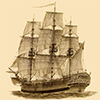 Countess Of Harcourt (generic)
References
| Primary Source | Australian Joint Copying Project. Microfilm Roll 88, Class and Piece Number HO11/5, Page Number 120 |
| Source Description | This record is one of the entries in the British convict transportation registers 1787-1867 database compiled by State Library of Queensland from British Home Office (HO) records which are available on microfilm as part of the Australian Joint Copying Pro |
| Original Source | Great Britain. Home Office |
| Compiled By | State Library of Queensland |
| Database Source | British convict transportation registers 1787-1867 database |
Claims
No one has claimed Alexander Green yet.
Photos
No photos have been added for Alexander Green.
Convict Notes

Apart from the obviously incorrect birth record, the biography in the top post is a copy and paste from: Ken Macnab, "Green, Alexander (1802–?)", Australian Dictionary of Biography, National Centre of Biography, Australian National University, https://adb.anu.edu.au/biography/green-alexander-12949/text23403 . A source for the ADB biography was a book by Ray and Richard Beckett, "Hangman: The life and times of Alexander Green, Public Executioner to the Colony of New South Wales", published in 1980. According to an article by Pamela Harrison, "The Life of Alexander Green Revisited: did he really hang 490 criminals in the colony of New South Wales?" in the Journal of the Royal Australian Historical Society, 103(2), 181–200 (2017), there are several mistakes. For example, Alexander Green did not become executioner in 1828. No one with the name of "Henry Stain" occupied the position of hangman: the chief executioner was Thomas Hughes and when he resigned in 1834 due to "the gradual decay of his sight", Alexander Green took his place, six years later than previously believed, so he hanged a lot fewer than 490 criminals. Alexander Green married, at the age of 36, a 42-year-old widow, Alien Robinson (convict, ship "Henry Wellesley" 1837), at St James Church on 15 October 1838 [1838 1694 Vol.22]. Alexander Green died on 31 August 1879. He was buried in St Patrick’s cemetery, Parramatta on 2 September 1879.

In the 1828 census, both Alexander Green and John Maher were working as labourers for the Australian Agricultural Company at Port Stephen, having been dismissed from their situations as constables.
COLONIAL SECRETARY'S OFFICE, JUNE 19th, 1827. HIS EXCELLENCY the GOVERNOR has been pleased to approve of the Following Alterations in the Police of the Colony :— Port Stephens—John Maher, per Lord Eldon, and Alexander Green per Countess of Harcourt dismissed from their Situations as Constables ; the former for Drunkeness and an Assault, and the latter for assisting the former in the Assault. By His Excellency's Command. ALEXANDER M'LEAY. The Monitor, 26 Jun 1827.
1828 Census Index. Alexander Green, age 28, C, Co. Harcourt, 1824, Life. Protestant. Labourer, A ??C? (not legible), Port Stephens district.
HIS Excellency the Governor has been pleased to approve of the following Appointments in the Police of the Colony: At Port Stephen .—To be Honorary Constables :--- Alexander Green, per ship Countess of Harcourt ; By Command of His Excellency the Governor ALEXANDER M'LEAY.

Sander Green/Grein born in 1803 as the son of Gijsbert Green/Grein and Bastiaantje van Driel CANNOT be the convict Alexander Green as this Sander died in Strijen (NL) in 1812. Another child called Sander was born soon after, but ultimately he will marry and die in Holland as well. As such, Alias 1 and 2 cannot be assumed to be valid either. source: www.wiewaswie.nl
Alexander Green was born 1803 and Christened 24 Jul 1803 in Westmaas, Zuid, Holland, Nederland The son of Gijbert Grein and Bastiaantje Van Driel. Alexander Green, flogger and public executioner, was born in the Netherlands, son of a travelling circus performer. At Shrewsbury Quarter Sessions on 16 January 1824 he was sentenced to be 'transported for the term of his natural life' for stealing a 'piece of brown stuff from a shop'. His indent read: 'Native Place: Holland; Calling: Tumbler; Age: 22; Height: 5 ft 4½ ins [163.8 cm]; Complexion: Pale, pitted; Hair: Flax; Eyes: Lt Blue'. He reached Sydney in the Countess of Harcourt on 12 July 1824. Lodged in Hyde Park barracks, Green was assigned briefly to William Hutchinson, then Samuel Marsden. He received a conditional pardon in May 1825, worked intermittently as an official scourger at the barracks and Sydney gaol, as a labourer and honorary constable at Port Stephens, and eventually as assistant to Harry Stain, the hangman. When Stain died in January 1828 Green became public executioner of Sydney Town and the colony of New South Wales at £15 14s. 2d. per annum plus accommodation within Sydney gaol. Over the next twenty-seven years Green officiated at the public execution of almost 490 people, including six women. More than 70 per cent of these were carried out in his first ten years, when harsh penal policies prevailed: under Governor Darling he hanged 170 people in 3 years 10 months, under Bourke 183 in 6 years. But under Gipps it was 10 in 8 years and under FitzRoy 27 in 8 years 6 months. The last, shortly after Denison arrived in January 1855, was the first under the Act banning public executions. Most of Green's hangings were carried out at the rear of Sydney gaol, on a high, wooden platform visible to crowds in the Rocks. On thirty-seven occasions, almost all before 1840, four or more prisoners were executed together, the largest group being eleven men in October 1828. Other notable executions were of ten bushrangers in Bathurst in November 1830, thirteen convict mutineers over two days on Norfolk Island in September 1834, seven stockmen hanged in December 1838 for the Myall Creek massacre and the Aborigines Broger and Dundalli. In classic 'Bloody Code' tradition, thirty-two of those executed by Green had their bodies 'given over for dissection', to be 'anatomised' by the surgeons. The bodies of two men executed at Goulburn Plains in November 1831 were 'hung in chains', until Bourke ordered their burial in 1833. Despite several 'botched' executions, 'the finisher of the law' appears to have been a competent hangman. He was strong, and skilled with ropes and mechanical drops and at assessing his victims. Notwithstanding occasional reports that prisoners 'died hard', or that Green swaggered and strutted, most executions went off routinely. Green associated with warders, criminals, ex-convicts and the lower orders generally. He had several minor brushes with the law, some of which involved incidents with women, but apparently he never married. He was instantly recognizable, having a livid scar down the side of his face, the result of an axe attack by a prisoner in December 1830. On 26 January 1831, his original sentence having been commuted to seven years, he became free. With the opening of Darlinghurst gaol in July 1841, Green moved into a small tenement on ground later known as Green Park, though whether it was named after him or an alderman is not clear. Most executions were now outside the main gate, the most famous being that of John Knatchbull in February 1844. From the mid-1840s Green, by now earning just over £60 a year, was in growing disfavour with the authorities for intoxication, insolence and mental instability. In early May 1855 the colonial secretary (Sir) Edward Deas Thomson ordered him committed to the Tarban Creek Lunatic Asylum. Nothing further is known; the relevant records are missing.