
Summary
Personal Information
Voyage
Transportation
Benjamin Haigh was transported on the St Vincent, departing 28th Dec 1852 and arriving 26th May 1853 with 214 passengers.
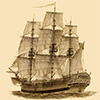 St Vincent (generic)
References
| Primary Source | Australian Joint Copying Project. Microfilm Roll 92, Class and Piece Number HO11/17, Page Number 632. --0-- Roscoe, Katy (2018), “Convicts and the Sea: the naval influence on Gibraltar Convict Establishment” at https://staffblogs.le.ac.uk/ |
| Source Description | This record is one of the entries in the British convict transportation registers 1787-1867 database compiled by State Library of Queensland from British Home Office (HO) records which are available on microfilm as part of the Australian Joint Copying Pro |
| Original Source | Great Britain. Home Office |
| Compiled By | State Library of Queensland |
| Database Source | British convict transportation registers 1787-1867 database |
Claims
No one has claimed Benjamin Haigh yet.
Photos
No photos have been added for Benjamin Haigh.
Convict Notes

WHAT BECAME OF THE OTHER THREE CO-ACCUSED? George Buckley was the first to arrive in VDL, per Maria Somes, in 1850. See his bio at https://convictrecords.com.au/convicts/buckley/george/13703. Richard Callan was also transported to VDL, on the St Vincent. See his bio at https://convictrecords.com.au/convicts/callan/richard/4516. David Casey appears to have served his time in prison in England. He was held aboard the Stirling Castle hulk, Portsmouth, listed as prisoner #2468, a weaver aged 27, single, born City of Cork. On 24 January, 1849, he was sent to the notorious Millbank prison in Pimlico, London (Prison Commission Records, 1770-1951 for David Casey; Misc.; Register of Prisoners; 1854-1865) After that, the trail goes cold.
13 December, 1853: Granted a Ticket of Leave. 3 April, 1855: ToL revoked and absent – this is the final entry in his Convict record (https://stors.tas.gov.au/CON33-1-115$init=CON33-1-115p94). --00-- Note: Another Benjamin Haigh, also from Leeds and convicted at York, was sent to VDL too. He arrived per Moffatt in 1842; born 1809 and died 1881. See his bio at https://convictrecords.com.au/convicts/haigh/benjamin/65282. --0--
IN VDL: 26 May, 1853: On arrival in VDL, BENJAMIN HAIGH was listed as convict #27939, a paper stainer, 26 years old, 5’3” tall with dark brown hair, grey eyes and a dark complexion. Tattoos included “Ann Beasly died March 23, 1845, aged 17” in a wreath on his right arm. He was single, Protestant and semi-literate. Native place: Leeds (https://stors.tas.gov.au/CON33-1-115$init=CON33-1-115p94). Family: Mother Ellen; brother William; sisters Elizabeth and Sarah – all at his native place (http://foundersandsurvivors.org/pubsearch/convict/chain/ai29108; and https://stors.tas.gov.au/CON14-1-47$init=CON14-1-47_00158_L). --0--
On Gibraltar, BENJAMIN HAIGH was described as 28 years old when convicted, sentenced to 15 years for “robbery with others and with violence and previous conviction”; once previously convicted for felony, once summarily; born in Leeds; Church of England; brown hair, hazel eyes and fair complexion, 5’3”tall; semi-literate; labourer; single; relatives/family – at Leeds (UK, Prison Commission Records, 1770-1951; Misc.; Register of Prisoners; 1810-1822 [mislabelled]). --0-- 3 February, 1853: He was sent aboard the St Vincent for transportation to VDL. Richard Callan, also at Gibraltar, was sent to board the St Vincent as well. See his bio at https://convictrecords.com.au/convicts/callan/richard/4516. --00--
Gibraltar and Bermuda were listed public works stations (and the second stage in the penal process). On Gibraltar, as “convicts worked together with free men on the dockyards, lines between them became blurred. Convicts, like seamen, were ‘easily recognised’ by ‘their swarthy, weather beaten complexions…[and] muscular well-knit frames’. The discipline on the penal settlement was also influenced by the naval department, who superintended part of the works. In the 1840s, for example, convicts were provided ‘a half gill of rum’ at 11am and 5pm, which they drank from a trough. This mirrored the daily allowance of diluted rum, known as grog, to Royal Naval seamen in the Victorian era. Convicts were also allowed to use part of their earnings, to buy goods, usually tobacco, which they were allowed to smoke in the evening in the barracks. Though official correspondence cited health reasons for grog allowance, it seems likely that the convict authorities feared insubordination if they were banned from drinking and smoking, which were provided to the sappers and dockyard workers whom they worked alongside… In 1854, the acting overseer stated that “half of the offences were committed when the men were excited by rum”. For more serious offences, convicts were flogged with a ‘cat o’nine tails’ whip against the ‘flogging mast’, and during an investigation Dr William Baly concluded that the whip which was used was an old naval cat, which was ‘much heavier than any now used in the government prison and hulks at home, or in the army.’” (Roscoe, Katy (2018), “Convicts and the Sea: the naval influence on Gibraltar Convict Establishment” at https://staffblogs.le.ac.uk/). --0--
TO GIBRALTAR: 25 January, 1849: HAIGH, BENJAMIN #1313, arrived on Gibraltar from the Stirling Castle hulk at Portsmouth per Appoline. He was held on the Europa hulk (UK, Prison Commission Records, 1770-1951; Misc.; Register of Prisoners; 1810-1822 [mislabelled]). --0--
NEWSPAPER REPORT OF TRIAL: 17 July, 1847: CROWN COURT, Thursday, July 15. HIGHWAY ROBBERY NEAR LEEDS. GEORGE BUCKLEY, 19, RICHARD CALLAN, 24. BENJAMIN HAIGH, 20, and DAVID CASEY, 26, were charged with having, on the 12th of May last, at Leeds, feloniously and violently assaulted John Smith, and stole from his person a hat, a frock coat, a pair of trowsers, and other articles his property. Mr. Ellis and Mr. Wheelhouse were for the prosecution; the prisoners were undefended. The prosecutor this case, John Smith, is a tailor, and resides in Bowling-street, Oxford-street, London. On the day in question he arrived in Leeds by railway, having left London for a short time to visit his mother, who lived at Horton, which is from three to four miles from Leeds. The prosecutor, after spending a few hours in Leeds, about half-past nine o'clock in the evening proceeded to walk to Horton, to the residence of his mother. He had with him a bundle containing his wearing apparel. When he had got about mile and a half from Leeds, he saw four men, who were walking on the middle of the high road, coming towards him. He was proceeding on the causeway, and when the four men came up, two of them separated from the other two, went upon the causeway, and met the prosecutor full in the face. They closed upon him, seized hold of his bundle, and a struggle ensued. The prosecutor made stout resistance, upon seeing which the two men on the road went up on the causeway to the assistance of their companions. The four now set upon the prosecutor, dragged him into the middle of the road, seized hold of the bundle, but in the struggle the prosecutor was enabled to regain possession of it. He was then knocked down, when one of the prisoners put something over the mouth of the prosecutor, to prevent his giving an alarm, but doing which he happened to get his finger into the mouth of the prosecutor, who bit it very severely. The prosecutor having got his mouth at liberty, shouted out lustily ‘Help’ and ‘murder’. His screams attracted the attention of two females, who were coming from Horton to Leeds. They saw the prosecutor on the ground struggling with four men. Armstrong and McKinnon which are the names of the two women, called out loudly for help, and eventually a person came up. As soon as the prisoners saw assistance near at hand, they left the prosecutor on the ground, and went the direction of Leeds, taking with them the prosecutor's hat, which they afterwards threw into a field at a short distance from the place of robbery. The prosecutor became insensible for a short time, as he had received many bruises about the head and face and other parts of his person by the fists of the prisoners. The person who came up was police-officer Thompson, who, on Armstrong and McKinnon pointing out the men who had committed the outrage, pursued them and succeeded in capturing Buckley and Callan on the road, but the other two at that time escaped. Soon after twelve o'clock, the same night, however, Thompson apprehended the other two prisoners Casey and Haigh in the Kings' Arms public-house in Leeds. On Callan's hand being examined there was a wound on one of his fingers, which he said he had received in a scuffle the previous afternoon at the Robin Hood public-house, but the wound appeared to have been more recently inflicted than to warrant the truth of his statement. The prosecutor identified all the prisoners, with the exception of Casey, not being able to speak positively as to him. Buckley, Haigh, and Callan stated in defence that they had had a quarrel the day of the robbery with a man, and that they attacked the prosecutor believing him to be the person with whom they quarrelled, but that they had no intention of robbing him. Casey denied being one of the party. The jury returned a verdict of Guilty against all the prisoners. Previous convictions of felony having been proved against Callan, Casey, and Haigh, they were severally sentenced to be transported for fifteen years. Buckley, no previous conviction being proved against him, was sentenced to seven years’ transportation.” (Yorkshire Gazette, p6-8). --00--
TRIAL: 10 July, 1847: Richard Callan, 24, George Buckley, 19, Benjamin Haigh, 20 and David Casey, 26, were convicted at the York Assizes and all except Buckley, were sentenced to 15 years’ transportation for “robbery with violence and a previous conviction felony”. In Callan’s case, he had a prior conviction for burglary (12 months’ jail). George Buckley received the lesser term of 7 years for “robbery in company with violence” and no previous conviction/s (England & Wales, Criminal Registers, 1791-1892 for Richard Callan; England; Yorkshire - North Riding; 1847). --0--
OCCUPATION: He was a paper stainer, not a parchment maker (the only option listed above that was close!). According to the Dictionary of Old Occupations, a paper stainer "coloured paper by machine or by hand. The paper was commonly used as wallpaper." (https://www.familyresearcher.co.uk/glossary/Dictionary-of-Old-Occupations) --00--