Summary
Personal Information
Voyage
Transportation
Michael Harrington was transported on the Hougoumont, departing 10th Oct 1867 and arriving 9th Jan 1868 with 281 passengers.
875 ton ship was built at Moulmein in 1852. http://www.australiangeographic.com.au/journal/on-this-day-in-history-australias-last-convict-ship-docks.htm ---------------------------- Incorrect Image ....This is a four masted steel hulled Barque in the drawing , im surprised Australian Geo didn't do a bit more research on this .......The Hougoumont was a works ship on the Forth Bridge Project in 1885 ....the one potrayed as a drawing in Aust Geo is the later version of this ship.....the photograph i have attached is the correct and original convict vessel. --00-- 1867 "The hired convict ship Hougoumont, which has been taken up by the Government for the conveyance of a numerous party of convicts to Freemantle, Western Australia, left the Nore on October 1, and proceeded down Channel, after receiving on board 150 convicts from the establishments at Chatham and Millbank. The convicts from the Chatham establishment, at St. Mary's, embarked from the dockyard on board the paddle-wheel steamer Adder, Mr. W. J. Blakely, and were in charge of a numerous party of convict guards and wardens, all heavily armed. Among the convicts shipped were a party of fifteen Fenians, who were engaged in the late conspiracy in Ireland, together with the officers and crew convicted of scuttling the ship Severn, and some others who have achieved notoriety from their crimes. The Fenian convicts, like the remainder of the prisoners, were chained together in gangs, but it was observed that they were kept apart from the other convicts in a portion of the vessel by themselves. The steamer Petrel also took down a number of convicts from the establishment at Millbank for shipment on board the Hougoumont, in charge of a strong escort and convict guard. On Tuesday, October 8th, the Hougoumont arrived in Portland roads. Shortly before midday ninety convicts were marched down to the Government pier at Portland under a strong escort of the 12th Light Infantry. The party included twenty-three Fenian convicts, among whom it was said, was Moriarty. The Government steamer employed in the breakwater service was used for conveying the convicts on board the Hougoumont transport ship. The convicts were chained together on embarking, and on board the steamer a strong guard of marines from her Majesty's ship St. George was formed, and saw the convicts safely placed on board the Hougoumont. The Governor of the penal settlement at Freemantle, Captain Young, is on board the Hougoumont, and returns in that ship to his sphere of duty after paying a visit to his native land." Source: Sydney Morning Herald, Thu 19 Dec 1867, p4, English Shipping, available on Trove at https://trove.nla.gov.au/newspaper/article/28608271?searchTerm=hougoumont.
 Hougoumont
References
| Primary Source | Australian Joint Copying Project. Microfilm Roll 93, Class and Piece Number HO11/19, Page Number 264. Western Australia, Convict Records, Registers(128/40-43), Reel No.FCN42 and General Register, Ref.No. ACC1156/R16. |
| Source Description | This record is one of the entries in the British convict transportation registers 1787-1867 database compiled by State Library of Queensland from British Home Office (HO) records which are available on microfilm as part of the Australian Joint Copying Pro |
| Original Source | Great Britain. Home Office |
| Compiled By | State Library of Queensland |
| Database Source | British convict transportation registers 1787-1867 database |
Claims
No one has claimed Michael Harrington yet.
Photos
No photos have been added for Michael Harrington.
Convict Notes

1866, September: Michael Harrington was one of seven soldiers taken from Mountjoy and sent to England where they were received on 4 September, at Pentonville jail, in north London. Their transfer was noted in the Pilot newspaper, of 29 September, p3: “Departure of Fenian Prisoners.— Thomas Darragh, Charles McCarthy, James Reilly, Thomas Chambers, Robert Cranston, Michael Harrington, and Joseph O’Reilly, the soldiers who were recently convicted of treason-felony, left Kingstown on Tuesday morning, per the steamer Connaught, Capt. Kendal, for Holyhead, en route to Pentonville Penitentiary, there to undergo their several terms of imprisonment. They were handcuffed two and two, and were in charge of Captain Farquharson, Deputy Governor of Pentonville Prison, and Chief Warder Maguire, of Mountjoy. A party of marines from the Royal George, under Lieutenant Tier, formed the escort to Holyhead.” (https://newspapers.bc.edu/) Completed in 1842, Pentonville was built “for the detention of convicts sentenced to imprisonment or awaiting transportation” (https://en.wikipedia.org/wiki/HM_Prison_Pentonville). Michael Harrington was listed as prisoner #3951. Two weeks later, a notation was added to his record: “Parchment Certificate of Discharge from Army Rec’d 19.9.66 & attached to Penal Record” (U.K. Prison Commission Records, 1770-1951; Pentonville 1866-1869). --0--
1866: Michael Harrington, prisoner #7298, was confined in Mountjoy prison in Dublin – but the date of his admission is not certain. As noted above, there is a mug shot from his time there (https://digitalcollections.nypl.org/items/510d47dc-975f-a3d9-e040-e00a18064a99). --0-- 1866, 7 July: Court martial – Michael Harrington was convicted for mutinous conduct and desertion and sentenced to penal servitude for life “on the evidence of a private to whom he confessed he was a Fenian, drinking to the health of the ‘“M.C’s” or the “M.B.’s”, or something like that.’ There was evidence that Harrington solicited men to take the Fenian oath. Another private testified to meeting Harrington at Fenian meetings when ‘Erin my country’ and ‘My heart beats for thee’ were sung.” (Pease, p34) --0—
1866, January: Private Michael Harrington deserted from the 61st Regiment of Foot in Dublin. Born in Goleen, County Cork, where his father was a merchant, he was an apprentice boat builder (Fennell & King 2006). Pease (p15) says while he had been given “the advantage of a liberal education”, his “tastes were for the army, and in 1844 he enlisted in the 61st Foot. He served through the Punjab war, and also through the Sikh war under Sir Hugh Gough, who made the now famous exclamation, ‘Magnificent Tipperary!’ Mr. Harrington also took part in the Sepoy war, and then returned home with his regiment. He joined the Fenian organization in 1864 and was very active in enlarging its membership. In January, 1866, being in danger of arrest and desirous of freedom to take a more active part in the projected uprising, he deserted." --0-- 1866, 12 March: Despite deserting, Michael Harrington remained in Dublin where he was arrested on suspicion after the suspension of the Habeas Corpus Act, and identified as a deserter. On the Registry of military prisoners at the Richmond Bridewell jail, in Dublin, he was recorded as prisoner #13, aged 39, 5’9” tall with brown hair, grey eyes and a sallow complexion, a baker, born at Macroom, a Catholic who could read and write and with the 61st Regiment of Foot. On 16 March he left the jail having been “given to escort [from the] 61st Regt” (Ireland, Prison Registers, 1790-1924; Dublin; Richmond (Bridewell) 1855-1878). --0--
Michael Harrington was among 17 Irish soldiers serving in, or deserters from, the British Army who were transported to WA aboard the Hougoumont. Of these so-called military Fenians (Irish Republican Brotherhood/IRB prisoners), eight – including Private Harrington – had been given life sentences. In 1869, all of the military Fenians from the Hougoumont were ignored when the House of Commons granted free pardons to Fenian convicts in WA, England and Ireland. But, in 1876, six Fenian “lifers” in jail at Fremantle were dramatically rescued and taken to freedom in America aboard the whaling barque Catalpa. Thousands of words have been written about their escape, including the 1897 account, “The Catalpa Expedition”, by Zephaniah Walter Pease; “The Fenians and Australia c1865-1880”, a PhD thesis by Keith Amos (1987); Eamon McDermott’s (1988) article “Martin Hogan and the Catalpa Rescue”, in The Old Limerick Journal, Vol 23, pp112-124; “John Devoy’s Catalpa Expedition”, edited by Philip Fennell & Marie King (2006); and Peter FitzSimons’s (2019) “The Catalpa Rescue”. With so much of the life of Michael Harrington already on public record, only a few key dates and details are listed below, from sources such as prison records, books, newspaper reports and various linked online sites. --00--
PHOTO of MICHAEL HARRINGTON: Taken in 1866 while he was an inmate of Mounjoy Prison, Dublin, and labelled Image ID 1111433. It is available online at https://digitalcollections.nypl.org/items/510d47dc-975f-a3d9-e040-e00a18064a99 (see The New York Public Library Digital Collections, 1866).
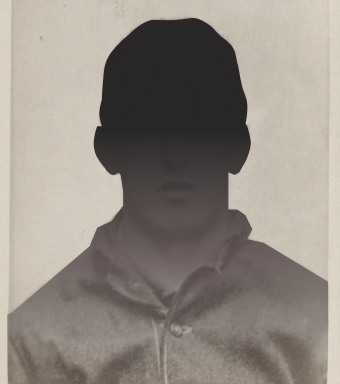
Convicted: 7 July 1866, Life, Single, aged 40, Laborer, can read and write Crime: Mutinous conduct and Desertion
The Great Australian Escape https://en.wikipedia.org/wiki/Catalpa_rescue Well documented ,published and promoted escape of the Militant Fenian band of convicts from Perth