
Summary
Personal Information
Voyage
Transportation
Henry Harvey was transported on the Malabar, departing 14th Jun 1819 and arriving 30th Oct 1819 with 172 passengers.
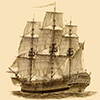 Malabar (generic)
References
| Primary Source | Australian Joint Copying Project. Microfilm Roll 88, Class and Piece Number HO11/3, Page Number 180 |
| Source Description | This record is one of the entries in the British convict transportation registers 1787-1867 database compiled by State Library of Queensland from British Home Office (HO) records which are available on microfilm as part of the Australian Joint Copying Pro |
| Original Source | Great Britain. Home Office |
| Compiled By | State Library of Queensland |
| Database Source | British convict transportation registers 1787-1867 database |
Claims
No one has claimed Henry Harvey yet.
Photos
No photos have been added for Henry Harvey.
Convict Notes
Tried and convicted at the Old Bailey on 2nd December 1818 for staeling a basket, he was sentenced to transportation for 7 years. Left England on 17th June 1819. Ship:- the 'Malabar' sailed with 173 male convicts on board of which 3 died during the voyage. Arrived on 30th October 1819. Henry's brother Robert was tried at Suffolk, only a few months later and sentenced to transportation for life. He was also transported on 'Malabar'. On arrival he was assigned to George Palmer at Pemberton Grange In the colony, Henry married Sarah Foulcher the daughter of convicts Robert Foulcher ('Albermarle' 1791) and Elizabeth Hutchins ('Indispensible' 1796), the couple had a daughter, Mary born in 1824. Henry was assigned as a government servant to his new wife before establishing himself as a miller and shopkeeper in Parramatta. On receiving his ticket of leave in 1825, he built a shop and house in Church Street, North Parramatta and alongside it a bakery. Determined to become a man of property, he erected a 'neat row of houses' on land in George Street, acquired land in Smith Street and built the steam mill to process his own flour. He built a steam operated mill between 1840 and 1841 at the foot of Smith Street Parramatta and commenced producing flour. Substantially built, the building was originally four stories in height but was reduced to two stories at some later date. The brick walls, which were painted, were reported as having been over twelve inches thick indicating that they were built in English or Flemish bond, both styles being common at the time. Deep in plan with a hipped roof (later of corrugated iron), the building gave the appearance that it was solidly built. Window openings were considered small in proportion to the wall area. The building was known in turn as Harvey's Mill, Dare's Mill, French's Mill, The Cumberland Fruit Preserving Company's Works and finally The Parramatta Ice Works. The mill stood originally on land leased to John Fullagher for 21 years in June 1823. Like most leases at the time, Fullagher had the right to convert it to a grant by erecting a building on it to the value of £1000 or more or by purchase for the payment of 21 years quit rent at a reasonably determined price. Evidently these conditions were not fulfilled as a grant of the allotment was made to Harvey on 26 October 1840. Having extended his financial borrowing's too far in the 1840's depression he was saved by his friends Houison and Payten who loaned him money by way of a mortgage over his properties. He successfully weathered the storm and continued dealing in real estate, particularly town allotments. He purchased MacDonald's farm in Ermington, eventually selling it to William Payten, his son-in-law. He owned Pemberton Grange also but finally settled at Morton House in East Parramatta for his remaining years. Having no sons, he invited his nephew Henry Granger, also a baker, to operate the bakery business, eventually selling the property to him; the bakery was sold by Granger's descendants in the 1960's to Fielder's Flour and demolished in 1969.[ Henry died on 27th January 1874 at Parramatta North age 76, having become a substantial citizen of Parramatta, despite his convict past. Sydney Morning Herald Wednesday 28th January 1874 p. 1 On the 27th instant, at his residence, Morton House, Parramatta North, Henry Harvey Esq., in the 77th year of his age. Sarah died on 29th May 1876 at Parramatta age 78.
Census 1822: Harvey, Henry, convict, Malabar, life, government servant to his wife, Parramatta. Harvey, Sarah, born in the colony, wife of H. Harvey, Parramatta. Census 1825: Harvey, Henry, free by servitude, Malabar, 1819, 7 years, shopkeeper Parramatta. Harvey, Sarah, born in the colony, wife of Henry Harvey, Parramatta. Census 1828: [Ref H0621] Harvey, Henry, 32, free by servitude, Malabar, 1819, 7 years, dealer, Parramatta. [Ref H0622] Harvey, Sarah, 30, born in the colony. [Ref H0623] Harvey, Mary, 4, born in the colony. The brother Robert was recorded living at Port Macquarie, [Ref H0620].
In the colony, Henry married Sarah Foulcher the daughter of Robert Foulcher (Convict, Albermarle, 1791) and Elizabeth Hutchins (Convict, Indispensible, 1796). The couple had a daughter, Mary born 1824.
Amazingly, Henry's brother Robert was tried at Suffolk, only a few months later and sentenced to transportation for life. He was also transported on "Malabar".
HENRY HARVEY was indicted for stealing, on the 21st of November, one basket, value 2 s., the goods of James Crump. WILLIAM VANLENT. I am constable of Clerkenwell. On the 21st of November I was passing along Goswell-street-road , and saw the prisoner and another person looking about Crump's window. I watched them and saw the prisoner go into the shop and come out in about three minutes, with a basket in his hand. When he got a little way off he began to run. I went into the shop, found they had missed a basket, pursued, and took him down a gateway with it. He threw the basket down, and tried to get away. (Property produced and sworn to.) GUILTY . Aged 20. Transported for Seven Years. Second Middlesex Jury, before Mr. Recorder.