Summary
Personal Information
Voyage
Transportation
Thomas Hassett was transported on the Hougoumont, departing 10th Oct 1867 and arriving 9th Jan 1868 with 281 passengers.
875 ton ship was built at Moulmein in 1852. http://www.australiangeographic.com.au/journal/on-this-day-in-history-australias-last-convict-ship-docks.htm ---------------------------- Incorrect Image ....This is a four masted steel hulled Barque in the drawing , im surprised Australian Geo didn't do a bit more research on this .......The Hougoumont was a works ship on the Forth Bridge Project in 1885 ....the one potrayed as a drawing in Aust Geo is the later version of this ship.....the photograph i have attached is the correct and original convict vessel. --00-- 1867 "The hired convict ship Hougoumont, which has been taken up by the Government for the conveyance of a numerous party of convicts to Freemantle, Western Australia, left the Nore on October 1, and proceeded down Channel, after receiving on board 150 convicts from the establishments at Chatham and Millbank. The convicts from the Chatham establishment, at St. Mary's, embarked from the dockyard on board the paddle-wheel steamer Adder, Mr. W. J. Blakely, and were in charge of a numerous party of convict guards and wardens, all heavily armed. Among the convicts shipped were a party of fifteen Fenians, who were engaged in the late conspiracy in Ireland, together with the officers and crew convicted of scuttling the ship Severn, and some others who have achieved notoriety from their crimes. The Fenian convicts, like the remainder of the prisoners, were chained together in gangs, but it was observed that they were kept apart from the other convicts in a portion of the vessel by themselves. The steamer Petrel also took down a number of convicts from the establishment at Millbank for shipment on board the Hougoumont, in charge of a strong escort and convict guard. On Tuesday, October 8th, the Hougoumont arrived in Portland roads. Shortly before midday ninety convicts were marched down to the Government pier at Portland under a strong escort of the 12th Light Infantry. The party included twenty-three Fenian convicts, among whom it was said, was Moriarty. The Government steamer employed in the breakwater service was used for conveying the convicts on board the Hougoumont transport ship. The convicts were chained together on embarking, and on board the steamer a strong guard of marines from her Majesty's ship St. George was formed, and saw the convicts safely placed on board the Hougoumont. The Governor of the penal settlement at Freemantle, Captain Young, is on board the Hougoumont, and returns in that ship to his sphere of duty after paying a visit to his native land." Source: Sydney Morning Herald, Thu 19 Dec 1867, p4, English Shipping, available on Trove at https://trove.nla.gov.au/newspaper/article/28608271?searchTerm=hougoumont.
 Hougoumont
References
| Primary Source | Australian Joint Copying Project. Microfilm Roll 93, Class and Piece Number HO11/19, Page Number 264 |
| Source Description | This record is one of the entries in the British convict transportation registers 1787-1867 database compiled by State Library of Queensland from British Home Office (HO) records which are available on microfilm as part of the Australian Joint Copying Pro |
| Original Source | Great Britain. Home Office |
| Compiled By | State Library of Queensland |
| Database Source | British convict transportation registers 1787-1867 database |
Claims
No one has claimed Thomas Hassett yet.
Photos
No photos have been added for Thomas Hassett.
Convict Notes


TRANSPORTATION: 1867, late September: Taken from Chatham jail to board the convict ship Hougoumont, Thomas Hassett was, according to newspaper reports, one of 15 Fenians sent from Chatham for transportation to WA: “The hired convict ship Hougoumont, which has been taken up by the Government for the conveyance of a numerous party of convicts to Freemantle, Western Australia, left the Nore on October 1, and proceeded down Channel, after receiving on board 150 convicts from the establishments at Chatham and Millbank. The convicts from the Chatham establishment, at St. Mary's, embarked from the dockyard on board the paddle-wheel steamer Adder, Mr. W. J. Blakely, and were in charge of a numerous party of convict guards and wardens, all heavily armed. Among the convicts shipped were a party of fifteen Fenians, who were engaged in the late conspiracy in Ireland, together with the officers and crew convicted of scuttling the ship Severn [only two were on the Hougoumont – Thomas Berwick and Lionel Holdsworth, each sentenced to 20 years for fraud], and some others who have achieved notoriety from their crimes. The Fenian convicts, like the remainder of the prisoners, were chained together in gangs, but it was observed that they were kept apart from the other convicts in a portion of the vessel by themselves. The steamer Petrel also took down a number of convicts from the establishment at Millbank, for shipment on board the Hougoumont, in charge of a strong escort and convict guard. On Tuesday, October 8th, the Hougoumont arrived in Portland roads. Shortly before midday ninety convicts were marched down to the Government pier at Portland under a strong escort of the 12th Light Infantry. The party included twenty-three Fenian convicts, among whom it was said, was Moriarty [true, but not Mortimer Moriarty, a Fenian leader who returned to Ireland from Canada to lead the uprising in Killarney. This was Bartholomew Moriarty.]. The Government steamer employed in the breakwater service was used for conveying the convicts on board the Hougoumont transport ship. The convicts were chained together on embarking, and on board the steamer a strong guard of marines from her Majesty's ship St. George was formed, and saw the convicts safely placed on board the Hougoumont. The Governor of the penal settlement at Freemantle, Captain Young, is on board the Hougoumont, and returns in that ship to his sphere of duty after paying a visit to his native land.” (Sydney Morning Herald, 19 Dec 1867, p4, at https://trove.nla.gov.au/newspaper/article/28608271). --00--
BRANDED with a “D”: At some point during his incarceration in England, Thomas Hassett was “branded”, a practice continued by the British until 1871, according to Phillip Hilton’s thesis, “Branded with a D on the left side”. Until 1829, any soldier could be branded but after that it was reserved for deserters. Hilton says “deserters were... 'branded’ with a D on their left sides as a means of humiliating offenders” (2010, p140 at https://eprints.utas.edu.au/17678/2/Hilton_Thesis.pdf), but he doesn’t say how the branding happened and there are conflicting versions among writers. For example, Peter FitzSimons refers to barbaric fire brandings, while others such as Amos (1987) describe painful tattooing using India ink. A post on the Irish Garrison Towns website (http://irishgarrisontowns.com/d-for-deserter/) says both practices were used – hot iron/fire branding being the preferred method until around the mid-19th century when it was replaced by tattooing: “A new device was created to mark the soldiers’ skin with ink, or even gunpowder... The large, blunt points [on the branding tool] hint at the pain it caused as a spring mechanism forced these points into the skin. Regimental doctors described the practice as ‘cupping’." Simon Barnard’s book “Convict tattoos: Marked men and women of Australia” (p55) has several shots of one of these spring loaded, brass “branding instruments” manufactured by John Weiss & Sons of The Strand, London. Barnard says they were used by medical officers to tattoo army deserters. The head of the “Weiss’ Invention” model holds 47 needle points arranged in the shape of a “D”, all clearly capable of puncturing human skin. So, too, the points of the brass instrument featured on the Science Museum of London’s website. Made by Savigny & Co of London, its adjustable points “still bear traces of ink” and were pushed through the skin by a spring-powered mechanism. Savigny & Co was “better known as a major manufacturer of surgical instruments in the 1700s and early 1800s”. The Museum says branding was abolished in 1829, except for army deserters. After this, the mark was tattooed on the body until the practice was abandoned altogether in 1879 (https://collection.sciencemuseumgroup.org.uk/objects/co155799/branding-tool-for-marking-deserters-london-england-1810-1850-branding-tool). But Thomas Hassett’s branding in 1866 or 1867 was – according to Peter FitzSimons’ scenario in “The Catalpa rescue” (pp53-54) – by fire, and similar to the scene he paints for fellow Fenian and former soldier Martin Hogan: “The British authorities running the fierce penitentiaries of mainland England don’t miss the opportunity to give their military deserter guests a souvenir to remember them by. Forever. With little preamble, and no explanation – for the prisoner has no rights and may be treated as a beast of burden – prison guards bustle Martin Hogan into a small room, lay him out on a long plank of wood that comes up from the floor at a 45 degree angle, and has an inverted triangle at the top. While his legs are now manacled to the bottom of the plank, each arm is splayed along one side of the triangle and also manacled. The one-time champion swordsman of the British Army would have made short work of the lot of them in a free fight. But they are too many, and after months of incarceration, he is too weak. He is at the mercy of merciless men. To his horror now, one of the warders roughly opens his shirt to leave his chest entirely exposed. A call goes up, and Hogan will ever after remember the horror of what happens next. In comes the prison blacksmith, with a bucket of hot coals. Out of the bucket he pulls a red-hot branding iron, on the end of which is the letter ‘D’... Before Hogan can even protest at the barbarity of it all, there is an instantaneous sensation of scorching heat … and the smell of burning skin. His own... Forevermore he will bear the large letter ‘D’ over his heart. This is what we do to Deserters. In their own prisons, Michael Harrington, Thomas Hassett and James Wilson are equally so branded.” --00--
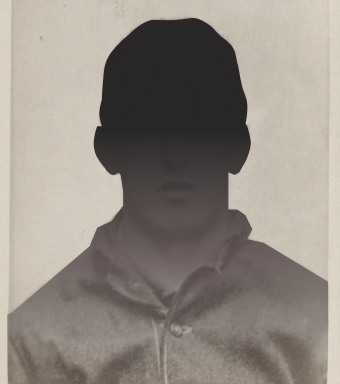
PRISONS contd: 1866, August: Thomas Hassett was admitted to Mountjoy jail in Dublin. A mug shot that may have been taken there can be seen at https://upload.wikimedia.org/wikipedia/commons/6/6c/ThomasHassettConvict.jpg About two months later, he was sent to England -- most likely by boat from Kingstown (modern day Dún Laoghaire) to the major port of Holyhead, in Wales. --0-- 1866, 24 October: Thomas Hassett was transferred to Pentonville jail in north London. Completed in 1842, Pentonville was built “for the detention of convicts sentenced to imprisonment or awaiting transportation” (https://en.wikipedia.org/wiki/HM_Prison_Pentonville). At Pentonville, he was listed as prisoner #4058, a Roman Catholic and “known Fenian”, sentenced to penal servitude for life. Also transferred with him were Martin Hogan, Patrick Keatinge, James Wilson, Thomas Delaney, James McCoy, John Shine, William Foley, John Donoghoe and John Lynch – all listed as known Fenians (UK, Prison Commission Records, 1770-1951; Pentonville Prison; Register of Prisoners 1866-1869). --0-- 1866, 1 November: He was sent from Pentonville jail to Millbank at Westminster in London, which served as a holding facility for convicted prisoners before they were transported to Australia. There he was listed as prisoner #2552, 23 years old, a carpenter, and Private 1st Battalion 24th Regiment, service no.1005. He was described as single, Roman Catholic, able to read and write imperfectly, and sentenced to life – penal servitude, for desertion and mutinous conduct, on 15 August 1866 by General Court Martial, Dublin. A notation says a parchment copy of his Discharge, received 20 December 1866, is attached. His behaviour was described as “good”; his next of kin was his brother John Hassett, of 10 Pottery Row, Myrthyr Tydvil, Wales (UK, Prison Commission Records, 1770-1951, Millbank Prison; Register of Prisoners 1866-1867). Note: By the 1850s, Pentonville and Millbank were places for all male convicts to serve “their probationary term (now reduced to 9 months), after which they would be transported or sent to a public works prison. This function continued more or less (notable exceptions including the reception of military prisoners in the 1860s…) until the decision to remove it from the convict prison system in 1885” (https://www.prisonhistory.org). --0-- 1867, 21 May: After 6½ months at Millbank, he was transferred to Chatham prison, east of London at St Mary’s Island in Kent. Chatham, a public works prison for male convicts, was notorious for riots in the 1860s (https://www.prisonhistory.org). --0—
1866, 15 August: At his court martial at the Royal Barracks, in Dublin, Private Thomas Hassett “defiantly pleaded guilty to treason” (Pease, p50). He was initially sentenced to death, “but the penalty was subsequently commuted to life imprisonment, and was finally further commuted to penal servitude.” Newspapers in both hemispheres covered the various Fenian trials and courts martial: 1. From the Pilot, Boston, Vol 29, No 44, 3 November 1866, p3: “The Recent Courts-Martial—The Sentences. At half-past two o’clock on Tuesday the 92nd Highlanders, the 83rd Regiment, and the 5th Dragoon Guards were paraded in full dress in the Royal-square, Royal Barracks, for the purpose of hearing read the sentence of ten men convicted by the recent courts-martial. They formed three sides of a square. Brigadier-General McMurdo, C. B., commanding. Brigade-Major Knipe read the sentences. Six of the prisoners belonged to the 5th Dragoon Guards, two to the 24th Regiment, one to the 61st, and one to the 60th Rifles. The sentence upon Privates Patrick Keatinge, James Wilson, and Martin Hogan, of the 5th Dragoon Guards, and Private Hassett, of the 24th Regiment, is imprisonment for life; Drummer McCoy, of the 61st Regiment, to 15 years’ penal servitude; Private Thomas Delany, of the 5th Dragoon Guards, to 10 years’ penal servitude; Private Giles, of the 60th Rifles, to 10 years; and Private Lynch and Foley, 5th Dragoon Guards, and Maloney, 24th Regiment, to five years’ imprisonment. The sentences having been read, the prisoners were removed to the military prison, Arbour hill, where they were dressed in the convict clothes. They were afterwards conveyed to Mountjoy Convict Prison in the van. (https://newspapers.bc.edu/) --0-- 2. From: The Brisbane Courier, 9 January 1867: “The suppression of Fenianism in the Army.—The sentences upon the ten men convicted at the late courts-martial in Dublin [in August 1866] have been promulgated. The sentence upon privates Patrick Keatinge, James Wilson, and Martin Hogan, of the 5th Dragoon Guards, and private [Thomas] Hassett, of the 24th Regiment, is imprisonment for life; drummer [James] McCoy, of the 61st Regiment, to fifteen years' penal servitude; private Thomas Delany, of the 5th Dragoon Guards, to ten years' penal servitude; private Giles, of the 60th Rifles, to ten years; and privates [John] Lynch and [William] Foley, 5th Dragoon Guards, and Maloney, 24th Regiment, to five years' imprisonment. The sentences having been read, the prisoners were removed to the military prison, Arbour- hill, where they were dressed in the convict clothes. They were afterwards conveyed to Mountjoy Convict-prison in the van, which was escorted by a troop of the 5th Dragoon Guards… – Dublin Cor. of the Times.” (https://trove.nla.gov.au/newspaper/article/1278902) Note: Arbour Hill prison, on a small site north of the River Liffy and near the site of the old Provost prison, was built in 1845-1848 as a military detention centre (PD O’Donnell, in the Dublin Historical Record, Vol 25, No 4, p145). --0--
1841-1866: Born in Doneraile in County Cork, Thomas Henry Hassett was a carpenter by trade. Pease (1897) says in 1859 he joined the Phoenix National and Literary Society, formed by members of the Young Ireland movement “for the liberation of Ireland by force of arms” (Wikipedia). Afterwards, Pease (pp12-14) says, “he went out with the Papal Brigade to Italy, serving through the brief campaign. In 1861 he enlisted in the 24th Regiment of Foot, and in 1864 was sworn into the Fenian Brotherhood. He, in turn, swore in 270 members of his regiment. It was his suggestion that the contemplated fight begin in Dublin by seizing the Pigeon House, which contained twenty-five thousand stand of arms. When it was considered to be in danger a guard of ninety men was placed upon it, of which number sixty were Fenians. Hassett proposed a plan of capture to his superiors in the organization, but it was rejected on the ground that they were not ready for a general fight. In January, 1865, Mr. Hassett was informed while on sentry that he would be arrested for Fenianism as soon as he came from his post. He concluded to leave at once, and, marching into the Fenian rendezvous in full uniform with his gun on his shoulder, presented himself to John Devoy. ‘Most of the fellows who desert for Ireland's sake,’ said he, ‘come to you empty-handed, but here am I, ready for work.' [John Boyle] O'Reilly presents a dramatic picture of Hassett's appearance at the meeting of organizers, whither he marched from the sentry post. He says, ‘Private Hassett walked off his post and, shouldering his rifle, proceeded confidently through the streets of Dublin, in which a soldier with arms is never questioned. It was ten o'clock at night, and it so happened that Hassett knew of a certain meeting of organizers, and other “boys on their keepin'”, which was being held that evening. Thither he bent his steps, reached the house, and, knowing how it was done, gained admission. The rebels sat in council upstairs; faces grew dark, teeth were set close, and revolvers grasped when they heard the steady stamp on the stairs and the “ground arms” at their door.’ A moment after, the door opened and the man in scarlet walked into the room; all there knew him well. With full equipments, knapsack, rifle and bayonet, and sixty rounds of ammunition, Hassett had deserted from his post and walked straight into the ranks of rebellion. He was quickly divested of his military accoutrements; scouts went out to a neighboring clothing-store, and soon returned with every requisite for a full-fledged civilian. The red coat was voted to the fire, and the belt and arms were stored away with a religious hope in the coming fight for an Irish republic. The next evening one more was added to the group of strangely dressed men who smoked and drank their pots-o'-porter in a certain house in Thames Street. The newcomer was closely shaven and had the appearance of a muscular Methodist minister. The men were all deserters, and the last arrival was Hassett. Vainly watching for the coming fight, the poor fellows lived in a mysterious misery for several weeks. It is hard to realize here now the feeling that was rife in Dublin then. At last one of the deserters was recognized in the streets by the military informer — Private [Patrick] Foley, of the 5th Dragoons — tracked to the rendezvous, surrounded by the police, and every one captured." --0--
Thomas Henry Hassett was among 17 Irish soldiers serving in, or deserters from, the British Army who were transported to WA aboard the Hougoumont. Of these military Fenians (Irish Republican Brotherhood/IRB prisoners), eight – including Private Hassett – had been given life sentences. In 1869, all of the military Fenians from the Hougoumont were ignored when the House of Commons granted free pardons to Fenian convicts in WA, England and Ireland. But, in 1876, six Fenian “lifers” in jail at Fremantle were dramatically rescued and taken to freedom in America aboard the whaling barque Catalpa. They were: Sergeant Thomas Darragh and Privates Robert Cranston, Michael Harrington, Thomas Hassett, Martin Hogan and James McNally Wilson. Thousands of words have been written about their escape, including the 1897 account, “The Catalpa Expedition”, by Zephaniah Walter Pease; “The Fenians and Australia c1865-1880”, a PhD thesis by Keith Amos (1987); Eamon McDermott’s (1988) article “Martin Hogan and the Catalpa Rescue”, in The Old Limerick Journal, Vol 23, pp112-124; “John Devoy’s Catalpa Expedition”, edited by Philip Fennell & Marie King (2006); Thomas Keneally’s (1999) “The Great Shame”; and Peter FitzSimons’s (2019) “The Catalpa Rescue”. With so much of the life of Thomas Hassett already on public record, only a few key dates and details are listed below, drawing from prison records, books, newspaper reports and various linked online sites. --00--

The Great Australian Escape https://en.wikipedia.org/wiki/Catalpa_rescue Well documented ,published and promoted escape of the Militant Fenian band of convicts from Perth