
Summary
Personal Information
Voyage
Transportation
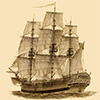
Michael Hayes was transported on the Kinnear, departing 10th Jul 1842 and arriving 23rd Oct 1842 with 174 passengers.
Built 1834 at Yarmouth. Wood barque of 369 Tons. (Register of persons transported is not yet completed - currently being listed.) 1842 Voyage. OCT. 23. - Arrived the barque Kinnear, Lidderdale master, from Dublin 10th July, with 180 male prisoners, Surgeon Superintendent - G. J. Fox, Esq. The guard consists of Captain Bull (with Mrs. Bull, 4 children, and 1 female servant), and 30 rank and file of the 99th Regt., - 4 women, and 6 children. Colonial Times (Hobart) 25 Oct 1842.
 Kinnear (generic)
References
| Primary Source | Tasmanian Records. |
Claims
"2nd great grandfather, Michael came to Victoria aboard the City of Hobart in Nov 1854."

Photos
No photos have been added for Michael Hayes.
Convict Notes

On the night of the 13th inst., Acting-Constable Lewes and party of the Bilboa station, proceeded to Bloomfield, county Tipperary, and after a fatiguing march of 15 miles through the mountains, succeeded in arresting Thomas Kennedy, one of the party who fired at John Ryan Luke, of Bilboa, on the night of the 2d May last, and killed the horse on which he rode. Kennedy's accomplice in the same act, Michael Hayes, was arrested by this efficient Constable, and was tried at the last Special Commission held at Clonmel, and sentenced to transportation for life. Limerick Chronicle, 20 July 1842. Thomas Kennedy was transported to VDL on the Navarino in 1842, arriving 1843.
2nd great grandfather, his son John Michael later came to Victoria, they both settled near Ballan, . Michael finally rec'd a ticket of freedom, and he came to Victoria aboard the City of Hobart in Nov 1854. Michael died 19th May 1886
The Kinnear Indent lists Michael's relations: Remarks: W. Mary. M, Ellen; 7 B, Jno, Martin, Thos, Morris, Pat, Edmund, Timothy; 1 S, Mary at N.P.
Michael was tried at the Clonmell Cpecial Commission. ---------------------------------------------------- SHOOTING WITH INTENT TO KILL. Michael Hayes was next indicted for having, on the 2d of last May, at Rahernager, in this county, fired at John Ryan (Luke), with intent to kill him. John Ryan (Luke) ?? remembered the 2d of May last being in company with Mr. Kenna, Mr. Bradshaw's agent, going to settle with some of the tenantry of Mr. O'Grady ; a shot was fired from behind the ditch on the turn of the road; the witness rode a horse into which seven slugs were driven; the prisoner at the bar was the man who fired the shot; it was then about nine o'clock in the morning; as soon as the first shot was fired the prisoner, who had a short gun in his hand, jumped off the ditch and said to another who was behind it, and had a fowling-piece, - fire again; he (the witness) then pelted away as hard as he could, and the second shot took no effect; the horse he rode carried him about two hundred yards further, and then dropped dead. Michael Kenna deposed that he was with the last witness, who was about three or four yards before; he heard the noise of the first shot, but did not see the smoke; he rode a pony, and did not get off until the second shot was fired; he then threw himself off the pony, and went to a man's house named Kennedy. The case for the crown closed. THE DEFENCE. Constable Lalor deposed that he saw the prisoner at the bar, and his brother, driving pigs on the day in question to the fair of Silvermines but about six o'clock in the morning the prisoner got behind a ditch, and on the witness asking his brother whether he went to the fair, he said he did not; that was near Hayes's house, and about a mile and a half from where the shots fired at Ryan. Mat Whologan proved that he went with Hayes, and his brother, to the fair of Silvermines about seven in the morning, and did not leave his company until they went to the fair. Thomas Hayes was next examined, and corroborated the evidence of Whologan. The case then closed, and Chief Justice Doherty having charged the jury, they returned a verdict- Guilty. Freeman’s Journal, 5 July 1842. ---------------------------------------------------- Shooting at with intent to kill— Michael Hayes, John Pound, Thomas Gleeson, Thomas Stapleton ; Limerick Chronicle, 22 June 1842. -------------------------------------------------- SENTENCE OF THE PRISONERS, The Chief Justice then said— John Pound Michael Hayes, Cornelius Flynn, Patrick Dwyer, Thomas Stapleton, and Thomas Gleeson, it my painful duty — a duty which I unwillingly perform, but which I look upon matter of absolute necessity—to pronounce upon you severally and respectively the punishment which the law's and the court award against you severally for the crimes of which you have been respectively convicted. They are crimes, one and all of them, of no ordinary enormity; they are crimes, for which in point of moral guilt you, one and all, and respectively, have brought upon yourself—the atrocious crime of murder. It has pleased God to spare your souls from the pollution of that offence ; but I cannot shut my eyes, nor can any person who has heard and considered your respective trials, have a doubt left upon their minds that though death has not ensued as a consequence upon the commission of the crimes of which you have been guilty, it had been through the mercy of God, not owing to your own forbearance, that that dreadful crime not visited upon you all. What country (said his lordship, in conclusion) do we live in that such crimes as those committed in the open light of day? You don’t even find it a matter that required, in the perpetration of your deeds of darkness, that they should be shrouded in the clouds of night. You perpetrate deeds, whose darkness in themselves you consider to be quite sufficient for your protection. How long do you think that the country can submit to the continuation such crimes, executed in such a manner, and such numbers and, I may say, without reason of any kind? There has not been at this special commission as well I now recollect, a single crime, however enormous, for which a shadow of pretence or provocation could legitimately assigned. I am not aware that any single instance there has been a shadow of proof, or an attempt at a statement, that the crime which you have been induced to commit has has been the consequence of the poverty of your circumstances, or the operation of distress. I don’t mean to say taut any such circumstances could be any justification whatever, though it might, perhaps, be in a compassionate mind some little palliation and excuse for your guilt; but there is not a single case of man brought here tor trial on whose behalf a suggestion of that kind has been attempted. Nor does it appear that one of the various criminals that have been tried and convicted at this commission have any of them been in such a state, that it could be suggested with truth that their offence was attributable to want and to distress. I have now done—it is late; but besides that, the public, I do hope, are now aware of the various occasions in which the actual state of the country has been laid before them from the bar and the benefit, that there can no mistake now existing as to what the public duty is. I will say, therefore no more about it; we had ample evidence, by the manner in which the jury here have done impartial justice, that when called for by a clear demonstration of guilt, there will be no want of energy or vigour on the part on the part of the gentry, of the yeomen, of the well disposed of all classes in this country, to join together and put it down by force, if necessary, acting always under the guidance and direction of those laws, which, with the blessing of God, will never be defeated by lawless attempts, by outrage, or by violence. I have now done, except to pronounce upon you, respectively, the sentence which the court pronounces—which the law pronounces as the proper consequences of the conviction for those crimes of which you have been severally tried and convicted by a jury of your countrymen. You, Michael Hayes, you, John Pound, you, Cornelius Flinn, you, Patrick Dwyer, you, Thomas Stapleton, and you, Thomas Gleeson, are severally and respectively sentenced by the court to transported for the term of your respective natural lives. The commission then terminated. Weekly Freeman’s Journal, 9 July 1842. TIPPERARY SPECIAL COMMISSION. On Tuesday evening six convicts, sentenced at this commission to transportation, arrived at Kingstown, and were put board the transport ship the Kinneir, at present lying in that harbour. The unfortunate men were conveyed Clonmel in caravan, and were guarded by six country policemen. There was an order for lodging them in Kilmainham gaol previous to embarkation, but it appeared that that was countermanded, and they were taken direct to the vessel. Weekly Freeman’s Journal, 9 July 1842. ADM 101/40/5. Medical and surgical journal of Her Majesty's convict ship Kinnear between 31 May 1842 and 23 October 1842 by George J Fox, Surgeon Superintendent, during which time the said ship was conveying prisoners from Ireland to Hobart Town Van Diemen's Land. Folios 21-23: Michael Hayes, aged 30, convict; case number 2; disease, dyspepsia. Put on sick list, 13 September 1842. Discharged 30 September 1842. ---------------------------------------------------- Kinnear Indent: https://stors.tas.gov.au/CON14-1-17$init=CON14-1-17P32 and https://stors.tas.gov.au/CON14-1-17$init=CON14-1-17P33 6741. Michael Hayes, tried at Tipperary, Special Commission, 28 June 1842, Life, age 30 height 5ft 4 ¾, catholic, can read and write, married, 2 children. Offence: Firing a shot at a man on a horse, named John Ryan, County Limerick. Surgeon’s Report: Good. Trade, F. Labourer. Native place, Tipperary. Remarks: W. Conduct Record: https://stors.tas.gov.au/CON33-1-28$init=CON33-1-28p83 T.L 6.8.1850. 21 June 1852, C.P. Approved.