
Summary
Personal Information
Voyage
Transportation
Thomas Higgins was transported on the Chapman, departing 25th Mar 1817 and arriving 26th Jul 1817 with 202 passengers.
The Chapman ship was built at Whitby, England in 1777, rebuilt in 1811 and refurbed in 1815. Tonnage: 558 The 1817 voyage from Ireland to New South Wales, Australia is not yet fully recorded on this web site - currently being updated. A mutiny occurred on this voyage with 7 men killed and many others wounded. (200 male convicts embarked) 1824 voyage from England to Van Diemen's Land (180 male convicts). 1826 voyage from England to Van Diemen's Land (100 male convicts, 2 escaped). Royal Staff guards & 19 private passengers.
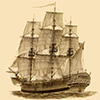 Chapman (generic)
References
| Primary Source | New South Wales, Convict Ship Muster Rolls and Related Records, 1790-1849; 1817; and New South Wales, Convict Indents, 1788-1842; Bound Indentures 1814-1818 |
Claims
No one has claimed Thomas Higgins yet.
Photos
No photos have been added for Thomas Higgins.
Convict Notes
1871 - General Hospital Hobart Admission dates: 11 Mar 1871 Ship: Jupiter Place of origin: Dublin Date of death: 05 Apr 1871 Cause of death; Morbus Cordis [Morbus cordis – definition Unspecified heart disease]
To Tasmania per Ship; Jupiter 1817 No; 37 1855 - Marriage Permissions Birmingham, Mary Ann. Ship/free: Duchess of Northumberland Marriage to: Higgins, Thomas. Ship/free: Free [Jupiter 1817] Permission date: 6 Mar 1855 1860 - Queen's Orphan School Application for admission 3 April 1860; CHILDREN; Higgins, Thomas. Aged; 9 years & 1 month Higgins, Henry. Aged; 6 years & 10 months FATHER; Thomas Higgins, Residence; Invalid Depot Brickfields Depot. MOTHER; Mary Ann Birmingham Residence; Bathurst Street. Had been cohabitating with another man but professes to be anxious to lead a virtuous life. Has 2 other children Higgins, Robert. Aged 3 years & 6 months Higgins, Samuel. Aged 1 year 1860 - Orphan Number: 2535 Orphan: Henry HIGGINS. Age when admitted: 3yrs Orphan: Thomas HIGGINS. Age when admitted: 4yrs 10mths Mother: BIRMINGHAM, Mary Ann Father: HIGGINS, Thomas Mother's ship: D Nothumberland Father's ship: Jupiter Date admitted: 17 Apr 1860 Date discharged: 26 Sep 1861 Institution(s): Queens Orphan School Discharged to: mother References: SWD6, 26/3, 26/7, 27 1864 - Orphan Number: 2539 Orphan: Robert HIGGINS. Age when admitted: 3yrs 6mths Orphan: Samuel HIGGINS. Age when admitted: 1yr Mother: BIRMINGHAM, Mary Ann Father: HIGGINS, Thomas Mother's ship: D Nothumberland Father's ship: Jupiter Date admitted: Apr 1864 Institution(s): Queens Orphan School Remarks: unknown whether admitted to Queens Orphan School References: SWD26/3, 26/7, 27 1841 - Thomas Higgins. 5 April 1871

IN VDL: By 1822, he had a Ticket of Leave but forfeited it as well as his position of Constable for drunk and disorderly behaviour and beating Thomas Cain (https://stors.tas.gov.au/CON31-1-18$init=CON31-1-18p17). In 1828, he was found not guilty of a charge of stealing a boat sail. 1840: Thomas Higgins received his Free Certificate #157 (https://stors.tas.gov.au/CON31-1-18$init=CON31-1-18p17).
IN NSW: 1817: On arrival in NSW, Thomas HIGGINS was listed as a labourer from Dublin; 5’2½” tall with a dark, pale complexion, black hair and brown eyes. He was listed as 19 years old on the Chapman’s Muster Roll, and 18 years old on the NSW Convict Indents (New South Wales, Convict Ship Muster Rolls and Related Records, 1790-1849; 1817; and New South Wales, Convict Indents, 1788-1842; Bound Indentures 1814-1818). 9 August, 1817: He was #24, one of 70 convicts (69 from the Chapman and one from the Pilot) who were forwarded to VDL per the brig Jupiter. --00--
THE VOYAGE: 10 July, 1816: Thomas Higgins was flogged, receiving 24 lashes for "making a noise", according to evidence given at an inquiry in NSW after the Chapman’s arrival. Oxley Batman’s article, below, sheds some light on the culture aboard that led, not only to such a severe punishment, but to the deaths of 12 men and serious wounding of up to 30 more during the Chapman’s voyage to NSW. Batman says the cause was (an unsubstantiated) “fear” of mutiny: “‘The Hell Ship’ — The Tragic Story of the ‘Chapman’ Convict Ship 1817 By Oxley Batman (1952) Fear caused the death of 12 men in the transport Chapman. The transport Chapman was a reasonably happy ship, as convict transports went, until a convict named Michael Collins decided to feather his own nest. Hoping for favors, he told Captain Drake a lurid story of a planned rising among the convicts. That story began a series of tragic events which ended in 12 convicts being killed, 30 wounded, and the others starved and ill-treated for the remainder of the voyage. Governor Macquarie’s secretary, Mr. Campbell, mustered the convicts when the Chapman reached Sydney in July, 1817, and was appalled by the reports he heard from them. Macquarie ordered an immediate inquiry and wrote to the authorities in London. Macquarie placed equal blame on Captain Drake, his officers, Surgeon Dewar (the officer in charge of the convicts), and Lieutenant Busteed, commanding the military escort. These officers, he alleged, had shown “wanton, indiscriminate and unprovoked cruelty toward the miserably unfortunate men entrusted to their charge.” The evidence at the inquiry was shocking. From the time Collins told his story, the seamen and soldiers were in a state of panic. Every unusual noise, and many quite common noises, from the convict quarters were magnified into mutinies. At last, on April 18, a cook on sentry duty near the convicts shouted an alarm. Seamen and troops rushed to arms and fired indiscriminately through the bulkheads. Terry Kiernan, a convict, told the court of inquiry that most of the convicts were in bed, and all were in irons when the shooting began. He heard third mate Baxter shout, “Fire away, boys, and kill them all.” The firing continued for an hour and a half, although the convicts had cried for quarter from the fourth shot. Even then the frightened crew would not enter the convict quarters. The wounded and dying convicts, floundering in the dark, bled and suffered until dawn when a strong armed party ventured in. The dead were thrown overboard, the wounded taken to hospital and the remainder double-ironed. Four men, arbitrarily declared to be ringleaders of the ‘mutiny’, were taken to the deck and chained in the open. One of them, William Leo, said Dewar told him they would be kept there in all weathers until they reached Port Jackson. The seamen put a rope around Leo’s body and threw him over board. Eleven times they let him sink under the water, then dragged him back again. When he was dragged back on the deck, more dead than alive, soldiers pricked him with bayonets until the sergeant intervened. On top of all that, he was given 42 lashes — and Dewar ordered brine to be poured on his bleeding back. Later, Leo said, during a second minor panic, Baxter ran up with a musket and shot one of the four chained men on deck. The ship’s log supplied damning evidence of brutality. The day after the shooting, Captain Drake flogged 10 convicts — and one of his crew who was seen talking to a convict. He punished 46 more convicts the next day; 33 convicts the day after that. Thomas Higgins was given 24 lashes for telling a seaman, ‘It isn’t over yet.’ Thomas Hall got 24 lashes for ‘rattling his chains and alarming the sentry.’ There was another panic one night when a few convicts rolled in bed at the same time causing a rattling of chains. The following night someone shouted an alarm, ‘The convicts are rushing aft.’ Another convict was killed and four wounded before Drake and Busteed could check their frightened men. The officers used the excuse of a mutiny to put the convicts on half rations—and pocket the profits. Dewar told Kiernan, ‘If any one complains about rations I won’t flog him. I’ll shoot him.’ Kiernan was flogged for breaking a link of his chains so that he could remove his trousers and get rid of vermin. He was flogged for speaking to Dewar in Latin. Only two or three men of the 200 convicts on board escaped a flogging during the voyage, he said. In desperation, to allay the fears of the crew, the convicts asked that they be chained to a cable at night. This, they thought, would free them from the incessant flogging. But convicts who coughed on the chain were flogged (Baxter said they had ‘insinuating coughs’). If they rattled their chains unduly they were flogged; if they wedged their clothes on the chain to stop rattling they were flogged. The frightened crew would not give the convicts knives to eat their meat. Some broke off the handles of their tin mugs to cut up their tough meat-and were flogged for it. The ship’s officers blamed each other. Lieutenant Busteed said Captain Drake was drunk ‘a good deal of the time’, and had no control over his men. On the night of the firing, they said, Drake ‘seemed very far gone in liquor.’ Captain Drake said he had no doubt a ‘most horrid conspiracy’ existed among the convicts. Busteed’s troops, he added, ‘were in a mutinous and disorderly state and my own crew could not be trusted.’ They had fired without orders, he complained, and would not stop when he intervened. Campbell returned a withering report. Apart from the killings, the floggings and starvation — the convicts were on half-rations for three months — the chaining of 76 men to a cable all night was inhumane, he said. ‘Let a humane man figure to himself a fellow-creature, double-chained to a cable and handcuffed for three months — except when he was taken off to be flogged,’ Campbell wrote. ‘This was inhuman, barbarous, and cruel beyond all reason — even a mutiny could not justify it.’ But the other members of the court — Judge-Advocate Wyld and Police Magistrate D’Arcy Wentworth — reported to Macquarie that no criminal charges could succeed against the officers of the Chapman. Macquarie, who had intended to send them all home in irons to face trial for murder, wrote bitterly to London about the inadequacy of the report. Captain Drake took action to sue Macquarie for unlawfully detaining his ship during the inquiry. Macquarie sent Busteed and Dewar home under open arrest, together with three soldiers and a group of convict and military witnesses. But he [Macquarie] knew no one would be adequately punished. Convict lives were cheap in 1817.” (https://remembering-the-past-australia.blogspot.com/2017/06/the-hell-ship-the-chapman-1817.html)
IN IRELAND: 17 February, 1816: Thomas HIGGINS, a labourer from Dublin, was convicted of stealing wearing apparel and sentenced to 7 years’ transportation (New South Wales, Australia Convict Ship Muster Rolls and Related Records, 1790-1849; 1817; Chapman). Thomas Higgins was held at Newgate prison in Dublin and sent from there to board the Chapman. —00—