
Summary
Personal Information
Crime
Transportation
John Jauncey was transported on the Asia 1, departing 4th Feb 1833 and arriving 27th Jun 1833 with 231 passengers.
Built by A Hall & Co at Aberdeen in 1818. A Brig of 536 tons. (Wikipedia) 1830 - Voyage. Asia from Ireland. Female Convict Ship; Stead; Master, Alexander Nesbit M.D. Surgeon Superintendent. Arrived in Sydney Cove 13 Jan 1830. Mustered - 186. Died on Voyage - 3. Disembarked - 1. Total Embarked - 200
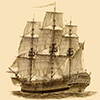 Asia 1 (generic)
References
| Primary Source | Australian Joint Copying Project. Microfilm Roll 90, Class and Piece Number HO11/9, Page Number 18 |
| Source Description | This record is one of the entries in the British convict transportation registers 1787-1867 database compiled by State Library of Queensland from British Home Office (HO) records which are available on microfilm as part of the Australian Joint Copying Pro |
| Original Source | Great Britain. Home Office |
| Compiled By | State Library of Queensland |
| Database Source | British convict transportation registers 1787-1867 database |
Claims
No one has claimed John Jauncey yet.
Photos
No photos have been added for John Jauncey.
Convict Notes

John Jauncey, son of James Jauncey and Mary Burrop was christened at Colwall Green on 6 Oct 1816. In 1831 his father was convicted of stealing and transported to Australia on the Lady Harewood in 1832. Mary was left destitute with seven young children. In 1832 at the age of 15 James was convicted of house breaking and sent to Australia as a convict. Worcester Quarter Sessions for 1832 for John Jauncey John was tried at Worcester (aged 15) on 3 Mar 1832 (just before his father was transported). His charge was housebreaking and he was sentanced to transportation for life. He sailed on "Asia I" departing Downs about Mar 1833 arriving at Port Jackson 5 Aug 1833. He had originally been sentenced to death but this was commuted to transportation for life. The year before he had been tried for stealing a watch and had been flogged. John arrived in the colony in 1833. The NSW Government Gazette 1837, Vol II p. 514, in a "list of male convicts assigned from the 26th June to 7th July 1837" the following entry is noted. W Curlewis.....Murray.............1 knife-boy I groom" Through this assignment John gained employment with Walter Curlewis, father of George and Septimus Curlewis, on their property at Ravenswood near Goulburn, near the headwaters of the Shoalhaven River. In the spring of 1833 a small party lead by George Curlewis set out on horseback with a pack- horse carrying supplies, and travelled from the Sydney area down as far as the Goulburn area, which was at that time about the limit of white settlement, looking for suitable sheep country. Accompanying the party was John Jauncey, at the time a youth of 17 who had been appointed convict overseer of Ballalba by the Curlewis. John Jauncey in 1886 described the countryside near Bega; “I first saw and passed through this beautiful Bega country about 53 years ago (1833). I wasthen a youth of 17, and one of a party in search of suitable sheep country. There were at thetime in the way of homesteads only two cattle stations in this neighbourhood – Cowper’s, insight of where we are now (near Yarranung), and Badgery’s, near where Mr Manning’s vineyard is situated, and there were only two men at each station.” (Comments by John Jauncey on his 70th birthday in 1886, and recorded by A.B. Jauncey, 1918). The party came on from Goulburn through Braidwood (unsettled then) and came down to the coastal area and subsequently returned. At that time there were two cattle stations in the Bega area with a couple of stockmen living at each. They were not alone in their trespassing beyond the "limits of location" proclaimed by the Government; many, many others did likewise, so much so that Governor Bourke soon realized that it was both "impolitic and impossible to restrain dispersion". When John returned with stock in February 1834, the block they had selected had been occupied by Dr Wilson's men from Braidwood. He crossed Wallaga lake and settled at Tilba-Tilba, not far from the lake shore. It was a squattage lease from the Crown. Stockman John Jauncey became one of the first settlers in the area when he established his run east of where Cobargo now sits at Narira in the late 1830s (the local Aborigines called the mountain 'Cubago'). When Commissioner of Crown Lands John Lambie visited "Tolbedelbo" - as he termed it - in January 1840, he found three people there, one of whom was Walter, superintending the run (althrough Lambie lists George as the licence-holder). The "improvements" consisted of a slab hut and a stockyard, and the run carried 300-odd cattle and a couple of horses. Janucey describes in some detail the two expeditions to find this run, and a third, in 1834, to take down from Krarwaree the sheep to stock,it, but fails to mention its name. It is apparently the same run as that listed from 1840 to 1843 in the Register of Licences - in hand-writing invariably difficcult to dexipher - as "Camagan", "Carnagan" or Carnagee" and that which appears in John Lambies' returns for 1840 as "Carcan Valley". its exact location and boundaries are no less difficult to determine. By the time that boundaries were being set down on paper, as in the Government Gazettes of 1848, this run had disappeared, apparently being absorbed into surrounding runs in 1841-2. The licences for the Snowy River run are all made out to G C Curlewis, and when Lambie visited in February 1840 he found a Donald McLellan in charge. Walter Curlewis was superintending the run when it was finally broken-up and the sheep over-landed to Gippsland in the late 1840s. Jauncey claims that in setting up the Snowy River run, they were the first to take sheep across the Snowy. At the time of Lambie's visit, the run was carrying some 4000 sheep, and as that, given the farming methods of the day, necessarily involved a large labour-force of shepherds and hut-keepers, Lambie's listing of no less than 16 persons in residence, and 7 huts and a slab cottage is understandable. This region, with its cold wet winters, may not have been the best location for a sheep run. At one of his Monaro runs - and this seems likely - George lost more than a third of a flock of over 400 ewes, in the winter of 1837, to an infectious disease then termed influenza or catarrh, and he attributed this to "exposure to great sudden extremes in temperature", having days in which the thermometer is at 70, succeeded by a sharp frost at night." On July 4th 1834 Governor Bourke, in a dispatch to the Home Office, described the TwofoldBay district in more glowing terms; “Already the flocks and herds of the colonists spread themselves over a large portion of thissouthern country…. The excellence of the pastures in the part of the colony I am describing has induced graziers to resort to it; and much of the fine wool, which is exported to England, is taken from sheep depastured on vacant Crown Land beyond the limits assigned for the location of settlers.” (Watson 1923 and cited by Bayley 1942) In Goulburn he met and married Mary Carew on 11 Apr 1842. Their first child John was born in on 22 January 1843 at Windellama. At this time George Curlews decided to develop Tilba-Tilba as a heifer station, and John Jauncey was appointed the first station manager. He and his wife and baby son, John, and also his father, James, came to Tilba-Tilba in April, 1843, and they were the first white people to sleep on Tilba country. They lived on what was later known as the John Young Estate property more out towards the sea. Among the hands were two aboriginal brothers Tom and Dick Toole. They lived in a primitive home for seven years, and then in a better one built alongside for another seven years. Jauncey managed an out-station for his employers until 1843. He had discovered by this time that the land was unsuitable for sheep, but very suitable for cattle and pig-raising. In 1843 John and Septimus Curlewis set up a joint venture in dairying which continued until 1846. John and Septimus established a big herd of milking short-horn cattle, with John having a percentage of the heifer calves for himself. Labour was no problem at that time, and he milked a big herd of cows which grazed everywhere as there were no fences at first. He had primitive buildings and made cheese, which he transported by bullock team to where Bermagui now is. There was no port, but sailing ships called in fairly regularly to some convenient spot and unloaded meagre supplies and took on cheese and anything else like bacon and corn. Their second child, Mary was born at Tilba-Tilba on 5th June, 1844, and was the first white child born on Tilba. She subsequently became Mrs John Otton Snr of ‘Numeralla’, Bega. In 1846 they were bought out by William Campbell of Moruya and John stayed on as manager. The next child, William, was born at Tilba on 1st June, 1847, and was the first white boy born at Tilba. John reminisces of one trip in 1848 that his wife, and a black boy, each carried a child on horseback, across the tidal inlets, then all open to the sea, to Moruya for baptism, by chance hearing that a visiting clergyman would be there. In those times, Tilba was an isolated place, on the road to nowhere; no churches, no schools, no postal communication. “I only say ----man --- pass through" John and Mary lived at Tilba-Tilba until 1856 when the property was sold to Thomas Forster. At the time Bega was being surveyed for settlement, which was something John has been looking forward to for a long time in the hope of procuring a permanent home near civilization. With the sale of Tilba they moved to Bega. All this family history goes back before the days of selections which only came into law in the Colony in 1861. John stated in later years that he had no idea that the law about free selections in 1861 would ever have become law, or he would have thought twice about leaving Tilba Tilba. In 1863 John was involved in a legal dispute with the Government over land around the Bega area that was reported in the Sydney Morning Herald on 10 Jul 1863. “Mr. LEARY asked the Secretary for Lands, .".When! do the Government, intend to pay John Jauncey for landpurchased at Bega by the Government ?" Mr. ROBERTSON, said when John Jauncey conveyed the land to the Government the Government would be willing to pay for it. '”