
Summary
Personal Information
Crime
Voyage
Transportation
William Henry Jeffery was transported on the Marquis Of Hastings, departing 19th Aug 1825 and arriving 3rd Jan 1826 with 154 passengers.
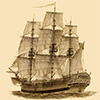 Marquis Of Hastings (generic)
References
| Primary Source | His Own Man W H Jeffery by Andrew Read,Curtin ACT 2002 National Library Australia Colonial Secretaries Letters,CGS905,4/1997,letter no 28/8402 |
Claims
No one has claimed William Henry Jeffery yet.
Photos
No photos have been added for William Henry Jeffery.
Convict Notes

WILLIAM HENRY JEFFERY was born in St John at Hackney, London, England on September 17, 1804, the son of James William Jefferis and Esther Davis. He was christened at St John of Hackney Church, London on October 7, 1804. St John at Hackney was an inner borough of London. In the 19th century it was noted for its poor housing and high crime rate. It's proximity to the City of London and the railway brought rapid development from the mid 19th century and for a time was a fashionable residential area. Very little is known of William during his early life other than he was indentured as a 12-year-old apprentice Bread and Biscuit Maker, probably in London. We do know that William moved to Bristol, an important dock and shipyard area in South West England, after completing his training whe he as about 16. William's family were in the area, no doubt his father utilising his trade as a sailor. It is known that he found lodging in Old Market Street together with Louisa Orchard who he was passing as his wife. At first he found employment in his trade but as the price of bread rose, people began making their own and William fell on hard times. It is in Bristol in November, 1824 that William joins the company of John Duffety and George Sims which proves to be his downfall. On December 1, 1824 they decided to raid the mansions of the rich. The trio burgled four houses but were only convicted for the raid on Clift House the residence of Dowager Lady Smythe at Aston. It seems it was not easy for William to dispose of the stolen goods and on Tuesday, December 21 he was arrested with the goods in his possession. Jeffery, Duffety and Sims were tried and found guilty and were sentenced to death. The following item appeared in the Bristol Gazette on December 23, 1824 under the heading; APPREHESION OF ROBBERS On Monday evening John Roberts, High Constable of St. Maryport, John Stevens Jnr., High Constable of St. James and George Vicary, High Constable of St. Michael, received some information which induced them to go early on the Tuesday morning to a house in the Old Market, where they arrested William Jeffery and a woman who passed as his wife, but whose name is Louisa Orchard; when taken they were in bed together and in the room in which they slept, property was found lately stolen from Mr. Jones, of Somerset Terrace and part of the property stolen from Sir Henry Lippincott, Bart. From further information, they were induced to apprehend John Duffety of Bedminister, an accomplice of Jeffery; after which they took George and Jane Sims into custody; as the receivers of stolen goods. On their premises they found the major part of the plate stolen from Lady Smyth and part of the property stolen from Sir Henry Lippincott and Mr. Jones. They now received further information which led them to believe that the sister of Sims, who lived at Somerton, about forty miles from Bristol, was in possession of some of the property; and Roberts, accompanied by Mr. Evens, the keeper at Bridewell, immediately set off post haste for Somerton and on their arrival proceeded to search the house of Sophia Sims. Here they found a box containing a quantity of stolen property from Lady Smyth, some articles belonging to Mr. Sheppard, including a gold watch and a valuable snuff box. There was also some property belonging to Mr. Jones and some to Mr. Drew of Keynsham, with a large quantity for which no owner has yet been found, sufficient to fill a small cart. The above burglars have been removed to Lawford's Gate prison. Much valuable information has been obtained of the accomplices, which it would be imprudent to divulge at present. In a day or two, they will be committed to Gloucester County Gaol. When William was committed to Ilchester County Goal on December 25, 1824. The record shows he was 21-years-old, 5ft 71/2ins tall, 152lbs fair complexion, brown hair light blue or grey eyes, scar over right eye, cut on forefinger of left hand, a baker born in London and living at Old Market Street, Bristol. He was unmarried and could read and write. It is interesting to note the different description in the Ships Indent of Convicts when he embarked on the 'Marquis of Hastings' in 1825. The following appeared in the Bristol Gazette on December 30, 1824. It read; Committed to Ilchester Gaol by Gabriel Goldney, esq., John Duffety, Wm. Henry Jeffery and George Sims for a burglary in the house of Dowager Lady Smyth. The said Wm. Henry Jeffery and George Sims also stand charged with a burglary in the house of Mr. E.T. Jones, Wellington Terrace, Bedminister. Charles Alexander Crockett, alias London Charley and Edmund Randall, for a burglary in the house of Mr. J. Matthews at Bedminister. Sophia Sims and Jane Sims are committed to Shepton Mallet Gaol [also in Somerset]. There are two other charges against the prisoners for burglaries, in the dwelling houses of Sir Henry Lippincott, Bart., and W. Sheppard Esq., in the County of Gloucester. At the Lent Assizes in Taunton, County Somerset on 26 March, 1825 William, Duffety and Sims were found guilty and were sentenced to death. It is not known why they were reprieved from the death sentence, instead William and John Duffery were sentenced to "Transportation to the Colony of NSW for the period of his natural life". George Sims for some reason was a little more fortunate and his sentence become transportation for 14 years. The following appeared in the April 7, 1825 issue of the Bristol Gazette; John Duffety, aged 24 and Wm. Henry Jeffries, aged 21 were charged with having on the 1 December broken open the dwelling house of the Dowager Lady Smyth, near Bristol and having stolen three silver spoons, a black cloth shawl, a black silk cloak, a grey silk pelisse and a table cloth. Jane Sims deposed to the property having been left at her house in Temple Street, Bristol, by the two prisoners. Louisa Orchard lives with Jefferies. Recollects the robbery at Lady Smyth's. Jefferies was out all night, 1 December; returned at 7 o'clock in the morning, in a wet and dirty state; said he had committed the robbery - that he had a pelisse and other things and wanted to bring them home to witness; she refused to receive them. Went out after breakfast and returned to dinner bringing with him a pair of sugar tongs; he scraped out the initials on them with a pen-knike. Had seen Jefferies and Duffety out at a public house together. Further evidence was adduced showing that the prisoners were seen at Rownham Ferry, a short distance from Lady Smyth's, at dusk in the evening before the robbery. They were observed at St James' Back, Bristol at about 7 o'clock the next morning, in a very wet and dirty condition and with mud on their clothes, of a peculiar sort - country mud. There had been a fall of snow in the night. They appeared to want to get to a fire; they tried at one public house, where they remained about a minute of two; they were heard to say on coming out they must go to a house where there was a fire. They were seen to go to the Jolly Coopers, where they remained. Witness who saw this, hearing of the robbery, went to Mr. Plumley, Lady Smyth's butler, who caused them to be apprehended. The property was identified by the butler and footman of Lady Smyth. The prisoners had nothing to say in their defence. The judge summed up and the Jury consulted a short time, when they returned a verdict of Guilty. The Judge pronounced a sentence of Death. On May 14 1825 the three convicts were taken by cart to Gosport where they were imprisioned in the hulk 'York' anchored in Portsmouth Harbour. 152 prisoners including William were later transferred to the 452 ton "Marquis of Hastings" and on August 22, 1825 sailed under the command of William Ostler for the colonies. The voyage was broken by calling into Rio de Janeiro for "refreshments" thought advisable by the ship's surgeon, George S. Rutherford. It is a tribute to his skills obtained from previous voyages that there wasn't any loss of life by the time the ship landed in Sydney Cove on the 3rd January, 1826 after a voyage of 134 days. The prisoners remained on board while the Ships Indent of Convicts and the Assignment details were completed. William was discribed as a well 22 year old, 5' 6 1/2" tall, of pale complexion with light eyes and rusty brown hair. He had large scars under his left cheek and neck and tatoos of a man on his right arm and a woman on his left. William was assigned to Hannibal Hawkins Macarthur, a leading pastoralist, politician and businessman in the Colony. Hannibal was the nephew of John Macarthur of the $2 note fame and son-in-law of former New South Wales governor, Philip Gidley King. His two mates, John Duffety was assigned to the Stage Coach Company, no doubt taking advantage of his harness making trade, and George Sims to Hyde Park Barricks. William's new home was at "Arthursleigh", a property on the Wollondilly River of some 13,200 acres at Eden Forest on the Southern Highlands where he was a shepherd to a flock of some 800 sheep. "Arthursleigh", still exists today north of Marulan, NSW but at that time was the frontier of civilisation. Established in 1820 when his uncle Hannibal McArthur was granted 1,000 acres to go with his other property, "Vineyard" near Parramatta. In 1828 William was reunited with his younger brother John who had come free from England in the previous year. John was also employed at "Arthursleigh" by Macarthur, probably using his trade as a shoemaker. William was recorded in the 1828 NSW Census as 26-year-old convict who arrived aboard the ship 'Marquess of Hasting' in 1826 having been sentenced to Life. On September 2, 1828 near the Wollondilly River at "Arthersleigh" William and fellow shepherd Thomas Fuller overpowered and captured bushrangers William Boyne and John Walsh, who had been terrorising the district. As a result William and Thomas Fuller were granted their Ticket of Leave "On the Special Recommendation of the Goulburn Plain's Bench in consideration of his having assisted in the capture of John Walsh, per Mangles and Wm. Boyne, per Ann and Amelia, armed Bushrangers" in the Goulburn Police District. [TL28/461 & 35/99, William Henry Jeffries [sic] as named on Ticket of Leave]. It was approved by the Governor on November 21, 1828 and notified in the Sydney Gazette on the same day. [Both William Boyne and John Walsh were later hanged]. Following is a transcription of letter from Hannibal Macarthur. It reads:- Vineyard Cottage 18 October 1828 Sir In reply to your letter of the 4th inst., which was awaiting my return from Argyle; I have the honor to state; that the conduct of my two assigned tentants, named in the margin, has been most exemplary in their capture of the armed bushranger referred to by Mr Williams. It affords me the great satisfaction to learn that His Excellency, the Governor has noted the wages recommentioned to the reward I have granted them and a Ticket of Leave has been added. I have the honor to be your most obedient and humble servant. signed Hannibal Macarthur. In margin: Mr Wm Jeffery per 'Marguis of Hastings' and Thomas Fuller per 'Shipley 3' Upon receiving his Ticket of Leave he was required to stay in County Argyle so moved to the nearby "Throsby Park", Bong Bong, an Estate owned by Charles Throsby II, a friend of Hannibal Macarthur in April 1829. No doubt this was in recognition of his service to his former Master. It was here that William the skills of a sawyer and met his new bride, Irish girl, Mary Hennessy in 1831. William had to have prior approval for the proposed marriage from MARY HENNESSY's Master James Atkinson, before he applied to the Colonial Secretary for the Governor's permission to marry in October, 1830. It was granted on November 29, 1830 and Banns for the marriage was issued the following month. Mary Hennessy was born about 1810 in Clonmel, a town on the southern border of County Tipperary in Ireland, the daughter of Richard Hennersee and Mary Fogarty. She was discribed as having grey eyes and brown hair. There are three other children known to the family; William and Maurice as well as a younger sister Catharine Fogarty. In 1822 when Mary was around 12 years of age and Catharine six, their father was transported with their uncle Michael Fogarty to the NSW Colony for life for stealing. Conditions must have been harsh in Clonmel for the Hennessy's as we find Mary doing Farm Work and Catharine employed as a Nurse Girl. About seven years later Mary stole some clothes and Catharine a cloak and coat. They were both tried in front of the Hon. Judge Jebb in the Criminal Assizies in Clonmel, County Tipperary in March 24, 1829. Mary pleaded guilty to stealing several articles of wearing apparel and sentenced to transportation for seven years. On being sentenced she was heard to exclaim, "Long life to you my Lord, that's all I want". She had been in gaol twice before for house robbery. Catharine come before the court on March 27, 1829 and was discribed as "a little girl about twelve years". She was found guily of stealing a cloak from Mary Londrigan and a coat from Patrick Lonrigan and was sentenced to transportation to the colony. The sisters spent some time on the hulks in Cork Harbour before sailing aboard the 'Asia 1' commanded by Thomas F. Stead on September 10, 1829 with 199 convict women aboard. The ship arrived in Sydney Cove on January 13, 1830 after a voyage of 125 days with a loss of three lives, two of these from dysentery as noted by the ship's surgeon, Elex Nisbet. Mary would have been aged about 19 at the time and Catharine a very young 13 years. Mary was assigned to James Atkinson at Oldbury Estate, Sutton Forest, just south of the present day town of Berrima. She was here only a short time when she met William Jeffery and married in March of the following year. The statis of convict women who married Ticket of Leave men is a little unclear. Mary was released from her assignment to James Atkinson, but she did not recieve a ticket of Leave. Legally she was still under the jurisdiction of the Principal Superintendent of Convicts and had to serve out the remainder of her sentence. However, she was released from the onerous requirement of reporting for musters. She was assigned to William; he had no legal jurisdiction over Mary, apart from the marriage vows. William and Mary had to wait until a minister was in the area to perform the ritual. On the March 28, 1831 in the little weatherboard chapel at "Arthersleigh" in the Parish of Sutton Forrest, County of Camden, William, the son of James Jeffery and Esther Davis married Mary, the daughter of Richard Henersee [Hennessy] and Mary Fogarty. The marriage was by Banns with the consent of His Excellency the Governor. William was able to sign his name to the register however Mary signed with her 'X' mark as well as their two witnesses, William's friend James Nye and Ann McDonald, James' future wife. Both James and Ann were convicts. The marriage was conducted by the Church of England Chaplain Rev. Thomas Hassall. [Ref.#573/25 vol.44B] Three of William and Mary's ten children were born at "Throsby Park Estate"; William Henry born January 3, 1832, Esther born July 4, 1833 and Robert born June 3, 1835. Somewhere around 1836 William, Mary and their young family moved from "Throsby Park" to Samuel Blackman's "Sandy Creek Station" near Binda, Georgianna County. Their fourth child and third son James was born here on June 22, 1837. Records show that the family had made another move in 1838 to "Wheeo Station" owned by Isaac Shepherd in Georgiana County on the Crookwell River. The stay was short lived because of the threat of bushrangers, as next we find William and Mary at William Brownlow's property "Funny Hill" near Binda, Georgianna County. William Brownlow was also a Sawyer. Their fifth child and fourth son John was born here on May 25, 1839. Mary receive her Certificate of Freedom [#.40/174] on January 17, 1840 even though she had served her seven year sentence by 1836. William and his family moved once again around February 1840, this time to the Rev. Thomas Hassall's station "Mulgowrie", midway between Binda and Bigga on the Mulgowrie Creek. It was whilst living here that William and Mary had their children; William Henry, Esther, Robert, James and John Baptised on the 30th March, 1840 at "Sletes Gully" by the Rev. Robert Cartwright. "Sletes Gully" was a nearby station owned by John and Mary Hearne. William and Mary's abode was incorrectly entered as 'Mungown' in the Register of Baptisms. "Mulgowrie" was sold in 1840 and this was possibly the reason why William and his family moved on once again, this time to "Greenwich Park", a station owned by John Jamieson Jnr in the Cookbundoon area of Argyle County. It is here that their sixth child and fifth son Richard Hennessy is born on September 30, 1841. The family stayed there until 1843. Their seventh child and sixth son Charles was born on June 20, 1843 at "Throsby Park", Bong Bong in the Moss Vale District whilst William was still working at "Greenwich Park". It is not known why Mary made the journey back to the estate for the birth. Following the death of John Jamieson in May 1943 and the division of the properties between the sons, William went to work on William Jamieson's inheritance west of the range, later called "Tarlo Estate", Argyle County. William Jeffery become a tenant farmer when he was encouraged to take up a small plot on the station [Portion 84, Parish of Norrang] where he built a small two room slab hut. As well as working his own plot William also worked on the station. In 1845, William was recommended for a Conditional Pardon by W. Sims, Benjamin & Moses, F. Macarthur JP & E. C. Atkinson JP. On January 16, 1847 Henry William Jeffries [sic] was granted a Conditional Pardon by the Governor His Excellency Sir Charles Augustus Fitz Roy, on the recommendation of Sir George Gipps Knight. [Ref. Pardon #47/43 Register #20 page 85 & 86] In 1847, William, Mary and their family settled on some 80 acres of vacant Crown Land on Jerrara Creek, south of Marulan, Portions 31/32 in the Parish of Jerrara they called "Mary Ann Vale" [now Marianvale] and built their home. It was here that their ninth child and second daughter was born, Mary Ann on September 9, 1947. This land gave William access to dense forests of timber, which enabled his trade as a sawyer to be in such demand at this stage that he had to employ an offsider. No doubt his sons were beginning to learn the required skills of a sawyer as they grew older. The timber was sold to large landholders in the district. Tragedy hit the family on December 8, 1850 in the shape of a fierce electrical storm resulting in the death of their son Robert when he was killed by lightning. [A newspaper report of the inquest to his death appears in Robert's section of the family tree.] William and Mary's tenth child and eighth son was born at Mary Ann Vale on October 8, 1851and they named him Robert, in memory of his late brother. On the 8th October, 1852 Richard Hennessy, Charles, Maurice and Mary Ann were baptised into the Catholic Faith by Father Robert Downing at their house at Mary Ann Vale. Mary's brother Maurice Hennessy and sister Catharine Kane were sponsors. No date has been located for the baptism of their youngest child, Robert. Christmas of 1854 would have been a sad time for the family with the death of their eldest daughter on December 24, at aged 21 years possibly from complications following the birth of her daughter Esther Eve during the previous September. Tragedy again struck the family when their youngest son Robert died four days short of his fourth birthday on October 4, 1855. With the passing of the Robertson Land Act in October, 1861, William Jeffery secured a Conditional Purchase Scheme of their 38 acre homestead block [Portion 31, Parish of Jerrara]. On July 4, 1862 William's 54-year-old brother John dropped dead whilst p
William Henry Jeffery was born 7 February 1803 in Finsbury, London to James & Esther Jeffery and baptised 17 October 1804 at St Dunstan in the West, London. He was apprenticed as a baker at the age of 12 and after qualifying at the age of 16, moved to Bristol and found lodging in Old Market Street. He shared his lodgings with Louisa Orchard. But as the price of bread rose, more people made their own bread and Thomas fell on hard times. In November 1824, he and friends John Duffety and George Sims were involved in four burglaries, but were only charged for the one at Clift House, the residence of the Dowager Lady Smythe. He was probably turned in by an informant, and on Tuesday 21 December he was arrested with stolen goods in his possession at his lodging. William was committed to the Ilchester County Gaol on 25 Dec 1824 and the record shows he was age 21, 5ft 7½ in tall, 152 lbs weight, fair complexion, brown hair, light blue or grey eyes, scar over right eye, cut on fore finger of left hand, born London, baker, living Old market St Bristol, unmarried and could read and write. At the Lent Assizes in Taunton, County Somerset on 26 March 1825 William, Duffety and Sims were found guilty. They were sentenced to death but this was commuted, for William and John Duffety to transportation for Life and for George Sims for 14 years. They were taken by prison cart on 14 May 1825 to the hulk “York” at Gosport for 5 months and on 22 August 1825 left Portsmouth on the first convict voyage of the “Marquis of Hastings”. She carried 152 male convicts and had no deaths en-route, arriving at Port Jackson on 3 January 1826. William was assigned to Mr Hannibal MacArthur, the nephew of Governor John MacArthur. He was sent as a shepherd to “Arthursleigh” at Sutton Forest in the Berrima district, at that time on the frontier of civilisation. The property, which still exists, was established in 1820 when his uncle granted Hannibal McArthur 1,000 acres to go with his other big property, Vineyard near Parramatta. The 1828 census has William at Arthursleigh as a shepherd. On 2 September 1828, near the Wollondilly River at Arthursleigh, William and fellow shepherd Thomas Fuller overpowered and captured bushrangers William Boyne and John Walsh, who had been terrorising the district. As a result, William and Thomas Fuller were awarded their Tickets of Leave. Handwritten letter from Hannibal Macarthur: Vineyard Cottage 18 October 1828 Sir In reply to your letter of the 4th inst., which was awaiting my return from Argyle; I have the honor to state; that the conduct of my two assigned tentants, named in the margin, has been most exemplary in their capture of the armed bushranger referred to by Mr Williams. It affords me great satisfaction to learn that His Excellency, the Governor has noted the wages recommentioned to the reward I have granted them and a Ticket of Leave has been added. I have the honor to be your most obedient and humble servant. signed Hannibal Macarthur In Margin: Mr Wm Jeffery per Marguis of Hastings and Thomas Fuller per Shipley 3 The Ticket of Leave conditions required him to stay in County Argyle, and he spent the next l0 years working as a Sawyer on various properties in the area: Charles Throsby’s Throsby Park, Bong Bong April 1829 - 1836 Samuel Blackman's Sandy Creek Station, Bigga1836 - 1838 Isaac Shepherd's Wheeo Station 1838 - 1839 William Brownlow's property at Funny Hill, Binda 1839 - 1840 Rev Thomas Hassall's Station at Mulgowrie 1840 John Jamieson's Station at Greenwich Park 1841 - 1843 William Jamieson's Station Tarlo Estate 1843 - 1846 27 year old William Jeffery met 20 year old Mary Ann Hennessy, a convict from Clonmel, County Tipperary, Ireland who had been assigned to James Atkinson from Oldbury estate at Sutton Forest. In October 1830 he applied to marry her. Permission was granted in November 1830 but they had to wait until a minister was in the area to perform the ritual. William and Mary were married on 28 March 1831 by the Rev Thomas Hassall at the little weatherboard chapel at Arthursleigh, Sutton Forest. The status of convict women who married Ticket of Leave men is a little unclear. Mary was released from her assignment to James Atkinson but she did not receive a Ticket of Leave. Legally she was still under the jurisdiction of the Principal Superintendent of Convicts and had to serve out the remainder of her sentence. However, she was released from the onerous requirement of reporting for musters. She was not assigned to William; he had no legal jurisdiction over Mary, apart from the marriage vows. Mary was finally granted a Certificate of Freedom on 17 Jan 1840 They had 11 children, six of whom died before their parents. In 1845, William was recommended for a Conditional Pardon by W Sims, Benjamin & Moses, F Macarthur JP & E C Atkinson JP – he was granted this Conditional Pardon 47/43 on 16 Jan 1847. In that year, freeman William Jeffery settled on vacant Crown Land at Mary Ann Vale (now Marianvale), south of Marulan. He selected 38 acres of land under the Conditional Purchase Scheme in 1862 and a further 40 acres under the Scheme in 1863. This land gave William access to dense forests of timber, which enabled him and his sons to work as Sawyers and to sell their timber to the large landowners in the district. In 1875, after the loss of various family members at Mary Ann Vale, William and Mary retired to Gundary, just south of Goulburn. Their sons William (Jnr), James and John had taken up residence on small holdings at Gundary. Mary died at Norwood, just north of Goulburn, on 12 February 1878. Her burial was held on 15 February at St Saviours Cemetery, Goulburn. William died two years later on 7 February 1880 at Laggan near Crookwell NSW. He was about 77 years old. Sources Birth 1803 and Christening 1804 London Metropolitan Archives: Church of England Parish Registers 1538-1812, London: St Dunstan in the West baptism Register 1795-1812, P69/DUN2/A/011/ MS010355, Item 002 London Metropolitan Archives, St Dunstan in the West, Register of baptisms, 1795 - 1812, P69/DUN2/A/011/MS010355, Item 002 / London, England, Baptisms, Marriages and Burials, 1538-1812 / Ancestry.com Operations, Inc. / 2010 / Provo, UT, USA England, Select Births and Christenings, 1538-1975 / Ancestry.com Operations, Inc. / 2014 / Provo, UT, USA Detention on York prison hulk 1825 Home Office: Convict Prison Hulks: Registers and Letter Books; Class: HO9; Piece: 9 / UK, Prison Hulk Registers and Letter Books, 1802-1849 / Ancestry.com Operations, Inc. / 2010 / Provo, UT, USA Arrival in Australia on Marquis of Hastings (1) 1826 / Assignment / Freedom NOTE: all convict records are for William Henry Jeffries New South Wales, Australia Convict Ship Muster Rolls and Related Records, 1790-1849 / Ancestry.com Operations Inc / 2008 / Provo, UT, USA 1828 New South Wales, Australia Census (TNA Copy) / Ancestry.com Operations Inc / 2007 / Provo, UT, USA Australia, List of Convicts with Particulars, 1788-1842; Ancestry.com Operations Inc; 2008; Provo, UT, USA State Archives website http://indexes.records.nsw.gov.au/searchhits_nocopy.aspx?table=Convict Index&id=65&frm=1&query=Surname:jeffries;Firstname:William;Vessel:Marquis of Hastings Marriage 1831 NSW BDM marriage 573/1831 V1831573 44B State Archives website http://indexes.records.nsw.gov.au/searchhits_nocopy.aspx?table=Applications to Marry&id=68&frm=1&query=[Applicant (Male)]:jeffries;[Applicant (Female)]:hennessy Death 1880 NSW BDM death 6717/1880 NOTE: http://www.convictrecords.com.au/convicts/jeffery/william-henry/123905 has an incorrect "community contributed" entry that shows William arriving on the Marquis of Hastings second voyage in 1827 -- but his assignment to Hannibal Macarthur is listed (as William Henry Jefferies) on the 1826 Assignment list for the Marquis of Hastings first voyage arriving in January 1826, and his 1845 recommendation for a Conditional Pardon states that his Ship was the Marquis of Hastings (1) Convict Records entry states Occupation: Bread & biscuit maker Crime: Burglary Convicted at: Somerset Assizes at Taunton Sentence term: unknown Ship: Marquis of Hastings Departure date: 14th April, 1827 Arrival date: 31st July, 1827 Place of arrival New South Wales Passenger manifest Travelled with 168 other convicts Primary source: His Own Man W H Jeffery by Andrew Read, Curtin ACT 2002 National Library Australia Colonial Secretaries Letters,CGS905,4/1997, letter no 28/8402
William was born Finsbury,London,England and at the age of 12 was apprenticed as a Baker and when his apprenticeship was up he moved to Bristol. He found lodgings in the Old Market Place. At first he found employment in his trade but as the price of bread rose, people began to make their own bread. In November 1824, William with his friends John Duffey and George Sims decided to raid the mansions of the rich. They raided four houses but were only convicted for the raid on Clift House the residence of Dowager Lady Smythe at Aston. It seems it was not easy for William to dispose of the stolen goods and on Tuesday 21 December he was arrested with the goods in his possession. On 26 March 1825 Jeffery, Duffey and Sims were tried and found guilty and William was sentenced to death. This was reprieved and he was sentenced to transportation for life. He was transported by cart to the hulk 'York' and on 20 August 1825 left England on 'Marquis of Hastings' and arrived Sydney on 3 January 1826. William was assigned to Hannibal Macarthur who decided to send him to his property 'Arthursleigh' which still exists today north of Marulan NSW. The 1828 census has William at Arthursleigh as a shepherd. On 2 September 1828, William and fellow shepherd Thomas Fuller overpowered and captured two bushrangers who were terrorising the district. As a result William and Thomas were awarded their Tickets of Leave Vineyard Cottage 18 October 1828 Sir In reply to your letter of the 4th inst., which was awaiting my return from Argle; I have the honor to state; that the conduct of my two assigned tentants, named in the margin, has been most exemplary in their capture of the armed bushranger referred to by Mr Williams. It affords me great satisfaction to learn that His Excellency, the Governor has noted the wages recommentioned to the reward I have granted them and a Ticket of Leave has been added. I have the honor to be your most obedient and humble servant. signed Hannibal Macarthur In Marging: Mr Wm Jeffery per 'Marguis of Hastings' and Thomas Fuller per 'Shipley 3" Original handwritten