
Summary
Personal Information
Transportation
Mary Jones was transported on the Active, Albermarle, Atlantic, Barrington, Britannia, Mary Ann, Matilda, Salamander And William And Ann, departing 31st Dec 1790 and arriving 9th Jul 1791 with 1265 passengers.
The Third Fleet consisted of 11 Vessels. Active, Albermarle, Atlantic, Barrington, Britannia, Gorgon, Mary Ann, Matilda, Queen (from Ireland) Salamander and William and Ann. These vessels were provided by a private company; Camden, Calvert and King to ship convicts to the colony.
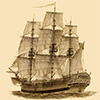 Active, Albermarle, Atlantic, Barrington, Britannia, Mary Ann, Matilda, Salamander And William And Ann (generic)
References
| Primary Source | Stevens, H 2000, 'The O'Hara story: John and Mary O'Hara and their descendants', Diploma thesis, Society of Australian Genealogists. |
Claims
No one has claimed Mary Jones yet.
Photos
No photos have been added for Mary Jones.
Convict Notes
The year of birth for Mary Jones varies in the records, eg 1762 (in 1831 Sydney Gaol description book), and 1768 (in 1828 census). She could be the Mary Jones baptised in 1766, parents William and Sarah Jones in Tyberton Herefordshire (sometimes spelled Tiberton), a little village west of Hereford, England (near the Welsh border). In 1790 Mary was in Tyberton, working as a servant of Catherine Brydges at Tyberton Court, the house of her brother Francis William Thomas Brydges (former high sheriff of Herefordshire) and his new wife Anne. On July 29th 1790 Mary Jones and another servant, Ann Tomkins (or Tomkyns) were found guilty in the Hereford Assizes to the theft, with force and arms of the following items from their mistress: two silk work bags, three silk purses, six linen shifts, two silk handkerchiefs, two muslin handkerchiefs, two muslin cravats, five cambric aprons, two pairs of cotton stockings, one 'beach stuff gown', three pieces of dimity, five pieces of silk, five pieces of muslin, five pieces of silk ribbon, and the last and most significant item on the list was 'forty gold guineas'. No details were given of the 'force and arms' used by the women. They were found guilty and were sentenced to be hanged, but luckily Catherine Brydges and others testified to their previous good behaviour and their sentence was commuted to transportation for life. 'The female servants for robbing their mistress would certainly have suffered death, had not the prosecutor, and other respectable persons, humanely testified their former good conduct and honesty.' [Hereford Journal 4 August 1790 ] They were transported on the ‘Mary Ann’ which sailed with 150 female convicts on board. Nine of them died during the voyage. They left England on 16th February 1791 and arrived at NSW on 9th July 1791. When they disembarked, they 'were landed in perfect health, all loud in their praise of their conductor' (that is, the ship's master, Mark Munroe). This is in stark contrast to the previous ships which had arrived the year before - the Second Fleet which was later known as the 'Death Fleet'. A good website about the 'Mary Ann' is https://www.jenwilletts.com/convict_ship_mary_ann_1791.htm On 2 Aug 1792 she gave birth to her son James, parents Mary Jones and John O'Hara (Neptune 1). He was baptised 12 Aug 1792 at Parramatta by Reverend Johnson: 'James Jones son of John O'Harra & Mary Jones born August the 2nd'. John O'Hara was probably working at Toongabbie, at Superintendent Thomas Daveny's farm. On 23 Jan 1797 Mary Jones and John O'Hara married: Mary Jones and John 'O’Harra', ‘of Prospect Hill’, by Samuel Marsden by Banns at Parramatta. John marked with a cross, and Mary signed. Witnesses were Catherine Daveny (Thomas Daveny's widow) and Robert Collett. In 1799 Her husband John O'Hara received a land grant of 60 acres granted at 'Toongabbie', actually at Seven Hills and by 1806 the entire 60 acres of land was in production. 27 September 1809 is the date of her husband John O'Hara's death. His grave is in St Johns Cemetery Parramatta. In 1812 Mary received an Absolute Pardon. On 14 June 1815 she married Michael O'Brien (Michael Bryan, Atlas 1) who had recently received a Conditional Pardon and had a farm at the Nepean: Michael O'Brien & Mary O'Hara married at Castlereagh Church Witnesses Thos Wheeler, G K Nicholls, Ann Carver. Her husband Michael O'Brien was granted 40 acres at Seven Hills in 1818, and a Ticket of Occupation was issued to him for 500 acres at Castle Hill in 1823. 1828 census: At Seven Hills, Mary O'Brien (60 AP Mary Ann '1787') with her husband Michael O'Brien (50 CP Atlas 1801). With them were Mary's grandchildren John O'Hara (18 BC servant) and Mary O'Hara (14 BC servant) and Michael Cantwell (51 CP Atlas '1810' settler, Michael O'Brien's brother in law, he is Michael 'Caulfield' on the Atlas in 1801). 1830: in August, the bushranger Jack Donohoe and his accomplices William Webber and John Walmsley appear at the sliprail at the back of the house at Seven Hills and offer Mary some cloth (from the MacQuade robbery and already hidden on their land) in exchange for hide-out and provisions. On 1 September Donohoe is shot dead by mounted police near Bringelly. Webber and Walmsley escape and 2 or 3 weeks later they return to the house and introduce themselves to Michael O'Brien. They will hide-out there a few times including Chistmas Eve 1830 to 3 January 1831. 1831: In January, Mary and Michael O'Brien, with Mary's grandchildren Mary, John and James jun O'Hara, and James O'Hara jun's wife Mary Ann, were arrested for receiving stolen goods and harbouring bushrangers. On 28 June they were convicted and sentenced to 14 years transportation. Mary and the two girls were sent to Moreton Bay in September. The men were sent to Norfolk Island. The Sydney Gaol records have her description: 5 feet tall, slight build, ruddy complexion, grey eyes, grey hair. At Moreton Bay, she and the girls were accommodated in the Female Factory, but soon after arriving she was admitted to the hospital suffering ‘anasarca’ (generalised oedema). She was treated with squill for fourteen days and discharged on 12th October. In 1838 Commandant Cottee wrote to Governor Gipps recommending a mitigation of sentence, induced by her 'excellent character'. This was approved and she left Moreton Bay on the 'Isabella' on 28th April. In 1840 she was with her son James O'Hara at 'Little Dural' (Kenthurst) and she wrote a petition to Governor Gipps in an effort to have her husband Michael O'Brien released - he was at the Woolloomooloo Stockade at this time. He was eventually released in 1842. 1845: Death of Mary O'Brien. Her burial 5 Jan 1845 is in St Patricks Parramatta burial register 'abode Dural', more likely Little Dural (Kenthurst) where her husband Michael O'Brien was farming land left to him by his brother in law Michael Cantwell. Source: Stevens, H 2000, 'The O'Hara story: John and Mary O'Hara and their descendants', Diploma thesis, Society of Australian Genealogists.