
Summary
Personal Information
Voyage
Transportation
Thomas Kelly was transported on the Hercules, departing 29th Nov 1801 and arriving 26th Jun 1802 with 56 passengers.
The "Hercules" ship was built in 1801 at South Sheilds, England. 1801 voyage from Ireland to New South Wales, Australia. Sailed via Rio de Janeiro and the Cape. A mutiny occurred just prior to their arrival at Rio - after 45 minutes it was quashed but 13 convicts had been killed. Jeremiah Pendergass was named as the ring leader and shot. 44 deaths in total on this voyage. There was then another ship, also named, "Hercules" built 1822 at Whitby, England who made 3 trips to Austraia, in 1825, 1830 & 1832.
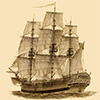 Hercules (generic)
References
| Primary Source | County Wicklow Heritage Project,The Last County; Charles Bateson, The Convict Ships; Musters 1806,1811; Shipping Indents, Hercules; Peter Mayberry, Convicts to NSW, 1791-1820 |
Claims
No one has claimed Thomas Kelly yet.
Photos
No photos have been added for Thomas Kelly.
Convict Notes
The Colonial Secretary Index, 1788-1825, has information on this person as follows: KELLY, Thomas. Per "Hercules", 1802 1811 Jul 20 - Paid from Police Fund for building a house for Superintendent of the Factory at Parramatta (Reel 6038; SZ758 p.217) 1812 May - Petition for mitigation of sentence (Fiche 3170; 4/1848 p.194) 1815 Nov 4 - Paid from the Police Fund for piers, buttresses and wall erected at Parramatta (Reel 6038; SZ759 p.151) 1820 Jun 12 - Memorial (Fiche 3023; 4/1824B No.418 pp.551-4)

You should check your records regarding the ship Hercules. A voyage was made from Cork departing November 29, 1801 and arriving in Sydney June 26, 1802. And it was on this voyage that Thomas Kelly arrived.
Our Thomas Kelly was born in county Wicklow, Ireland and was brought to trial in 1801. This was the time of rebellion in Ireland which started in the adjacent county, Wexford in the May of 1798. Within some six weeks the rebellion had been virtually put down ‘with the only rebel forces still at large were around 5000 armed with pikes in Wicklow.’ It was the time of unbelievable cruelty by the authorities and the military with ‘sentences of 500-999 lashes and other forms of extreme torture’. Thomas was undoubtedly one of the so-called Wicklow rebels and received a life sentence for his troubles. Wicklow was one of the most active theatres during the 1798 rebellion. So rebellious was Wicklow that in 1800, the Government commenced construction of the Military Road through the Dublin and Wicklow mountains so that the army could be dispatched to pacify any disquiet in the hills above the City. He arrived in the colony aboard the Hercules on June 26, 1802. This voyage had a particularly high death rate on the trip out from Ireland with only 96 (of a total of 140) disembarking at Sydney. On December 29, 1801, 30 days out of port, all on board were ‘aroused by the sound of the shot, the soldiers and seamen swarmed on deck and opened a general fire at the convicts.’ Thirteen convicts were killed when the master Luckyn Betts used inappropriate force to put down what was really a very minor uprising. It was the bloodiest mutiny attempt which had occurred in a convict ship, and during the remainder of the voyage Betts kept the prisoners closely confined. Later Betts was brought to trial for the shooting of 13 convicts in the suppression of this uprising; however, he was convicted of manslaughter of only one man and fined ₤500. Governor King doubted the court’s power to impose such a sentence so he granted Betts a conditional pardon but described the conditions of the convicts as being “filthy beyond description … [with some convicts] lying dead with heavy irons on, while many more died as they were coming from the ship to the hospital.†Thomas Kelly was a stonemason, cum builder, for most of his colonial life. He received a pardon in January, 1813 and the 1806 Muster shows Thomas as having his ‘ticket of leave’ On February 19, 1807 Thomas married Mary Kennedy at St. John’s, Parramatta and they were to have two children living to adulthood. For some time, as yet to be determined, but certainly up to 1822, Thomas was employed at Elizabeth Farm, one of Australia’s most historic homes. In 1823 Governor Brisbane granted Thomas a parcel of land (135 rods) on the north side of Parramatta River, just to the north-west of the present ‘Gasworks’ Bridge. Thomas Kelly was 65 when he died on January 17, 1828 and being Irish and of the Roman Catholic faith he was buried at St. Patrick’s, North Parramatta.