
Summary
Personal Information
Crime
Voyage
Transportation
Launcelot Knowles was transported on the Lady Shore, departing 31st Jan 1797 and arriving 28th Aug 1797 with 69 passengers.
1797 - August. Mutiny on board. Did not arrive in Australia. Fate of the Female Prisoners There were sixty-four young female convicts on board, and when they arrived at Monte Vido, it not being customary for Europeans to do any work, they were taken under the care of the female inhabitants who provided them with Spanish dresses, and made them their companions. some of the women conducted themselves with a deal of propriety and are married and settled there - some to the inhabitants and some to American Captains. Several of them behaved in a very loose and disorderly manner, and were in consequence taken into custody, and carried before the Governor who committed them to prison at Buenos Ayres where they reformed and agreed to profess the Roman Catholic Religion [5] https://www.freesettlerorfelon.com/convict_ship_lady_shore_1797.htm
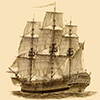 Lady Shore (generic)
References
| Primary Source | Australian Joint Copying Project. Microfilm Roll 87, Class and Piece Number HO11/1, Page Number 220. Old Bailey trial 11 January 1797. Knowles picked up off Cadiz: Freemans Journal, Thursday, 3 January 1805, p.4]; Hardie, Elsbeth 'The Passage of the Damned' pub 2019, esp pp 86 & 92. |
| Source Description | This record is one of the entries in the British convict transportation registers 1787-1867 database compiled by State Library of Queensland from British Home Office (HO) records which are available on microfilm as part of the Australian Joint Copying Pro |
| Original Source | Great Britain. Home Office |
| Compiled By | State Library of Queensland |
| Database Source | British convict transportation registers 1787-1867 database |
Claims
No one has claimed Launcelot Knowles yet.
Photos
No photos have been added for Launcelot Knowles.
Convict Notes

Source for Montevideo: HARDIE, Elsbeth, 'The Voyage of the Damned', esp pp 86 & 92.

KNOWLES TREATMENT IN MONTEVIDEO, September 1797 to 1804. When the Lady Shore arrived in Montevideo the men on board were confined in the citadel of the city (and some of the sailors remained under guard on the ship) while the Spanish authorities undertook an Inquiry into the circumstances of the ship's capture. 57 men from the ship were interrogated over the three months from their arrival. Launcelot Knowles was recorded by the Spanish authorities as being “at an advanced age”. He assisted them in helping to translate the ship's official documents. For his good conduct, and as he had requested, he was allowed to be at liberty. Later, When all the men were removed across the river to be imprisoned in Buenos Aires, Knowles was allowed to remain in Montevideo (as was the ship's surgeon, Charles Fyfe).
KNOWLES’ ENGLISH CRIME Launcelot Knowles, said to be 65 years old, was found guilty at the Old Bailey on 11 January 1797 of obtaining money by false pretences, and was sentenced to 14 years’ transportation. See Old Bailey proceedings of that date. Knowles had falsely represented to the mother of a 24 year old man sentenced to death at the old Bailey for stealing clothes, that he could obtain the condemned man’s pardon and release into His Majesty’s navy on a man of war ship. He requested £5 to do so, claiming he had influence with the Duke of Portland (head of government’s administration), also with the Duke’s secretary Mr Baldwin, and with Sir Watkin Lewes (a respectable magistrate), who he claimed as a very good friend who he, Knowles, had served as serjeant in the City militia. In fact he had no influence at all, and money was not required to be paid to obtain pardons or to get people into the navy, and the King was the only person who could grant pardons. Later he requested another 2 guineas and then another 3 guineas from the mother, who said in evidence: “I told [the prisoner] it was not in my power to let him have it; I told him my agreement was five guineas, and he had extorted another from me, and I would give him no more; he put himself in a very great passion, and said, d-n his blood if he would do any more for him, and would stop what he had done for him; he told me that he had saved his life; I said, no, he had not, for Sheriff Liptrap saved his life, if his life was saved, for he had presented a petition; … … “ His Grace the Duke of PORTLAND gave evidence: - Examined by Mr. Garrow: “I would just ask your Grace, whether the prisoner had any influence with your Grace to procure pardons?” – Answer: Certainly not. Knowles was convicted and sentenced to 14 years transportation. Belfast Newsletter 21 April 1797 – “The ship Lady Shore, for Botany Bay has now on board 110 men women and children, belonging to the New South Wales corps and 70 convicts, only two of whom are males, Major Semple, and Knowles, the Duke of Portland's late porter. Their numbers are expected to be considerably increased by the time they reach the place of their destination as most of the female convicts are fine young girls, and many of them already promise to be prolific.” SHIP ‘LADY SHORE’ Knowles sailed on the ship “Lady Shore” for NSW, departing 3 April 1797. There were 119 prisoners on board, including eight French sailors who had been captured by the English as prisoners of war and were being sent to be soldiers in New South Wales, in lieu of being executed, and several other prisoners-of-war of different nationalities. MUTINY However, on 1 August 1797, at sea, some of these prisoners, including the French, and some Irish sailors, mutinied. The mutineers elected Frenchmen Sélis as Captain and Thierry as Lieutenant. The captain and first mate were killed. To reduce the number of prisoners they had to watch over, the mutineers selected 29 people and cast them off in a longboat (with navigation instruments and food) off the coast of Brazil. The 29 comprised some of the officers (the second and third mates, and lieutenant commanding the army detachment) and soldiers (an ensign, two sergeants, two corporals and two privates), their wives and children and four convicts. Tone of these was the only other male convict, known as Major Semple. The longboat safely reached the shore the next afternoon. The French recruited some of their prisoners to help sail the ship. These were seven Irish ( Conden, Keaning, Lynch, M'Ginnis, Keating, Kelly, and Sheridan); and four English (Church, New, Deviling, and Pyott). Lady Shore sailed to Montevideo in Uruguay (a Spanish possession), arriving on 31 August 1797, and hoisted the French colours. The Spanish contested the validity of the French capture of this English ship and removed all the prisoners and arrested the three Germans and seven French. After Sélis and Thierry protested to the Vice-Roy, and sought support from the French ambassador, the Spanish released the French prisoners. Only when a French frigate squadron sailed into the harbour did the Spanish acknowledged French authority over the Lady Shore and its prisoners. KNOWLES FOUND [Per Freemans Journal, Thursday, 3 January 1805, p.4] In 1804, seven years after ‘Lady Shore’ had left England, the British captured some Spanish plate-ships off Cadiz. On board one of these, the ‘La Fama’ frigate, was Launcelot Knowles who said he was then above 70 years of age, and had been born in Roseway, Ireland. Three other British subjects were on board another Spanish frigate, the “Medea” off Cadiz. They’d all been NSW Corps soldiers on Lady Shore – John Brown, Edward Eagle and Francis Ward. After being prisoners at Montevideo they were taken to Buenos Ayres as prisoners. On the Spanish frigate Knowles was put on the sick list and shown every indulgence because of his age. When he was taken by the English Knowles “lamented much he did not reach Botany Bay, observing he should have passed his time as comfortably there as in London having a strong recommendation from the late Mr Kirby, the Keeper of Newgate, and several other persons, to Governor Hunter, and that he’d had considerable property given him by his friends to take. This property had been lost.” AT the end of 1804, Knowles was liberated, by order of Sir Richard Ford”.