
Summary
Personal Information
Crime
Voyage
Transportation
Edward Lees was transported on the Anna Maria, departing 6th Mar 1848 and arriving 7th Aug 1848 with 190 passengers.
Built 1836 in Calcutta. Wood barque of 421 Tons. Master Edward Smith. Sailed from England 1848 with 190 men from Pentonville prison under the care of surgeon Dr Robert Stevenson, . Twenty seven prisoners deemed to fall into "second class" were disembarked in Hobart and granted tickets of leave on landing and the remainder were disembarked at Geelong with conditional pardons. Sailed from Woolwich on 6 October 1851 under surgeon W. McCrae with 196 female convicts, landing on 26 January 1852.
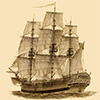 Anna Maria (generic)
References
| Primary Source | The Sheffield & Rotherham Independent; Saturday April 11, 1846 268 |
| Source Description | This record is one of the entries in the British convict transportation registers 1787-1867 database compiled by State Library of Queensland from British Home Office (HO) records which are available on microfilm as part of the Australian Joint Copying Pro |
| Original Source | Great Britain. Home Office |
| Compiled By | State Library of Queensland |
| Database Source | British convict transportation registers 1787-1867 database |
Claims
No one has claimed Edward Lees yet.
Photos
No photos have been added for Edward Lees.
Convict Notes

SHOOTING A GAMEKEEPER AT ECKINGTON It is with feelings of regret that we this week record another of those dreadful outrages committed by poachers, when interrupted in their nocturnal depredations, by meeting with gamekeepers, and which in one or two previous instances in the neighbourhood of Eckington have terminated in the death of some of the parties. Between nine and ten o'clock on Tuesday night, the servants at Renishaw Hall, the seat of Sir George Sitwell, Bart., were sitting round the hall fire, when they heard the firing of two guns, apparently at no great distance from the hall. Sir George's head keeper, Henry Jackson, immediately summoned to his assistance another of the keepers, and a man employed in the stables, and they three unarmed went out to give the parties a meeting. When in the park, Jackson, for the greater certainty of coming up with the poachers, sent the other two men to take another direction, and to meet him near the lodge, in which direction he himself went direct. After having passed the east end of the Hall, and when between it and Renishaw Lodge, he suddenly came upon a party of four men, two of whom were armed with guns. Placing themselves in front of him, one of them called to him to stand back, or take the consequences, and said if he advanced another step towards them, they would shoot him. The blaze from the furnaces belonging to the Renishaw Works, enabled him to see the men distinctly, and though unarmed, he proceeded, notwithstanding the threat which had been used, to advance slowly towards them, when one of them fixing his gun to his shoulder, pulled the trigger twice, but failed in discharging the contents, the gun missing fire. Jackson finding, from the desperate threats of the men, that it would be running heedlessly into danger to enter into a conflict with them alone, and unarmed, was turning to walk back, when one of the guns was fired, and the greater part of the charge was lodged in the back of his thighs and legs. The poachers, seeing Jackson fall, ran away before any assistance could arrive. Jacksons calls for help were so loud that they were heard by the watchman on duty at the Railway Station, and also at Renishaw Hall, where, in consequence of hearing the second report of fire arms, a second lot of the servants were assembled to go to the keeper's assistance. They went as quickly as possible in the direction of the cries, and found Jackson insensible on the grass and weltering in blood. He was carried to the stables, and the assistance of Mr. Askham, surgeon, immediately procured, and after every attention had been pain to the wounded man, Sir George Sitwell sent an express to Sheffield for some of the police force, and an officer having a knowledge of the locality, was promptly dispatched to apprehend the offending parties, two of whom the wounded man spoke to by name. This officer (police constable Black) arrived before two o'clock, after having an interview with sir Geo. Sitwell, he called in the assistance of Heald, one of the constables of the village. The officer proceeded to make minute inquiries into the circumstances, and the result was that he and Heald at once proceeded to apprehend four persons for the offence. One of them they succeeded in capturing before six o'clock in the morning, after the perpetration of the outrage, and the other three were also taken a few hours after. The names of the parties apprehended are Edward Lee, a brickmaker, residing with his father at Bole hill; John Marples, of Eckington, employed as a labourer by Lee; Andrew Cartledge, of Mosbrough, sickle grinder; and George Holy, of Eckington, wood turner. In the course of the day, they were taken before Henry Bowden, Esq., and by him remanded until the keeper should be so far recovered to be able to give evidence, and for safe custody, were the same night brought to Sheffield, and lodged in the Town Hall. The prisoners are well known as inveterate poachers, two of them having been convicted for it. Lee had only been out of Derby gaol about seven weeks, where he had been imprisoned six months, for having on another occasion, when met by one of the keepers, when out poaching, shot a valuable deer hound, which the keeper had with him, and also pointed his gun at the keeper and threatened to shoot him. So far as the evidence against the prisoners goes, it appears that in addition to Jackson's identifying two of them by name, they were all four traced to be in company together at several public-houses, at Barlbrough, during the morning before the occurrence, and at one of these places, they produced two guns, and intimated that they were going out at night. One of them observed that they intended to put a few shots through any one who attempted to stop them. They also, whilst at Barlbrough, purchased a quantity of caps, shot and powder, and after leaving Barlbrough, were traced to Spink hill, where they were also drinking together. After leaving there, they appeared to have got at night to the New Inn, near the Railway Station at Eckington and close by Renishaw Lodge, where they remained until within half an hour of the time that Jackson was wounded, when they all four went away together, and had two guns with them. When the prisoners were apprehended, a strict search was made for any fire arms that might be in their possession, and in Marples's workshop, his coat was found on the work bench quite wet, and inside it were wrapped up the barrels and stocks of two guns, one of which was loaded, and in the pocket of the coat a quantity of gun wadding. Two of the prisoners admitted to the constables, when told what they were apprehended for, that they were present in the Park, but denied that they were the persons who fired, each of them endeavouring to turn it off his own back upon his companions. When searched at the Town Hall, a quantity of caps were found in Cartledge's pocket. Jackson, who has a wife and six children, the eldest of whom is not more than eleven years of age, is from Wales, and has not been in Sir Geo. Sitwell's service more tha six or seven weeks. The four prisoners will be detained at Sheffield, until the keeper may have so far recovered as to be able to give evidence.
Attempted murder of a gamekeeper. Edward Lee, aged 29, charged with having on the 7th April, at the parish of Eckington, feloniously and unlawfully attempted to shoot William Jackson, with intent feloniously and unlawfully to kill and murder the said Wm. Jackson; John Marples, aged 20, charged with shooting, at the same time and place, the said Wm. Jackson, with intent then and there to kill and murder him; and Andrew Cartledge (on bail), indicted with these prisoners for a similar offecnce. Mr. Wilderman and Mr. McCaulay prosecuted; Lee and Marples were defended by Mr. Miller; Cartledge was defended by Mr. Wing. On the evening of the 7th of April, between nine and ten o'clock, Jackson left the servant's hall, in company with a man named Bond; when on the coach road saw three or four persons; some one said, "Here he is!" Another called out, "Shoot him;" heard the report of a gun, and felt he was wounded. George Hawley (brought up in custody) proved he had been drinking on the day in question with the prisoners; they all went to a cover near Sir G. Sitwell's; Marples and Lees had each a gun; two guns were fired in the plantation; a man came up who was ordered to stand back or they would shoot him; the man turned back, and witness directly heard a gun explode, and a man scream; witness said, "Surely you have not shot the man;" this was to Marples; he replied, "By God, I have though, and Lees would have shot him, but his cap missed; witness said Marples deserved to have his brains knocked out for his conduct. Cross-examined - Has since married the sister of Cartledge, and expects to be let off for giving evidence. Corroborative evidence was given, clearly making out the case of firing with intent to do grievous bodily harm. Cartledge was acquitted; the others were found guilty and sentenced to be transported for 15 years.