
Summary
Personal Information
Crime
Voyage
Transportation
William Loder was transported on the St Vincent, departing 28th Dec 1852 and arriving 26th May 1853 with 214 passengers.
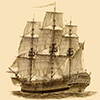 St Vincent (generic)
References
| Primary Source | Australian Joint Copying Project. Microfilm Roll 92, Class and Piece Number HO11/17, Page Number 638. --0-- https://discovery.nationalarchives.gov.uk/details/r/899203f7547043f1b9857c193c35a601 --0-- Roscoe, Katy (2018), “Convicts and the Sea: the naval influence on Gibraltar Convict Establishment” at https://staffblogs.le.ac.uk/ |
| Source Description | This record is one of the entries in the British convict transportation registers 1787-1867 database compiled by State Library of Queensland from British Home Office (HO) records which are available on microfilm as part of the Australian Joint Copying Pro |
| Original Source | Great Britain. Home Office |
| Compiled By | State Library of Queensland |
| Database Source | British convict transportation registers 1787-1867 database |
Claims
No one has claimed William Loder yet.
Photos
No photos have been added for William Loder.
Convict Notes


OTHER: 19 February, 1856: He was granted a Ticket of Leave – delayed due to several “infringements” such as drunkenness, insolence, etc., that resulted in various terms of hard labour and/or solitary confinement. 10 February, 1857: William Loder was granted a Conditional Pardon (https://stors.tas.gov.au/CON33-1-115$init=CON33-1-115p123). --00--
TO VDL: 26 May, 1853: On arrival in VDL, William Loder, convict #27967, was listed as a coachman; 31 years old, 5’8” tall with light brown hair, grey eyes and a fresh complexion. He was single, Protestant and literate. Native place: Edgware Road, London. He said he had been transported for “desertion from the Royal Marines, absent nearly a month”; two prior convictions for desertion, 2 and 4 months’ jail. Gibraltar report – “no serious offence, weak intellect” (https://stors.tas.gov.au/CON33-1-115$init=CON33-1-115p123). Family: Mother Mary; brothers Francis (Fusilier guard), Henry (artillery) and Edward; sisters Martha and Mary – at his native place. Trade: Nearly 4 years in the Royal Marines; coachman and groom (http://foundersandsurvivors.org/pubsearch/convict/chain/ai43159). --0--
MORE ABOUT HIS "TATTOOS": BRANDED with a “D”: Until 1829, any soldier could be branded but after that it was reserved for deserters. In "Branded with a 'D'", Phillip Hilton (2010, p140) says “deserters were… ‘branded’ with a D on their left sides as a means of humiliating offenders” (https://eprints.utas.edu.au/17678/2/Hilton_Thesis.pdf), but he doesn’t say how the branding happened and there are conflicting versions among writers. For example, Peter FitzSimons (2019) refers to barbaric fire brandings, while others such as Keith Amos (1987) describe painful tattooing using India ink. A post on the Irish Garrison Towns website (http://irishgarrisontowns.com/d-for-deserter/) says both practices were used – hot iron/fire branding being the preferred method until around the mid-19th century when it was replaced by tattooing: “A new device was created to mark the soldiers’ skin with ink, or even gunpowder… The large, blunt points [on the branding tool] hint at the pain it caused as a spring mechanism forced these points into the skin. Regimental doctors described the practice as ‘cupping’.” Simon Barnard’s (2016, p55) book, “Convict tattoos: Marked men and women of Australia”, has several shots of one of these spring loaded, brass “branding instruments” manufactured by John Weiss & Sons of The Strand, London. Barnard says they were used by medical officers to tattoo army deserters. The head of the “Weiss’ Invention” model holds 47 needle points arranged in the shape of a “D”, all clearly capable of puncturing human skin. So, too, the points of the brass instrument featured on the Science Museum of London’s website (https://collection.sciencemuseumgroup.org.uk). Made by Savigny & Co of London, its adjustable points “still bear traces of ink” and were pushed through the skin by a spring-powered mechanism. Savigny & Co was “better known as a major manufacturer of surgical instruments in the 1700s and early 1800s”. The Museum says branding was abolished in 1829, except for army deserters. After this, the mark was tattooed on the body until the practice was abandoned altogether in 1879. --00--
3 February, 1853: William Loder was sent aboard the St Vincent for transportation to VDL. --00--
On Gibraltar, WILLIAM LODER was described as 20 years old, sentenced to 14 years for desertion; born in London; Church of England; light brown hair, blue eyes and a fresh complexion, 5’9” tall; tattooed with 3 Ds under his left arm [for deserter]; literate; groom & soldier, Marines; single; relatives/family – mother and sister Rochester Place, Dorset Square, London (UK, Prison Commission Records, 1770-1951; Misc.; Register of Prisoners; 1810-1822 [mislabelled]). --
Gibraltar and Bermuda were listed public works stations (and the second stage in the penal process). On Gibraltar, as “convicts worked together with free men on the dockyards, lines between them became blurred. Convicts, like seamen, were ‘easily recognised’ by ‘their swarthy, weather beaten complexions… [and] muscular well-knit frames’. The discipline on the penal settlement was also influenced by the naval department, who superintended part of the works. In the 1840s, for example, convicts were provided ‘a half gill of rum’ at 11am and 5pm, which they drank from a trough. This mirrored the daily allowance of diluted rum, known as grog, to Royal Naval seamen in the Victorian era. Convicts were also allowed to use part of their earnings, to buy goods, usually tobacco, which they were allowed to smoke in the evening in the barracks. Though official correspondence cited health reasons for grog allowance, it seems likely that the convict authorities feared insubordination if they were banned from drinking and smoking, which were provided to the sappers and dockyard workers whom they worked alongside… In 1854, the acting overseer stated that “half of the offences were committed when the men were excited by rum”. For more serious offences, convicts were flogged with a ‘cat o’nine tails’ whip against the ‘flogging mast’, and during an investigation Dr William Baly concluded that the whip which was used was an old naval cat, which was ‘much heavier than any now used in the government prison and hulks at home, or in the army.’” (Roscoe, Katy (2018), “Convicts and the Sea: the naval influence on Gibraltar Convict Establishment” at https://staffblogs.le.ac.uk/). --
TO GIBRALTAR: 24 July, 1848: LODER, WILLIAM #1215, arrived on Gibraltar from England per Enterpe. He was held on the Europa hulk (UK, Prison Commission Records, 1770-1951; Misc.; Register of Prisoners; 1810-1822 [mislabelled]). --
CRIME: Desertion from Royal Marines (not listed as an option above). --0-- 5 July, 1847: Court martialled at Woolwich and sentenced to 14 years' transportation for desertion (2 previous convictions for same). --0-- From: Records of Royal Marines, ADM 158 - Admiralty: Royal Marines: Description Books; Subseries within ADM 158 - Woolwich Division: Reference: ADM 158/55/7/34 Name: William Loder. Age: 25 years 8 months. Place of birth: Marylebone, London, Middlesex (https://discovery.nationalarchives.gov.uk/details/r/899203f7547043f1b9857c193c35a601). --00--