
Summary
Personal Information
Voyage
Transportation
George Lowe was transported on the Caledonia, departing 5th Jul 1820 and arriving 17th Nov 1820 with 150 passengers.
Ship Name: Caledonia (1) Rig Type: S. Built: Sunderland Build Year: 1815 Size (tons): 412 Voyage Details Source. Claim a Convict website. http://www.hawkesbury.net.au/claimaconvict/shipDetails.php?shipId=186
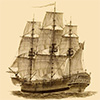 Caledonia (generic)
References
| Primary Source | Australian Joint Copying Project. Microfilm Roll 88, Class and Piece Number HO11/3, Page Number 340 |
| Source Description | This record is one of the entries in the British convict transportation registers 1787-1867 database compiled by State Library of Queensland from British Home Office (HO) records which are available on microfilm as part of the Australian Joint Copying Pro |
| Original Source | Great Britain. Home Office |
| Compiled By | State Library of Queensland |
| Database Source | British convict transportation registers 1787-1867 database |
Claims
No one has claimed George Lowe yet.
Photos
No photos have been added for George Lowe.
Convict Notes
War Office Records. Registers Court Martial. https://nla.gov.au/nla.obj-1606814777/view Private Thomas Brooker, 57th Regt, and Private George Lowe, 57th Regt, Tried at Valenciennes, 3 Mar 1818, for Theft in stealing a large sum of money. Transportation as a Felons for 7 years. Case sent to Prince Regent, 7 Apr 1818 for confirmation before the Prince Regent.

Record on Fold3 by Ancestry. He was 22 years of age at the court trial. His Christening/Baptism on Family Search is 25 September, 1976.

George was convicted of robbing a Frenchman in Valenciennes, France, and convicted 4 March, 1818. He was sent to Van Diemen's Land on the ship "Caledonia". Description - 5ft 7inches, complexion ruddy, hair sandy, eyes blue, Tats - two blue dots over right eye, one blue dot over left eye, a ship in full said on breast, a mermaid with comb and glass on right arm below elbow, dot hearts? dog. Free of servitude and tried again in Adelaide 14 Mar 1842. Sentenced to 7 years for highway robbery and arrived VDL on the ship "Dorset". He was aged 44 years. Murdered at Brighton in June 1847 by W. Powell (or Charles Benwell alias). Served in the 57th Regiment for 8 years from 1810-1818 in England, America and France. Arrived inn Adelaide with wife and 3 children approx 1838 after being gree. Came on the ship "Lady Emma" (no record of their names). Hobart Town Courier & Gazette Saturday Morning July 31, 1847, Page 3 The George Lowe referred to below, who was murdered, was the brother of Robert Lowe, our convict ancestor. Murder at Bagdad It is our painful duty to lay the following particulars of a murder which has been committed in the Bagdad Tiers before our readers. Two men named William Williams and George Lowe, sawyers, were residing in a hut about three miles from Green Ponds, in the direction of Jerusalem, on the 20th June last. The mother of Williams was residing at Constitutional Hill, and it appears that he went to see her and remained there two days. Upon his return he found the hut had been robbed and George Lowe (his mate) was missing. No tidings were heard of him until Monday last. As noticed in our last publication, two men (Charles Benwell and James Wing) were apprehended on a charge of cattle stealing in the tiers by District Constable Beckwith, and conveyed to Brighton gaol. Mr Hodgins, the District Constable of Brighton, when visiting the watch-house, saw a great coat in the possession of Charles Benwell answering the description of one which was lost from the hut of the missing man (George Lowe). Williams, the mate of the deceased, was sent for; and recognized the coat, and also a pair of boots on Wing which belonged to the deceased. Both prisoners seemed very much alarmed at the discovery, and ultimately the boy (Wing) gave Mr Hodgins information which led to the discovery of the body. He proceeded with three constables through the tiers to Bagdad and Jerusalem. In two days they succeeded in finding the cave where the outlaws had lived for the last five months. Here several of the articles stolen were found. The body of the deceased was partially interred on the summit of an almost inaccessible tier about three miles from the cave, eighty yards from which a cask containing about eight sheep in salt, and a tan-pit with some skins, were noticed by the police. The men are now awaiting the result of the coroners' inquest upon the body. Colonial Times, Hobart, Tas , 1828-1857, Friday 3 September, 1847 Page 3 Supreme Court - Criminal Sittings Wednesday, September 1, 1847 (before Mr Justice Montagu) The Court was crowded this morning as it was known that the murder case would come on. The prisoner Benwell having been arraigned and pleaded not guilty, the following jury was sworn:-Messrs. James Barnard (foreman), Francis Atkinson, R Joynes, Joseph Dixon, James Williams, Edmund Hodgson, Thomas Johnson, John Atkinson, AF Manning, Andrew Jackson, - Winter, and William McRobie. Charles Benwell was charged with the willful murder of George Lowe, on the 20th June last, by shooting him with a gun. Upon the application of Mr Macdowell who defended Benwell, witnesses were ordered to leave the Court until called for. The Attorney-General said, that it was his intention to apply to the Court for permission to have the evidence of Thomas Wing, who had been committed with the prisoner Benwell, given in this case as an approver. Mr Macdowell, before this application was granted, wished his Honor to hear the address of the Attorney-General, when he would be enabled to judge whether such evidence could be admitted; he (Mr Macdowell) thought it was an unprecedented case to admit the evidence of a principal. His Honor did not think he had any discretion in the matter; if the Attorney-General was of opinion that Wing was a material witness, he was entitled to call him; the Attorney-General would however, act upon his own responsibility, and having filed no bill against Wing, it must be presumed that he was cognizant of all the facts. The Attorney-General then rose to address the jury; they, he observed, had heard the information read, and if the facts (pointing to the depositions) now before him were substantiated, they could hardly conceive that a more cruel and cold-blooded murder had ever been perpetrated. The learned counsel here concisely placed the facts of the case before the jury, as detailed by the evidence, and in reference to the testimony of the accomplice, Wing, he declined to offer any remarks upon that, as he would leave the jury to form their own conclusions respecting it, merely observing that it would require perfect corroboration to enable the jury to place confidence upon its veracity. Disclaiming any wish or intention to prejudice the jury, the Attorney-General thought it better to leave the case as it stood, and proceed at once to call his witnesses. A brief discussion now took place as to the reception of Wing's evidence, Mr Macdowell again submitting that it could not be admitted, he being the principal in the case. On reference to "the books," however, the Attorney-General showed that, where a person was the actual perpetrator of murder under fear and terror of his life, he was no longer a principal in law. In his opinion the learned Judge, who said he had read the depositions, coincided, and Mr Macdowell bowed to his Honor's decision. The prisoner being in a weak state of health, was accommodated with a chair. William Fitzgerald, the "mate" of the deceased, stated, that he lived at the Coyne Tiers, three miles from Green Ponds, and was a splitter and sawyer; he had been there with Lowe about eighteen months; on Saturday, the 19th of June, witness went with Lowe to see his (witness's) mother at Constitution-hill; they stopped there that night, and Lowe left the next day to return to the Tiers; witness also returned on Monday morning at day-break, and on reaching the hut found all the things gone except a few trifling articles his mate was gone too. (The witness here enumerated the articles which had been taken away and identified them, and amongst others, a very fine black kangaroo dog: he also described the dress worn by Lowe when he left his mother's house, namely, a blue woolen shirt, a striped regatta ditto, dark moleskin trowsers, black silk handkerchief, a dark waistcoat, a Jim Crow hat bound with a black ribbon, sewn in three places, and a pair of water-tight boots; the waistcoat and boots were positively sworn to) Witness reported the case to Constable Allone at Jerusalem, and he next saw the dead body of Lowe on a Saturday in July (17th) in the rocks on the Coyne Tiers, about two miles from his hut, in the presence of the boy Wing. Mr Foster, the Police Magistrate, Dr Gorringe, and others; Wing guided them to the place; the body was lying on its face, covered over with stones. On his cross-examination by Mr Macdowell, the witness amongst other things stated, that he did not think he could carry one hundred weight of flour on his back to the place where the body was found, the main road being very rough. On his re-examination by the Attorney-General, he said there was a smoother road round the foot of the hill by which he might have carried the flour by resting: Lowe was as strong as witness (the witness was a fine athletic young man). In reply to a question from his Honor, the witness said it would take about half an hour to go from the hut to the rocks. Evidence was now adduced (which we are obliged to compress) to prove the apprehension of Benwell and Wing in July, on a charge of cattle stealing, and of their imprisonment at Pontville. On their apprehension, a coat belonging to Fitzgerald was worn by Benwell, and the water-tight boots of the deceased by Wing; Fitzgerald saw the prisoners at the watch-house, and immediately recognized the coat and boots. Evidence also of the finding of the body, under Wing's guidance, was also adduced. Another important point was likewise proved, namely, the borrowing of a gun by Benwell of a man named Tomkins, who had previously borrowed it of Mr John Lamb/Limb? Of Jerusalem; and that this was the gun by which the unfortunate deceased was shot. These facts having been substantiated, the jury retired for a short time when Thomas Wing was placed in the witness-box, and briefly addressed by the learned judge, who, having explained the course pursued by the Attorney=General, directed him to speak the truth, the whole truth, whether it might be in his favour or otherwise. On this condition, should he afterwards be indicted for the offence to which he was liable and convicted, his Honor would recommend the Government to pardon him. Was he willing to give evidence on these terms? The boy sullenly answered "Yes", and his examination proceeded. Thomas Wing - I have known the prisoner, Charles Benwell, since the 6th November last; I have lived at Mr Palmer's for one place, and at Mr Harratt's at Norfolk Plains, and after this in the bush with Charles Benwell, near the foot of the Jerusalem Tier, about three miles from the Barren Rock; we had a hut there, built by Benwell and myself; I knew Fitzgerald and Lowe, who lived about six miles off, as near as I can guess; I was first at their hut about the beginning of June, when we were out dangarooing; I did not go into the hut, hut was about 300 yards off; I saw one of the parties, but did not speak to him; I next saw the hut on the 19th June: Benwell was with me: I saw a man carrying something in a bag, which Benwell said was flour; we were about 500 yards off the hut: it was about three o'clock in the afternoon and we watched where the man carried the bag to and then saw him go away, about half an hour afterwards we saw two men leave the hut, and go towards Green Ponds: Benwell and I went down to the hut; this was on the Saturday; there was in the hut a pot of tea on a bit of a block, and a piece of damper; we sat down and ate some of it; we searched for the bag but could not find it; Benwell said, he would wait till one of the men came back and make him show us; we waited about three hundred yards from the hut that night, and the next morning went about a quarter of a mile from the hut; we waited until three o'clock in the afternoon, when Benwell saw Lowe coming; he said = "Here they come, let us run." We ran about one hundred yards and stood behind a stump; Benwell told me, when the man came up, he would cry "stand" and I was to do the same. When Lowe came up, Benwell cried - "Stand, or I'll blow your brains out!" Benwell had a gun, and I had a stick. As soon as Benwell told him to stand, he told him to tie up a dog that was with him; Lowe did so with a strap, which he took off his body; I think I should know that strap again: (a strap was here produced which had been proved to have been found in Benwell's hut, and which witness said was very like that with which the dog was tied). Lowe put the strap round the dog's neck, and gave it to Benwell; Benwell then said, that he and I were robbed last night, and that he believed Lowe to be one of the men; Lowe said it was not him - he was down at the settlement; Benwell said he did not believe him, and should take him into custody; Lowe said again it was not him, as he did not leave his hut till Saturday afternoon. Benwell asked him where his hut was, when Lowe said he would show him, and he did so. Benwell asked him how much flour he had about the place, and desired Lowe to show it to us: he took us about 150 yards from the hut, and showed us the bag in a hollow tree: Benwell asked how many kangaroo skins he had; Lowe said, only two as he knew of; he then showed them to us, at the root of a large tree; Benwell took them up, and asked Lowe where the tea and sugar was; Lowe said he did not know; Benwell then took Lowe into the hut and made him sit down, and told me to take the things out of the hut; Benwell tied them up in a rug (here the witness enumerated the articles and identified several): Benwell tied the flour on Lowe's back with a rope and two straps (the witness described Lowe's dress, which corresponded exactly with Fitzgerald's evidence, and also identified the gun used on the occasion): after the flour had been tied upon Lowe's back. Benwell tied up the other things, except an axe, and carried them himself; Lowe carried the flour about one hundred yards and asked to rest; Benwell said he might, and after about ten minutes we went on again; Lowe carried the flour about two miles and a half after resting about three times. Benwell then told him to stop which he did, when Benwell tied the kangaroo dog to a stringy-bark sapling; Benwell then untied the flour from Lowe's back and asked him how much money he had about him. Lowe said he had not any: Lowe's hands were tied behind him with a piece of rope: Benwell now told Lowe to strip himself, and untied his hands. Lowe said he hoped they were not going to turn him away naked. Benwell said, "Never you mind about that." Lowe tried to persuade Benwell not to make him take off his clothes; Benwell said, "You sit down, and get cool." Lowe did so and asked Benwell if he would let him have a pipe of tobacco? Benwell said, "Yes;" filled a pipe and struck him a light; Lowe sat for about a quarter of an hour, when Benwell told him to take off his clothes: Lowe pulled off his blue shirt, and was going to take off his trowsers, when Benwell told him to take off his shoes first: Lowe did so, and then his trowsers. Lowe again begged Benwell not to turn him away naked, when Benwell again replied, "Never you mind that." Benwell pointed to a large log, and told Lowe to stand up against, and prepare himself for the next world. Lowe said, "Surely to God you are not going to kill me! When Benwell said again, "Never you mind about that; I'll make a place for you, where you will be warm enough". Benwell then told Lowe to say his prayers, as he should only give him five minutes to prepare himself for the next world. Benwell kept walking about, and I sat on a stone; Lowe took his blue shirt and sat down by me; he had then his other shirt on; he begged of Benwell not to take his life - he should have all he had, but implored him not to take his life. Benwell then asked him name and his age. Lowe having previously told him he was fifty-three. Benwell asked him if he knew a man named Robert Lowe? He said he did, and had a brother of that name. Benwell said - "He is a d---d scamp". Lowe replied that he was the first man he had ever heard say so. Benwell now told Lowe to pull off his other shirt and his hat, and still kept walking backwards and forwards. Lowe asked me to beg him off; I said, I could not, as I should get killed myself; I told Lowe he had better run; Lowe said, "well, then, I'm off!" and he ran about 40 or 50 yards, when he fell down amongst some rocks, and Benwell caught him and said "I've got you now; you had a mind to run away didn't you?" Lowe replied, "it would make any man run away if he could." Benwell took off Lowe's other shirt and tied his hands behind him, and set him on a stone, and snapped his gun at him three times (His Honor here directed the witness to explain more particularly this portion of his evidence, which he did). Benwell then gave the gun to me, Lowe still sitting on the stone, and told me to put a fresh cap on which I did; Low now fainted: Benwell lifted him up and placed him on the stone again; Lowe again begged for his life; Benwell said if he (Benwell) was on Dogherty's drop, he Lowe, was not the man to come and beg him off, but would be one of the foremost to let down the drop; Benwell then asked Lowe if he was ready? Lowe answered he could not make himself ready; Benwell then said it was time he had, and told me to fire the gun and shoot him in the back. I looked at Benwell and said "what is the use of shooting the man?" Benwell said d---n thy eyes, if thou doesn't do it I'll burn thee alive - anyways I'll shoot the first and burn thee alive afterwards along with him, pointing to Lowe, Benwell asked Lowe if he felt comfortable after that! Lowe made no answer. Benwell said he could lay down and sweat a bit; in about five minutes after the gun went off Benwell told me to cover him up; Benwell helped me cover him with stones and then sat down and smoked his pipe. I finished covering him up and put some boughs over him. Benwell tied up the things in a bundle, and went back to Fitzgerald's hut, Benwell carrying the flour, the frying pan, and the tin pot. The witness now proceeded to describe what occurred afterwards, which as it is immaterial, except as corroborative of the evidence of other witnesses, we shall omit. He mentioned however, that the gun was loaded with an ounce ball, and eight large shots. Upon his cross-examination by Mr Macdowell, nothing particular was elicited to shake his testimony. Mr Macdowell's address was clever and ingenious, being principally directed to a close criticism of the testimony of the several witnesses; and his Honor's summing up was perspicuous and explicit; the evidence was carefully examined, and ably expounded: and the jury, after consulting for some time, returned a verdict of Guilty, when the wretched culprit was sentenced to death, without any hope of mercy. The trial lasted till past ten o'clock, and the court was crowded during the whole time; we might add that the boy Wing was brought before the court yesterday morning, and after a suitable admonition by the learned Judge, discharged from custody, and taken away by Mr Stodart, in whose service we understand he had previously been. Extract from Basford Union minutes 3.11.1840 - Letter from the Mansfield Union requestion an examination of James Lowe, living in Papplewick to be sent to them. (NAO:PUB 1/1/4) M.R. 2.6.1876 Poaching - At the Shire Hall, Nottingham, on Saturday last, William Mellors, Emmanuel Lees, and John Gleen, three rough looking young fellows, were charged with a poaching offence at Papplewick, on the 7th inst., on land beloging to Mr Walter. George Lowe, keeper to Mr. Walter, spoke to being out with Palmer on the morning in question. He saw the three defendants in Papplewick village. Each man had a dog in a slip, and when they got near to Mr Nall's house they loosed the dogs, and sent them after a hare. The dogs pursued the hare and killed it. After hearing other evidence, a witness named Sylvester Smith, who said he was a "gentleman" was called by Mr Lees for the purpose of proving an alibi concerning Mellors. Mr Everall (prosecuting): You say you are a gentleman; do you know the clubhouse? Yes - Do you fill dring there? - Yes - Then in addition to being a tap boy, you are assistant general at the delivery of pigs. (Laughter.) Wittness said that Mellors had assisted him in attending to the birth of some pigs. Lees was discharged, and the two others fined a guinea each.