
Summary
Personal Information
Voyage
Transportation
James Lynch was transported on the Lady Mcnaughten, departing 23rd Jun 1835 and arriving 30th Oct 1835 with 44 passengers.
558 Ton vessel. Commander: George Hustwick Surgeon: George Ellery Farman
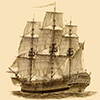 Lady Mcnaughten (generic)
References
| Primary Source | Irish Convicts to NSW 1788-1849 |
Claims
No one has claimed James Lynch yet.
Photos
No photos have been added for James Lynch.
Convict Notes

Thomas Archer of Wallerawang was responsible for the capture of two runaways. He was walking along the side of a rocky gully about a mile from the station when he saw a thin wreath of smoke curling up from between two big boulders suspended across the mouth of a small gully and forming a kind of cave. As there had been no Aboriginals about for some time he concluded that the smoke must come from a bushranger's fire. Withdrawing quietly, he ran back to Wallerawang. Thomas’ brother, David Archer, was away on one of his trips to the outstations, but their other brother, William, armed himself and Thomas and called on the convict carpenter, Patterson, to go with them. They rushed to the foot of the gully and moved quietly up to the cave. When they were within fifty yards of it two men jumped out, but these were unarmed and so were easily captured. It turned out later that they had run away from one of the Walker outstations and had lain hidden in their retreat for several days before their capture. Their fellow convicts on Wallerawang had smuggled provisions out to them and they were waiting for a favourable opportunity to start their bushranging career when Thomas discovered them. One of them, named James Lynch (arrived 1835 onboard Lady McNaughten), afterwards proved himself a very ugly customer. He managed to escape from custody later and again took to the bush where he was joined by two other runaways. These three managed to steal horses and arms and began a bushranging career on the upper reaches of the Castlereagh, robbing stations and drays. One afternoon they appeared suddenly at Biamble, stuck up the half-dozen men about the place and put them under guard in a hut. The others rifled the store, smashed the arms they did not want for themselves, stole all the ammunition they could find, and then ordered the storekeeper's wife to prepare a meal. While Lynch kept guard outside the hut, the other two sat down at the table with their guns between their knees. The overseer at Biamble was Simon Scott, a young man who had entered James Walker's employment after becoming friendly with him on the voyage to Australia. He caught the eye of the convict Patterson and one or two of the other men and quietly exchanged signals. Taking an opportunity when the two bushrangers were distracted, Scott suddenly jumped up. Followed by Patterson and two others he rushed the bushrangers and overpowered them. Patterson ran outside, knocked Lynch over and struggled with him on the ground. Wrenching the pistol from Lynch's hand Patterson fired it in his face and the bushranger turned over and lay still. Patterson went back into the hut to assist in securing the other two bushrangers but when he came out again Lynch was gone. The pistol had been loaded with blank cartridges and, as soon as the coast was clear, Lynch had jumped up and escaped. The other two were handcuffed together and Scott and Patterson started off with them to the nearest gaol, at Mudgee about seventy miles away. During the night they took turn about to sleep. In Scott's watch one of the men, who was very slightly built, managed to slip the handcuffs off his wrist. Then both the bushrangers rushed Scott, disarmed him and escaped. They joined Lynch and again began to rob stations and drays. David Archer mustered a party of armed men and, with a black-tracker, went in search of this gang. For several days he followed them from one station to another, gaining on them since they lost time "bailing-up" the stations. At length they reached a station where the bushrangers had spent the previous night and had left only a short time before. After David had followed the fresh tracks for some time shots were heard ahead. These came from one of James Walker's stations in Wellington Valley. Soon afterwards the bushrangers were seen returning on their own tracks at a pace which quickly brought the two parties face to face. They exchanged shots but when one bushranger was shot in the shoulder the others surrendered. At the station they found that the only man there had defended himself against the bushrangers but, on their promise to let him go unharmed, had come out of his hut. He was then shot in cold blood by Llewellyn Powell and was dead when David's party arrived. This was the first recorded murder of a European in the region and occurred in the vicinity of Curban, in the Gilgandra district, on 6th August 1839. On that morning a party comprising escaped convicts Llewellyn Powell (arrived 1835 Marquis Of Huntley), James Lynch and Charles Clip raided John Hall’s Carlingoengoen Station near the Castlereagh River. Powell and Lynch had absconded from James Walker’s Wallerawong Station and Ellis from one of Edwin Rouse’s properties. Seeking to rob the station they accosted James Hand and his wife Anne and ordered everyone in the huts to come out. They shot at the door of one hut and Abraham Meers, a dairyman employed by Mr Hall, fired from inside the hut. Meers’ shot slightly wounded Powell in the head. After being promised that no harm would come to him Meers left the hut and dropped his weapon. He asked the bushrangers to put down their arms. Lynch was the only one who did so. Powell led Meers away from the hut and ordered him to go down on his knees. He then fired a pistol shot at Meers who jumped up and began to beg for his life. Powell said that Meers had attempted to take his life and would be killed. He then shot Meers in the face with a musket and Lynch fired a second musket ball into Meers’ head. The gang then stole tea, sugar and some clothes from the hut. They also stole a horse, ordering James Hand to saddle it. John Hall returned to the property some time after the gang had left and arranged for Abraham Meers to be buried not far from the house. Later that day Powell, Lynch and Clip were arrested by a party of five men led by James Walker’s Superintendent David Archer. This party included ticket-of-leave men Edward Jerry and John Patterson, and assigned convict Thomas Maddox. They had been seeking Powell’s group after they had committed a number of other robberies in the region. At the time they encountered Powell’s group they were unaware of the murder of Meers. The three prisoners were taken to the police station at Wellington and later sent to Sydney, convicted of murder and hanged. Powell, Lynch and Clip were convicted of the murder of Meers and hanged in Sydney.
Recorded in the Vale of Clwydd, Hartley Court House Bench book records in April 1836, is the case of James Lynch, a convict who arrived in 1835 and Peter Rogers who arrived in 1832, both of who were sentenced to transportation for sev- en years. Edward Quirk, a hut-keeper at one of the out-stations at Loowee stated that he found a ewe with two broken legs in the sheep yards. The men were accused of breaking her legs with the intention of having an excuse to kill her, retaining the hind part and giving the rest to their dogs. Quirk was assaulted when he challenged the men. Lynch and Rogers were found guilty of as- sault by Magistrate Edward D Day and were to work in iron leg chains for 12 calendar months.