
Summary
Personal Information
Voyage
Transportation
Ambrose Mcguigan was transported on the Britannia Iii, departing 10th Dec 1796 and arriving 27th May 1797 with 48 passengers.
Third voyage to Australia. Arrived in Sydney Cove on 18 July 1798 1814 voyage departed from Bengal with 10 male convicts. All tried in India.
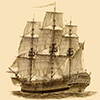 Britannia Iii (generic)
References
| Primary Source | 1.BOOK:'Ambrose and Mary' by Mary Pike (a copy is in The National Library in Canberra. 2.NSW Births Deaths and Marriages: reg # V181366-7 3.A news article in 'Belfast Newsletter' 23rd-27th Nov 1795. 4.A second news article in 'Belfast Newsletter' from Pomeroy House, dated 25th March 1796. |
Claims
"Ambrose is my 5x great-grandfather"
"Ambrose McGuigan is my 4th Great Grandfather through his daughter Mary Ann McGuigan"

Photos
No photos have been added for Ambrose Mcguigan.
Convict Notes
Ambrose McGuigan was born in 1767 at Erifhaloughan Termonel, Tyrone, Ireland (modern day Carrickmore) to parents Edward McGuigan and Jane Donnelly. At this stage not much is known about Ambrose’s life prior to his involvement in the Battle of the Diamond and subsequent troubles with British law due to his activities as an Irish Rebel, other than that he had an older brother named Simon (who would also be transported to Australia). As stated above, Ambrose was engaged in the Battle of the Diamond, which was a planned confrontation between the Catholic Defenders and the Protestant Peep o' Day Boys that took place on 21 September 1795 near Loughgall, County Armagh, Ireland. This battle ultimately resulted in a Catholic defeat and led to the foundation of the Protestant ‘Orange Order’. Ambrose was a member of the Defenders, a Roman Catholic agrarian secret society, and possibly an early member of the United Irishmen. Prior to his transportation Ambrose was a Dancing and Music Master and it is believed that he also used the alias ‘Switcher Donnelly’ (with Donnelly being his mother's maiden name). His occupation as a Dance Master gave this rebel an opportunity to enter English homes and to spy out the land. When he was found out, the Committee of the Barony of Dungannon offered a reward of 50 guineas to any person who could bring his body before a magistrate of County Tyrone. Ambrose was wanted for stopping the Honourable Major Cole-Hamilton (one of the scions of the Protestant ruling class of Ulster) on the road from Gorteen to Pomeroy. Ambrose fired a shot at Cole-Hamilton, perhaps in self defence, and he slightly wounded the major in the thigh. He was convicted of shooting and wounding Major Cole Hamilton along with political insurrection against the British in Ireland and was accused as a 'Defender' and taking 'Unlawful Oaths' at the age of 29. His brother Simon was also transported on the same ship for being a Defender. PLACE AND DATE OF TRIAL: The ship Britannia’s indent states that he was tried in County Tyrone in spring 1794. However the correct date was March 1796. CHARGE AND SENTENCE: He was charged with being a ‘notorious Defender’ and wounding the Hon. Major Cole-Hamilton. He was found guilty and sentenced to be transported for life, although a colonial record states his sentence was for seven years. No account of his trial was found but the details of the crime, committed in early November 1795, were published in ‘The Freeman’s Journal’: Reward - the committee of the Barony of Dungannon Association offer a reward of fifty guineas to any persons who shall within six calendar months from the date thereof, apprehend and bring before Robert Lowry Esq. of Pomeroy for the Co. of Tyrone, the body of Ambrose McGuiggan of Enishalongham parish of Termon, County of Tyrone, aforesaid Dancing Master, against whom information, upon oath, have been lodged for being a notorious Defender and having administered unlawful oaths. The said committee do further offer a reward of the same sum for the apprehending and lodging in safe custody the person who, on Tuesday 3rd inst, stopped the Hon. Major Cole-Hamilton on the road leading from Gortune to Pomeroy, Co. of Tyrone and fired a shot at him, by which he was slightly wounded in the thigh. N.B. Dungannon Nov 8, 1795 - There is every reason to believe that the above mentioned Ambrose McGuiggan was the person who fired at the Hon. Major Hamilton. A proclamation was issued on 23 February 1796 and published in ‘The Freeman's Journal’: Whereas we have received information upon oath that as the Hon. Arthur Cole-Hamilton was riding on the high road from Gortune to Pomeroy between the hours of three and four o'clock Tuesday 3 November past last, he was stopped on said road by a person called ‘Switcher Donnelly’ otherwise Ambrose McGuiggan of said county, a dancing master, who swore that ... Arthur Cole-Hamilton should not pass that road and did at the same time wilfully, maliciously and feloniously present a gun loaded with shot and fired the same at him ... part which struck him [Cole-Hamilton] on the thigh and also the shoulder. On 25 March 1796, after McGuiggan's trial had concluded at Omagh, another notice was issued at Pomeroy House and proclaimed that: The man who met Switcher Donnelly, otherwise Ambrose McGuiggan (for firing at the Hon. Major Cole-Hamilton) acknowledges to have received from Robert Lowry Esq. (and for which he has his receipt) the sum of £65.19.6 which with £471.15.6 allowed by him for the soldiers is in full of £2131.15.0 being the amount of Government and the Dungannon Association reward for the apprehending of the said man. Ambrose and Simon were convicted of treason and sentenced to be transported to NSW for seven years or life (varies depending on record) and endured one of the most brutal voyages to the new colony onboard the Britannia. They were first held in a county Gaol in Tyrone, most likely Omagh before being sent to a city Gaol in Belfast and then again in Dublin. Once in the Dublin New Prison they were again moved and put on board a vessel (most likely the Britannia) at the North Wall to be brought down to Cork on 11 August 1796. The Britannia left Cork, Ireland on 10 December 1796 with 144 male and 44 female prisoners and arrived in Sydney Cove on 27 May 1797 with ten male convicts and one female convict having died during the course of the voyage. These convicts had perished due to severe punishment, neglect, and callous and brutal treatment by the ships’ captain and crew. The harrowing story of the voyage of Britannia to New South Wales under Captain Thomas Dennott and surgeon Augustus Beyer is told in Charles Bateson's The Convict Ships: “As in the Second Fleet transport Neptune, the combination of a callous and brutal master and a weak, incompetent surgeon made the voyage of the first Britannia one of the worst in the history of transportation. There was one death to every 17 prisoners embarked, 10 men and one woman dying out of 144 men and 44 women; but the convicts were brutally mistreated and the survivors were landed in a wretched and emaciated state. The Britannia's master, Thomas Dennott, was a sadist who, in consequence, as Governor Hunter declared,.' of some conjecture of mutiny', kept the prisoners confined in irons and flogged them unmercifully. Even the women received three or four dozen cuts from a cane for the most trivial offences...” After a voyage of 169 days, the Britannia arrived in Port Jackson on the 27 May 1797. One hundred and thirty-four male convicts and forty-three female emaciated and brutalized convicts were landed at Port Jackson. By the 1801 Muster Ambrose had completed his sentence. He was in Sydney, his time expired, making roofing shingles for a living. He lived with fellow convict Mary Cresswell who had arrived on the Britannia in 1798. In January 1803 McGuigan charged John Moary and William Wade with stealing 850 roof shingles from him. He had caught them in the act of taking the shingles away from where he had left them in the woods. His cross cut saw was also missing. The accused had offered to make restitution for the shingles but they were found guilty and sentenced to work in the gaol gang for three months. In December 1803 McGuiggan gave notice that he was about to leave on the schooner Edwin for Port Phillip Bay, where he spent a few months sealing around Tasmania and the Bass Straight. It appears that Ambrose was onboard the Edwin when it was tasked to evacuate the settlement at Port Phillip to Hobart, making him present at the founding of the settlement of Tasmania. It has been said that Ambrose made a small fortune from his time hunting seals, despite him only having done so for a few months before going back to Sydney in 1804. By the 1806 Muster, Ambrose was free by servitude, a self assigned labourer in Sydney. He was now living with fellow convict Mary Murrell neé Titley who had arrived in 1804 aboard the Experiment. Ambrose and Mary had been cohabiting since Mary’s arrival in the colony, with their first child John, having been born in 1805. Like Ambrose, Mary was convicted alongside a family member and arrived in the colony with her sister Ann Jones neé Titley. Mary and Ann were both widows at the time of their sentencing and were charged with stealing several items of wearing apparel, out of the dwelling house of Mr Samuel Winnall of Lilleshall, ordered to be transported for seven years. Mary and Ann were both from Shrewsbury, Salop, Shropshire, England. On 29 December 1810 Ambrose was appointed a Constable in Sydney, being sworn in January 1811. On 8 June 1813 in Sydney Ambrose McGuiggan, a widower, married Mary Murrell, a widow. Witnesses were Simon and Eleanor McGuiggan. This union produced six children: 1. John McGuigan (1805-1869) 2. Jane McGuigan (1808-1859) 3. James McGuigan (1810-1869) 4. Edward McGuigan (1812-1871) 5. Eliza McGuigan (1814-1855) 6. Mary Ann McGuigan (1816-1876) During his time as a Constable, Ambrose was rewarded for capturing a runaway convict Jack Smith. Gibber Jack, as he was known, had been sent to Newcastle, with his papers marked ‘to be kept in irons’. Gibber escaped from the coalmines and headed for Sydney where McGuigan arrested him and was rewarded £25 paid from the Police Fund on 23 October 1813. The reward may have helped McGuigan build a single storey timber inn on land he owned at ‘Brickfield Hill’. The inn was located on the west side of George Street between what is today Valentine Lane and Rawson Street, Haymarket, just south of today’s Great Southern Hotel. The land had about 66ft frontage to George Street, south of Hay Street with a depth of about 130ft. The first mention McGuigan receiving a license for his inn on ‘Brickfield Hill’ appears in the Sydney Gazette in April 1815. The old cattle markets and the carriers’ camping ground were nearby and the pub became a favourite watering hole for the teamsters visiting Sydney on business. By the 1814 Muster, McGuiggan was off the stores, a publican. He had resigned as a constable 22 January of this year and received a land grant of 60 acres at Appin in June. It appears that Ambrose didn’t spend much time at his property in Appin and chose to remain focused on his publican business. His inn ‘The Dog and Duck’ was licensed on 1 April 1815. In addition to being a favourite watering hole for travelling teamsters, The Dog and Duck was also the terminus for the passenger coaches arriving from places such as Windsor, Parramatta and Liverpool. On 17 November 1815, Ambrose was a Juror at inquest on Robert Campbell held at Sydney; appears as McGwiggan. Ambrose died suddenly in Sydney, aged 50 on 1 or 8 October 1817, having established many of the colony’s first pubs and inns. The ‘Sydney Gazette’ of 11 October noted that “Ambrose McGuigan was on Wednesday last seized with the quincey and shortly expired”. McGuigan had contracted quinsy from abscessed tonsils and died after an epileptic seizure. He died intestate (meaning he hadn’t written a will) and was buried at the old Sydney Burial Grounds in Devonshire Street Cemetery, where Central Station is today. During 1901 this cemetery and its inhabitants were relocated and McGuigan’s remains were moved to Botany or Rookwood. After her husband’s death his widow Mary became host of the Dog and Duck, helped by her brother-in-law Simon McGuigan. Simon McGuigan died aged 55 on 6 May 1820 the same year he officially took over the license. His death was reported in the ‘Sydney Gazette’ on 13 May: "On Saturday last, as Mr. Simon McGuigan was going through Liverpool on horseback, he unfortunately fell from his saddle, and only lived until the morning following, when he expired, after suffering much bodily pain. - He was an old inhabitant, and by his honest industry had obtained a comfortable subsistence, and become possessed of a tolerable property." Simon had been drinking with friends at the Toll House for two hours prior to his death. Running a busy pub was hard work for a woman with a young family and without the help of her brother-in-law she quickly remarried. When Mary remarried John Cullen, she had six children to support. The youngest child was two years old and the eldest was thirteen. In 1820 the administration of Ambrose’s estate was transferred by order of the Supreme Court from John Cullen to E. Redmond and J. Holt. Cullen, Mary’s new ex-convict husband, a native of County Galway, took over the license of the Dog and Duck in 1821. When Mary died on December 6 1823, Cullen married Frances Murphy, and they reportedly began to cheat the McGuigan family of their share of the estate; mainly the rents from property, including the Dog and Duck, and the profits from McGuigan’s Appin land grant. Mary’s death was reported in the ‘Sydney Gazette’: “after an illness of three weeks, Mrs Cullen … of Brickfield Hill, Sydney, in the 45th year of her life, leaving a young family of six children to lament their loss”. Despite all the hardships the McGuigan children endured, most of them went on to live successful lives, with many becoming pioneers of the Molonglo, Queanbeyan, and Braidwood districts. Interesting side story about Jane McGuigan and how she met her husband Cornelius Dempsey. According to family lore it seems that one evening at dusk, before his arrival in Australia, the young Con Dempsey was leaving an Irish fair, he crossed a gypsy's palm with silver, and she told him this fortune: "One day, you will cross wild strange oceans,and, stepping ashore in an even wilder and stranger land, you will there marry a woman you pick out of the gutter." Young Con crossed himself hastily, and hurried on, hoping no one had heard. And the gypsy smiled a white smile in her dark and dusky face, and the silver hoops in her ears circled and swung in the waning light. One day in 1824, three years after his arrival in Australia, as young Con Dempsey went whistling along a crooked street in Sydney Town, enjoying the early winter sunshine, and with no particular cares at all, a horse in a gig suddenly reared and bolted, the gig swaying and lurching in the ruts and holes left by bullock drays. A white-faced, terrified girl clung desperately to the sides and the reins trailed dangerously. In no time at all the gig overturned, and she was thrown out at Con Dempsey's feet. He picked her up gently from the muddy gutter. She was shaken but not much hurt. Her name was Jane McGuigan. He told her the story of the Irish gypsy some time after they were married by Fr Therry on 16th August of that very year, 1824. It is not known where Cornelius and Jane lived directly after they were married. Their first two children, James Nicholas and Esther were registered as born in Sydney and baptised by Fr Therry - James Nicholas on 11th Sept 1826, and Esther at George's River on Monday, March 31st, 1830. After that, Cornelius and Jane must have moved up Braidwood way. The grant of land for Emu Flat was not until 1838. But Mary Dempsey, their third child, was born at Molongolo on Sunday, 15 June, 1834. She also was baptised by Fr Therry. At this time, Jane had a married sister, Mary Ann Campbell, living at Gundillion, which was only two miles from Emu Flat. She also had two brothers Edward who was married and living at Norongo, in the District of Queanbeyan, and John who was also married and living somewhere near where Canberra stands today. (John, incidentally, had ten daughters, one of whom became Mother Francis McGuigan, Superior of the Sisters of Charity for 26 years.)
Colonial Secretary Index. MCGUIGAN, Ambrose. 1810 Dec 29 - Appointed a constable in Sydney (Reel 6038; SZ758 pp.151-2) 1813 Oct 23 - Paid from Police Fund for apprehending a runaway from Newcastle (Reel 6038; SZ758 p.426) 1814 Jan 22 - Resigned as constable (Reel 6038; SZ758 p.449) 1814 Jun 30 - On list of persons to receive grants of land in 1814 (Fiche 3266; 9/2652 p.17) 1815 Apr 1 - On list of persons licensed as publicans for 1815; at Sydney. Listed as McGwiggan (Reel 6038; SZ759 p.54) 1815 Nov 17 - Juror at inquest on Robert Campbell held at Sydney; appears as McGwiggan (Reel 6021; 4/1819 p.73) 1816 Apr 6 - On list of persons licensed as publicans for 1816; at Sydney. Listed as McGwigan (Reel 6038; SZ759 p.192) 1817 Apr 19 - Publican of The Dog and Duck, Sydney. On list of persons licensed as publicans for 1817 (Reel 6038; SZ759 p.340) 1820 May 11 - Administration of estate of transferred by Supreme Court from J Cullen to E Redmond and J Holt (Reel 6050; 4/1747 pp.7-10) 1821 Mar 5 - On list of persons for whom grants of land have been handed over to the Surveyor General for delivery, with amount of fees to be charged (Fiche 3266; 9/2652 p.63) 1822 Nov 26 - His widow married John Cullen. Petition by John Cullen for mitigation of sentence (Fiche 3215; 4/1864 pp.104-5)
Brother Simon on same ship
Ambrose was listed as 30 years old on arrival. Native Place: Enishalongham Parish of Termon Tyrone Co. Transported for 'Wounding Major Cole Hamilton'. Occupations: Music dancing master labourer police constable innkeeper Died after seizure with the quincey (an epileptic seizure).
Ambrose McGuigan married Mary Murrall (nee Titley), also a convict, on 8th June 1813 in St Philips, Sydney, NSW (#reg V181366-7). Ambrose McGuigan was given a sentence of seven years for political insurrection against the British in Ireland and was accused as a 'Defender' and taking 'Unlawful Oaths'.