
Summary
Personal Information
Transportation
Patrick Mcmanus was transported on the Hercules, departing 3rd Jul 1830 and arriving 1st Nov 1830 with 205 passengers.
The "Hercules" ship was built in 1801 at South Sheilds, England. 1801 voyage from Ireland to New South Wales, Australia. Sailed via Rio de Janeiro and the Cape. A mutiny occurred just prior to their arrival at Rio - after 45 minutes it was quashed but 13 convicts had been killed. Jeremiah Pendergass was named as the ring leader and shot. 44 deaths in total on this voyage. There was then another ship, also named, "Hercules" built 1822 at Whitby, England who made 3 trips to Austraia, in 1825, 1830 & 1832.
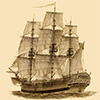 Hercules (generic)
References
| Primary Source | NSW death certificate |
Claims
"GGG Grandfather"

Photos
No photos have been added for Patrick Mcmanus.
Convict Notes
SECOND CLASS CONDITIONAL PARDONS.-His Excellency-the Governor has directed it to be notified, that Her Majesty has been graciously pleased to authorise the issue, in conformity with the provisions of the Act of Parliament 6 Victoria, cap. 7, of Conditional Pardons of the second class to the following individuals, to take effect in the Australian Colonies, including New Zealand, but not elsewhere. The necessary instruments will accordingly be forthwith prepared : Bernard M'Manus, per Hercules 3 ; Patrick M'Manus, per Hercules 3; Sydney Morning Herald, 4 July 1846.
Patrick was sent to Maitland area on arrival in Australia. His wife Mary joined him there in 1834 and they had seven children. He was the publican of the Donnybrook Fair and the Darlington Inn near Singleton. He died in 1856 and is buried with Mary in the cemetery in Queen Street Singleton
Lived in the Singleton area from arrival to Australia. His wife Mary joined him here in 1834 and they had 7 children. Patrick and Mary are buried in the Queen St Cemetery in Singleton.
Ireland, Fatal and Alarming Riots. (Kerry Evening Post, 22 July 1829 Monday a vast crowd persons assembled at Derrylin, (about seven miles from Enniskillen.) but for what purpose could not be ascertained. Lord Enniskillen, having being apprised of the circumstance, repaired to the spot, but his efforts to make them disperse, aided by the Priest, were ineffectual. In the evening they marched from Derrylin to Knockninny, and a false alarm having been given to an Orange Lodge (that had dined together at at Dromaine-bridge, in that neighbourhood) that Lord Enniskillen and the police were attacked, a few of them sallied forth, as they supposed, to his Lordship’s assistance. When they came near a place called Macken, they observed a crowd and a man near them, who was known to be of the Protestant party, one of whom advanced to him, and lifting his hands, said, Merciful God, are we not all fellow Christians, and why will we kill each other ?” He begged of the Roman Catholic to make the multitude retire, and he consented, and was, when he had got to the top of the hill, to give a signal to that effect—but, the treacherous man! he gave a contrary signal, and beckoned them to come on, when about 800 armed men with pikes, scythes on poles, pitch-forks, &c. &c., attacked the Protestant party, killed poor Mealy on the spot, who had advanced to make peace, and wounded seven others mortally, three of whom are since dead, and the remainder despaired of. The names of the persons dead are Mealy, Price, Robinson, and Scarlott. Baldwin’s London Weekly Journal, 25 July 1829. Source, https://www.freesettlerorfelon.com/convict_ship_hercules.htm The Story of the Macken fight.by Michael McManus, YDNA Project....... The New Reformation of 1827 was a Protestant movement against Catholic emancipation in Ireland and it had sprung up at the end of 1826 in County Cavan. Apart from denying them emancipation many Protestants wanted to convert Catholics and.... 450 Catholics were converted in Cavan where they publicly renounced their faith in various Protestant churches. The movement obviously caused much friction in the communities and one side acted as badly as the other - Protestants tried to force Catholics to conform and Catholics tried to persuade ex-Catholics to return to Catholicism. The New Reformation movement spread to Fermanagh and Lord Enniskillen was one of its great supporters. According to one account, he ordered his Catholic tenants to attend Protestant church services or be evicted from their land. Three families, the Duffys, the Maguires and the MacManus, must have refused because they were evicted and settled in the hilly terrain at Ruscaw. So, at the time of the Macken Riot there was a polarisation of the usual religious and political conflict which had been going on in Ireland for many centuries. The Battle of Macken - The Montgomeries and McManus who were sentenced by Judge Jebb to be hanged at Enniskillen on Thursday last and whose lives the Duke of Northumberland has been graciously pleased to spare, by commuting their sentence to transportation for life, were brought up on the outside of the Cavan day coach yesterday and sent off to the hulk at Kingstown. We trust the ferment excited in Fermanagh by the trials of those men, and the unfortunate McManus who was executed last week, will induce his Grace to postpone the trial of the other fifteen Catholics who are in prison for the same crime of which they were found guilty. Freeman’s Journal, 3 April 1830.
Monday week, Francis Montgomery, Pat Montgomery, and Pat M'Manus, were tried Enniskillen assizes, for the murder of Edward Scarlet, at Macken, on the July last, and found guilty They were ordered for execution on Thursday. Manchester Courier, 3 April 1830. FERMANAGH ASSIZES. Patrick M'Manus, Patrick Montgomery, and Thomas, otherwise Francis, Montgomery, who were tried on Monday at Enniskillen, and found guilty of the murder of Edward Scarlet, at Macken, on the 13th July last, have been reprieved by the Lord Lieutenant. The sentence of death, which was to have been carried into execution on Tuesday, has been commuted for that of transportation for life. Newry Telegraph 30 March 1830.
Native of Kinawley, Fermanagh; son of Denis McManus and Margaret (nee McGraugh); Catholic. Convicted on 23 March 1830 for his part in the murder of Edward Scarlett, which took place during the Macken Riots on 13 July 1829.