Summary
Personal Information
Transportation
Ludewig Hermam Moll was transported on the York, departing 7th Oct 1862 and arriving 31st Dec 1862 with 301 passengers.
The York I was built in Southwick, West Sussex, England in 1819. 429 tons. Three voyages to Australia with transport convicts - 1829, 1830 and 1832. The York II was built in Sunderland, England in 1854. 940 ton ship. Transported convicts and pensioner guards and families to Western Australia in 1862.
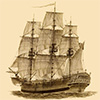 York (generic)
References
| Primary Source | Australian Joint Copying Project. Microfilm Roll 93, Class and Piece Number HO11/18, Page Number 457 (230) |
| Source Description | This record is one of the entries in the British convict transportation registers 1787-1867 database compiled by State Library of Queensland from British Home Office (HO) records which are available on microfilm as part of the Australian Joint Copying Pro |
| Original Source | Great Britain. Home Office |
| Compiled By | State Library of Queensland |
| Database Source | British convict transportation registers 1787-1867 database |
Claims
No one has claimed Ludewig Hermam Moll yet.
Photos
No photos have been added for Ludewig Hermam Moll.
Convict Notes
Ludewig Herman Moll was born 13 Jan 1839 and Christened 17 Feb 1839 in Nevekirche, Berlin Stadt, Brandenberg, Germany. He was the son of Friedrich Wilhelm Moll, a tobacco merchant and Marie Sophia Eichler. He went to England where he was a 24 year old "London man of business" when convicted of forging and uttering in 1861. Sentenced to ten years' penal servitude, he was transported to Western Australia on board the York, arriving in December 1862. Herman Moll was described as 5' 9¼" having greyish hair and hazel eyes. His face is described as “full”, his complexion “dark” and his build as “middling stout”. At the time, it was noted that he had a “scar left thumb and near forefinger, injured third finger right hand”. Herman received his ticket of leave 16 July 1864 and was appointed to teach in the York district. He later found work as a clerk and accountant for John Monger. He was eventually promoted to manager of Monger's York business. In 1874, Moll was elected to the local Board of Education, a prestigious and respected position attained by only three other ex-convicts: Daniel Connor, Malachi Meagher and James Hasleby. He served only one or two years, resigning to accept the management of Monger's business in Perth. He was one of only four such convicts to be elected to the prestigious and respected position of member of a local Education Board. He married Agnes Roe, daughter of James Elphinstone Roe in 1874. They were to have four children; 1. Cecilia Mary Agnes Moll 1875, who was to marry farmer John White of Jennacubine 2. Sophia Mary Josephine b 1877, who was to become a Dominican nun and live her later years in South Australia 3. Wilfred Joseph "van Eyck" Moll b 1879, who was head boy at Hale in the 1890s 4. Herman Moll b 1881 who died as a young child. In 1880, Moll moved to Cossack to manage the business of Macroe and Co. Two years later he broke a leg while disembarking a ship and died of complications. It is likely he is buried in an unmarked grave at Cossack. Wife Agnes Moll as a widow supported her three fatherless children by running a boarding house.