
Summary
Personal Information
Crime
Voyage
Transportation
John George Munns was transported on the England, departing 28th Apr 1826 and arriving 18th Sep 1826 with 148 passengers.
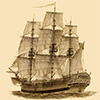 England (generic)
References
| Primary Source | Australian Joint Copying Project. Microfilm Roll 88, Class and Piece Number HO11/6, Page Number 22 |
| Source Description | This record is one of the entries in the British convict transportation registers 1787-1867 database compiled by State Library of Queensland from British Home Office (HO) records which are available on microfilm as part of the Australian Joint Copying Pro |
| Original Source | Great Britain. Home Office |
| Compiled By | State Library of Queensland |
| Database Source | British convict transportation registers 1787-1867 database |
Claims
No one has claimed John George Munns yet.
Photos
No photos have been added for John George Munns.
Convict Notes
From Familypedia: George John Munns was born as John George Munns to John George Munns and Eleanor Potts. His occupation was a Waterman on the Thames. He was transported to New South Wales as 21 year old John George Munns aboard the "England" which left England on 28 April 1826 and arrived in New South Wales on 29 September 1826. He was transported for life for larceny (theft) from a person. During the voyage out to Australia he warned, on 31 May 1826, about a mutiny planned by some of the convicts. As a result he then needed to be protected for the rest of the voyage. 31 May 1826, in consequence of insubordinate state of the convicts one half only allowed on deck at a time. At 7 am received a letter from Walter E Taylor requesting me to send for him stating that he had something to communicate privately of the utmost importance. I immediately sent for him to my cabin, when he informed me that John George Munns had come to him (at the hospital) very early (before he or the other convicts were out of bed) and told him privately that there was a conspiracy formed to murder him (W.E.T.) to prevent his giving any alarm and then to murder me and all who would not assist them to seize the ship and run her into South America. That Robert Hughes and Thomas Jones were at the head of it, and their intention to carry it into effect the first time the ship was in a squall. In consequence of this information, the following memorandum of a protection was given by me to Walter E Taylor, to be shown to men he could trust, as two thirds of the convicts are desperate characters and robust athletic men, in order to prevent their taking any alarm and assassinating in the prison as they had threatened to do; those convicts who dared to divulge their wicked intentions, every precaution was taken, until the ringleaders could all be discovered and safely secured without violence. 2 June 1826, sent for John George Munns to come quietly in my cabin, when he requested my protection to prevent the conspirators strangling or assassinating him in the prison, having promised him protection, he immediately communicated and gave me the names of those concerned, viz. Robert Hughes, Thomas Jones, William Brown, James Hawkes and James Norman. On his returning to the prison, it was whispered that Munns had turned 'nose' (King's evidence)... J G Munns requested permission to sleep on deck which was granted. Captains Log, "England" convict transport, 1826 He was recorded in the 1828 census as as John Munns, 24, Government Servant, Protestant, a Labourer for Mr Browne at Patersons Plains. On 5 June 1830 he was granted permission to marry Mary Ann Tackaberry who had been transported from Ireland for 7 years on the "Forth" in 1830. On 15 June 1830 this permission was withdrawn as it was discovered that Mary Ann Tackaberry was already married. In 1840 he was a member of Dr John Dobie's party which travelled overland from Maitland to the Clarence River, arriving at Ramornie on 16 June 1840; the first overland journey from Maitland. The journey took 5 months and 11 days. In 1840 he was also granted a Ticket of Leave with the condition that he had to remain in the Maitland area. On 11 May 1841 he was granted permission to marry Ann Boggs. The marriage took place on 21 June 1841. It was about this time that he changed his name to George John Munns. In England he had been a salesman, and first in New South Wales he worked as a labourer, but after his marriage he was trained as a blacksmith and wheelwright by his father-in-law John Boggs (1796-1869). On 31 December 1847 he received a Conditional Pardon making him a free man as long as he did not leave the country. Ann Boggs and John had 8 children, some dying in infancy.