
Summary
Personal Information
Voyage
Transportation
Francis Nicholas was transported on the Mangles, departing 24th Apr 1835 and arriving 1st Aug 1835 with 310 passengers.
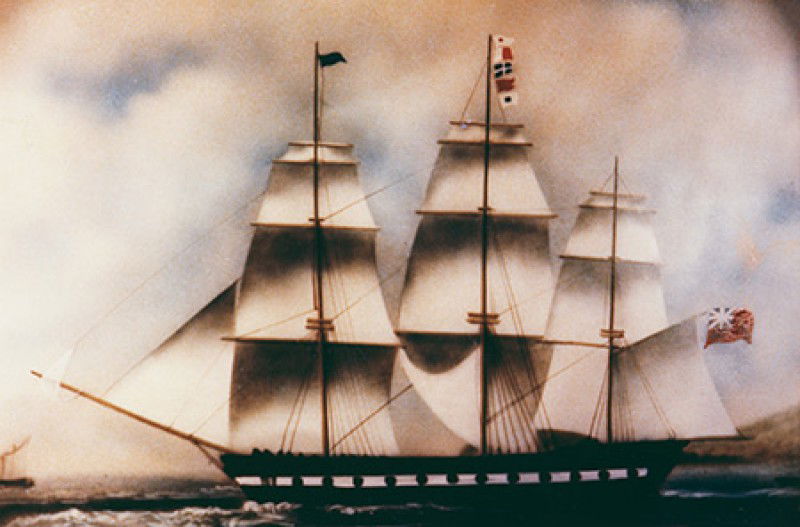 Mangles
References
| Primary Source | Australian Joint Copying Project. Microfilm Roll 90, Class and Piece Number HO11/10, Page Number 46 |
| Source Description | This record is one of the entries in the British convict transportation registers 1787-1867 database compiled by State Library of Queensland from British Home Office (HO) records which are available on microfilm as part of the Australian Joint Copying Pro |
| Original Source | Great Britain. Home Office |
| Compiled By | State Library of Queensland |
| Database Source | British convict transportation registers 1787-1867 database |
Claims
No one has claimed Francis Nicholas yet.
Photos
No photos have been added for Francis Nicholas.
Convict Notes

“Salisbury: Committed to Fisherton gaol: - Francis Nicholas and George Frowd, upon five separate charges, namely, for stealing two ewe sheep, the property of Walter Flower, at Odstock: for stealing a great-coat, the property of Stephen Wilkins, of the same place; for stealing a powder flask and a bill-hook, the property of Thomas Challis, of the same place; for stealing a chisel, the property of John Pope, of the same place; and also for stealing a gimlet, the property of F. Pope, of the same place. “ 1 Sept 1834, Salisbury and Winchester Journal “Francis Nicholas and George Frowd, recently committed to Fisherton Gaol, on various charges of felony, such as sheep-stealing &c., in the neighbourhood of Odstock, near Salisbury, appear to have established their head-quarters in a clump of aged yews, situate the midst of a wood lying at no great distance from Combe. Here they had appropriated the leafy recesses to the various purposes of eating, sleeping-apartments, &c., and were, it seems, accidentally discovered by a labouring man who observed smoke arising from that part of the wood at a period when the robbers were cooking a portion of their ill-gotten provisions. It is believed that the prisoners above named are only a part of a confederate gang of thieves by whom the snug retreat in question had for some time past been tenanted. The fellows were well armed, and declared on their apprehension, that had the remainder of the gang been present they would not have been so easily taken.” 15 Sept 1834, Salisbury and Winchester Journal Wilts Quarter Assizes - The Odstock sheep stealers – The King on the prosecution of The Earl of Radnor, against Francis Nicholas and George Frowd..- The prisoners were indicted for stealing two sheep, at the parish of Coombe Bissett, on the 21st August last. Mr Gunning, the Counsel for the prosecution, stated that the prisoners were both strangers in the neighbourhood where the robbery was committed; that, on the 9th of August last, Mr Walter Flower, who rented a considerable farm under Lord Radnor, counted his sheep, which he found correct; and on the 23rd of August, in consequence of two sheep skins having been found in the Odstock Yews, he again counted his sheep, and found that two were missing. It would be clearly proved, that the two skins found were from two of Mr Flower’s sheep, for both of them had been marked ,on the 9th, in a particular manner, between the pin-bones, with red ochre and oil, and one of them was of a sheep which Mr Flower had purchased at an auction, and had a particular mark on the left ear, that there would be no difficulty in identifying the skins – Mr Flower and two of his would state that they had not the least doubt of the identity. The second point, and indeed almost the only one which the Jury would have to decide, would be upon the possession by the prisoners of the property, the evidence of possession being of an extraordinary and novel character. The Learned Counsel proceeded to state, on the 21st August, Charles Dowland, one of Radnor’s woodmen, saw, from a distance, a strange man in Odstock Wood, and on going to the spot, perceived a track in the underwood, which he had never before noticed, following the track for about fifty yards (having had occasion to creep on his hands and knees to get through the thicket), he found himself in an open space formed by two large yew trees, under which the underwood did not grow, but so thickly surrounded with the underwood, that it formed a complete gloomy chamber; there were many hundreds of such chambers formed by old yew trees in the wood. In the centre of this chamber was a fire with pot over it, suspended by a chain from one of the limbs of the yew tree. From the first chamber which Dowland entered, he could look into a second one, larger, but of similar description, formed by four yew trees, and he saw hanging on one of the trees the greater part of a sheep cut up in lumps, in a very rude manner. Being convinced that he had come some human habitation, and becoming alarmed lest the inhabitants should return and discover him, retreated by the track by which he had entered. On the following day, accompanied by several farmers, to whom he mentioned his discovery, again visited and on entering the apartment which the fire, they found the two prisoners sitting it, with a dish of potatoes just boiled and quantity of mutton, also just boiled, in another dish. The prisoner Nicholas immediately sprang upon his legs, and made a rush to escape down a small track made in the underwood; but Dowland followed him so closely, that he took him within twenty yards. The prisoner Frowd did not offer to escape. On Nicholas being taken, he said, if our mate had been here you would not have taken us so easily; but he is gone to get some beer for our dinner. The prisoners being apprehended, a diligent search was made by Dowland and his assistant, in the two chambers described, and they found a considerable quantity of wearing apparel stowed away in the trees, on the ground where two guns, a powder flask, wood axes, and sundry articles necessary for the occupiers of such place; part of the wearing apparel and one of the guns were claimed by the prisoners. ... ... The learned Counsel observed that there could be no doubt that the prisoners had for a considerable time been the occupiers of these chambers, and it would be for the jury to say, whether the evidence of possession was not as strong it would have been if mutton cut unusual lumps had been found on the table of the prisoners regular habitation – other parts found in a chamber, and the skins garden attached to the dwellinghouse. The Learned Counsel having concluded his statement, which excited considerable interest court. Proceeded to call his witnesses. Mr Housman, the solicitor for the prosecution, put in and proved the accuracy of a plan which he had taken of the place, in which the various tracks described by Mr Gunning were laid, Mr W Flower and his shepherds, Richard Newton and Joseph Harris, proved the loss of two of the sheep from Mr Flower’s flock, and identified the skins which were found; and Charles Dowland proved the other facts, as they had been detailed by Mr Gunning. The prisoner Frowd was defended by Mr Stephen Williams; but nothing material was elicited by the cross-examination of the witnesses. The Chairman (T B Estcourt, Esq.) having summed up the case, the Jury immediately returned a verdict of Guilty against both prisoners, upon which the Chairman sentenced them to be transported for life, observing, that they might consider it fortunate that their mate, to whom the prisoner Nicholas referred on his apprehension, was absent; for if resistance had been made, and Dowland or his assistants had been wounded or murdered, they would have had to answer for it with their lives. 20 Oct 1834, Salisbury and Winchester Journal. --------------------------- The following convicts, sentenced to transportation, have been removed during the week from Fisherton Gaol, and put on hoard the Leviathan hulk, Portsmouth viz.,—… George Frowd and Francis Nicholas, sheep-stealing; … Salisbury Journal, 17 Nov 1834.