
Summary
Personal Information
Crime
Transportation
Ann Parsons was transported on the Emu, departing 30th Sep 1812 and arriving unknown with 40 passengers.
The Emu was captured by an American privateer in 1812. Under the command of Lieutenant Alexander Bisset, Emu left England in October 1812 with 49 female convicts. While en route to Hobart Town, she was captured on 30 November 1812 in the Atlantic by the American 18-gun privateer Holkar, captained by J. Rolland. The captain, twenty two crew, and the forty-nine female convicts were put ashore at Porto Grande on the island of St Vincent (now São Vicente) in the Cape Verde Islands on 17 January 1813. Emu was subsequently taken to Newport, Rhode Island as a prize and sold there. The captain, crew and convicts were eventually picked up after 12 months by the Isabella and returned to England. The female convicts were placed on a hulk in Portsmouth harbour and subsequently sent aboard the transport Broxbornebury to Port Jackson.
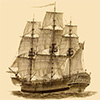 Emu (generic)
References
| Primary Source | Australian Joint Copying Project. Microfilm Roll 87, Class and Piece Number HO11/2, Page Number 77 (40) |
| Source Description | This record is one of the entries in the British convict transportation registers 1787-1867 database compiled by State Library of Queensland from British Home Office (HO) records which are available on microfilm as part of the Australian Joint Copying Pro |
| Original Source | Great Britain. Home Office |
| Compiled By | State Library of Queensland |
| Database Source | British convict transportation registers 1787-1867 database |
Claims
No one has claimed Ann Parsons yet.
Photos
No photos have been added for Ann Parsons.
Convict Notes
PARSONS, Ann (c1774-1831) Tried - 16 March 1812 Devon Lent Assize Ann was born somewhere between 1774 and 1786 (the records vary) and was committed for trial at the Lent Assize at Devon in 1812. She was a servant and was given a sentence of 7 years transportation for larceny (Source: England & Wales, Criminal Registers, 1791-1892, Class: HO 27; Piece: 8; Page: 52) and banished to New South Wales. Parsons was first sent to the Colony in 1812 on the Emu and finally reached Sydney in 1814 on the ship Broxbornebury. For info re her colonial life, see the second entry for Ann Parsons on this site listed as a convict on the Broxbornebury On the 12th of November 1812, the ship Emu left England in company with the brig James Hay, bound for the Colony of New South Wales. Lieutenant Alexander Bisset of the Royal Navy was the Commander of the Emu and he had a crew of twenty-two men although the Declaration given to Bisset stated there were thirty-six crew. They carried stores of food to last three months. The ship was a small brig of 182 tons, with two decks and two masts, especially built for service in New South Wales and was armed with ten guns mounted and fitted with a devise to prevent attacks over the side. As well as some stores and a large quantity of ammunition for the Colony, on board were forty women convicts, several with children, having been put under sentence of transportation to Sydney, Port Jackson in the Colony of New South Wales, over 20 thousand kilometres away. At this time Britain was still fighting a war with France (mainly at sea against Napoleon) however in 1812 a second Colonial war with America began, called the War of 1812. The American's grievance was the British insistence upon the right of search of their vessels at sea and the trade blockades which were in place. The Americans started with inflicting heavy losses on English ships using privateers (American government-sanctioned pirates) and their "prizes" were often sailed into American waters and sold. The Americans also invaded Canada, which was under British rule, and set fire to the city of Toronto. The English retaliated with setting fire in Washington to the presidential mansion (the White House). On leaving England, Captain Bisset was handed a Declaration granting him Letters of Marque and Reprizals “for the apprehending, seizing, and taking the ships, vessels and goods belonging to the United States of America”. The war was soon over, but unfortunately the Emu found herself directly in the firing line. In the Bay of Biscay they had parted company with the James Hay and on the 30th of November they were alone when the Holkar, an American privateer approached. Captain Jonathan Rowland was the commanding officer of the larger vessel which was mounted with eighteen guns and a crew of one hundred and fifty. The Emu was vastly outnumbered and most of the crew refused to fight, except for Captain Bisset, a gunner and a landsman. With little choice against such odds, Bisset capitulated, first throwing overboard the ship's papers and other official documents and the Emu was boarded by the Americans. Nearly seven weeks after their capture, on the 17th of January 1813, the crew of the Emu and the forty women convicts were landed at Mindelo on Saint Vincent one of the Cape Verde Islands “with provisions enough for four months”. The Holkar sailed away with the Emu to Providence Harbour, Rhode Island where the ship was sold as a “prize” and the Captain and crew receiving most, if not all, of the money received. The Cape Verde Islands are located in the Atlantic Ocean, six hundred and twenty kms. off the Coast of Senegal, Africa, then under the control of the Portuguese. There seems to be no official record of what happened to the women convicts, their children and the crew during their stay there, but an unverified report states that they were looked after by Catholic nuns. One of the women, Elizabeth King, died on the island on the 29th of January 1813. It must have taken a few months for the news of the ship's capture to be known by the authorities in England and they finally sent the ship Isabella to the Cape Verde Islands for their “rescue”. They arrived back at Portsmouth England (via a journey to Bear Haven, Ireland), about the 12th of October 1813, only for the authorities to be told the women were “….in a state of nakedness and inadvisable of their being landed…” They were kept on board in the harbour for a total of four months until another ship was made ready for a voyage to the Colony, which was the Broxbornebury in February 1814, along with an extra eighty-five female convicts. Not all the thirty-nine remaining women from the Emu made the journey to New South Wales. Five convicts were transferred to the Captivity prison hulk ship in Portsmouth Harbour. Four of these women were granted Full Pardons and one died on the hulk ship. For the other thirty-four it had been a long voyage when they finally arrived in Sydney in July 1814, twenty months after first embarking on the Emu! From the book “Journey to a New Life…” the story of the ships Emu & Broxbornebury by Elizabeth Hook (3rd ed. 2014). I am the author & can be contacted on hookey5609@yahoo.com.au for further info Sources: Public Record Office (UK), Reel 32; CO 201 (Colonial Office); Original Correspondence; Vol. 70, pp72-3 Admiralty records at National Archives (UK) ADM 7/319 & ADM 108/24 p15)
On 11th November 1812 the Emu, commanded by Lieutenant Alexander Bissett R.N., with 49 female convicts on board sailed from England for Hobart. The Emu was captured by the American privateer Holkar. On 17th January 1813 Bissett and the female convicts were landed on the island of St. Vincent, Cape Verde Islands where they remained for twelve months before being returned to England. There were forty nine female prisoners on the Broxbornebury who had been tried in 1812 or earlier and most of these were probably those who had previously been sent on the Emu. After 12 months Isabella picked up Emu's captain, crew, and convicts and returned them to England. The convicts were placed on a hulk in Portsmouth harbour and subsequently sent aboard the transport Broxbornebury to Port Jackson. Ann Parsons is listed on both the Emu 1812 and the Broxbornebury 1814. Ancestry Convict Indents: Ann Parsons was listed as 40 years old on arrival - no crime listed. 29/7/1825: COF 23/6/1831: Convict Death Register - Ann Parsons died in the District of Sydney, aged 50 (big discrepancy in age).